

Reverse Logistics System to Support the Lamp Circularity …
269
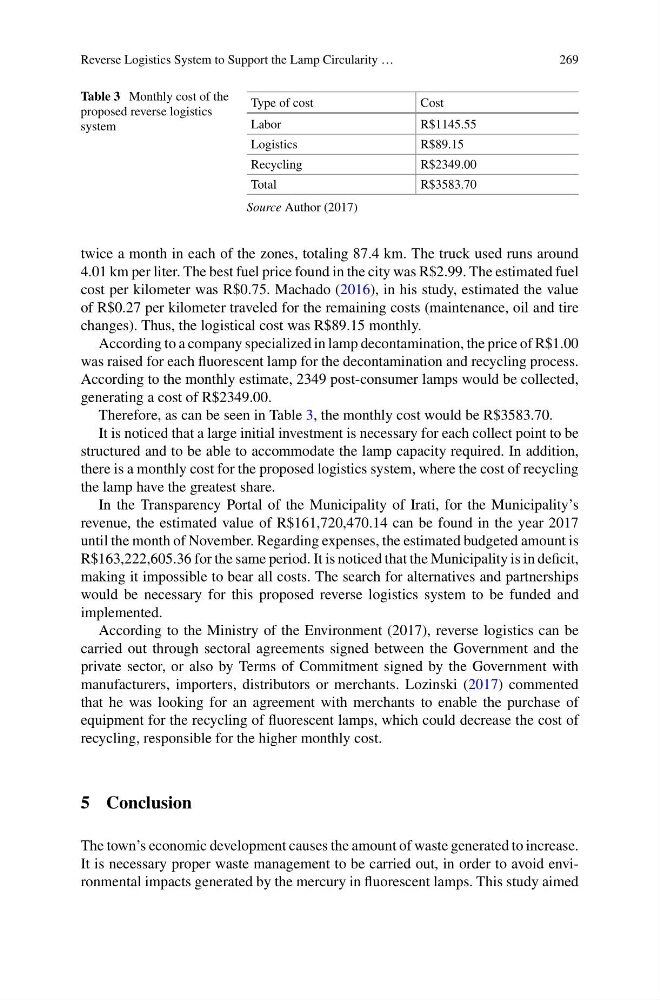
Table 3 Monthly cost of the
proposed reverse logistics
system
Type of cost
Cost
Labor
R$1145.55
Logistics
R$89.15
Recycling
R$2349.00
Total
R$3583.70
Source Author (2017)
twice a month in each of the zones, totaling 87.4 km. The truck used runs around
4.01 km per liter. The best fuel price found in the city was R$2.99. The estimated fuel
cost per kilometer was R$0.75. Machado (2016), in his study, estimated the value
of R$0.27 per kilometer traveled for the remaining costs (maintenance, oil and tire
changes). Thus, the logistical cost was R$89.15 monthly.
According to a company specialized in lamp decontamination, the price of R$1.00
was raised for each fluorescent lamp for the decontamination and recycling process.
According to the monthly estimate, 2349 post-consumer lamps would be collected,
generating a cost of R$2349.00.
Therefore, as can be seen in Table 3, the monthly cost would be R$3583.70.
It is noticed that a large initial investment is necessary for each collect point to be
structured and to be able to accommodate the lamp capacity required. In addition,
there is a monthly cost for the proposed logistics system, where the cost of recycling
the lamp have the greatest share.
In the Transparency Portal of the Municipality of Irati, for the Municipality’s
revenue, the estimated value of R$161,720,470.14 can be found in the year 2017
until the month of November. Regarding expenses, the estimated budgeted amount is
R$163,222,605.36 for the same period. It is noticed that the Municipality is in deficit,
making it impossible to bear all costs. The search for alternatives and partnerships
would be necessary for this proposed reverse logistics system to be funded and
implemented.
According to the Ministry of the Environment (2017), reverse logistics can be
carried out through sectoral agreements signed between the Government and the
private sector, or also by Terms of Commitment signed by the Government with
manufacturers, importers, distributors or merchants. Lozinski (2017) commented
that he was looking for an agreement with merchants to enable the purchase of
equipment for the recycling of fluorescent lamps, which could decrease the cost of
recycling, responsible for the higher monthly cost.
5 Conclusion
The town’s economic development causes the amount of waste generated to increase.
It is necessary proper waste management to be carried out, in order to avoid environmental impacts generated by the mercury in fluorescent lamps. This study aimed
269
Table 3 Monthly cost of the
proposed reverse logistics
system
Type of cost
Cost
Labor
R$1145.55
Logistics
R$89.15
Recycling
R$2349.00
Total
R$3583.70
Source Author (2017)
twice a month in each of the zones, totaling 87.4 km. The truck used runs around
4.01 km per liter. The best fuel price found in the city was R$2.99. The estimated fuel
cost per kilometer was R$0.75. Machado (2016), in his study, estimated the value
of R$0.27 per kilometer traveled for the remaining costs (maintenance, oil and tire
changes). Thus, the logistical cost was R$89.15 monthly.
According to a company specialized in lamp decontamination, the price of R$1.00
was raised for each fluorescent lamp for the decontamination and recycling process.
According to the monthly estimate, 2349 post-consumer lamps would be collected,
generating a cost of R$2349.00.
Therefore, as can be seen in Table 3, the monthly cost would be R$3583.70.
It is noticed that a large initial investment is necessary for each collect point to be
structured and to be able to accommodate the lamp capacity required. In addition,
there is a monthly cost for the proposed logistics system, where the cost of recycling
the lamp have the greatest share.
In the Transparency Portal of the Municipality of Irati, for the Municipality’s
revenue, the estimated value of R$161,720,470.14 can be found in the year 2017
until the month of November. Regarding expenses, the estimated budgeted amount is
R$163,222,605.36 for the same period. It is noticed that the Municipality is in deficit,
making it impossible to bear all costs. The search for alternatives and partnerships
would be necessary for this proposed reverse logistics system to be funded and
implemented.
According to the Ministry of the Environment (2017), reverse logistics can be
carried out through sectoral agreements signed between the Government and the
private sector, or also by Terms of Commitment signed by the Government with
manufacturers, importers, distributors or merchants. Lozinski (2017) commented
that he was looking for an agreement with merchants to enable the purchase of
equipment for the recycling of fluorescent lamps, which could decrease the cost of
recycling, responsible for the higher monthly cost.
5 Conclusion
The town’s economic development causes the amount of waste generated to increase.
It is necessary proper waste management to be carried out, in order to avoid environmental impacts generated by the mercury in fluorescent lamps. This study aimed