

Reverse Logistics System to Support the Lamp Circularity …
267
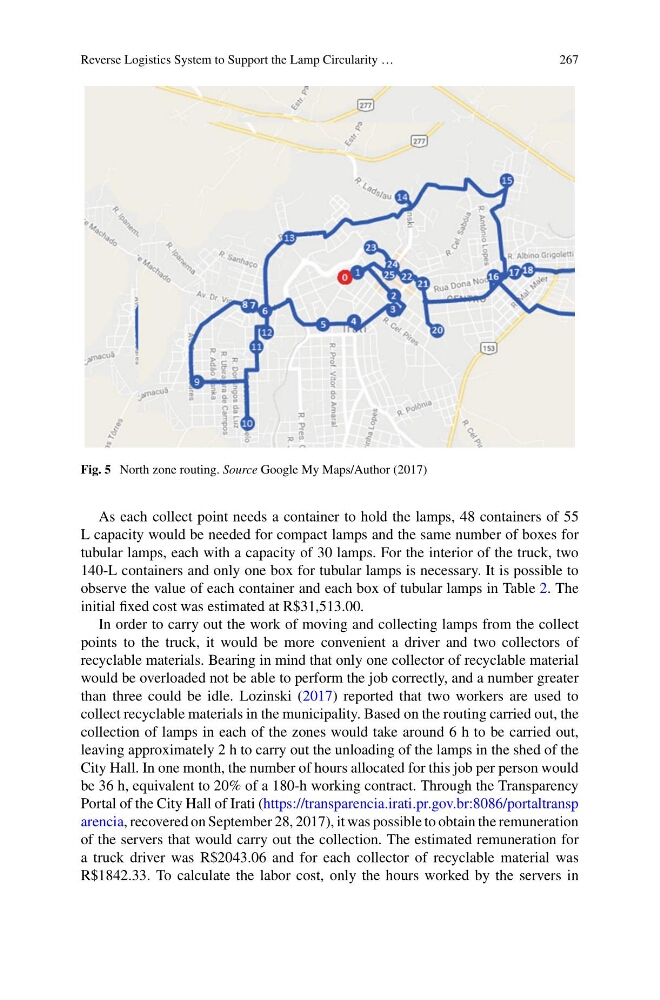
Fig. 5 North zone routing. Source Google My Maps/Author (2017)
As each collect point needs a container to hold the lamps, 48 containers of 55
L capacity would be needed for compact lamps and the same number of boxes for
tubular lamps, each with a capacity of 30 lamps. For the interior of the truck, two
140-L containers and only one box for tubular lamps is necessary. It is possible to
observe the value of each container and each box of tubular lamps in Table 2. The
initial fixed cost was estimated at R$31,513.00.
In order to carry out the work of moving and collecting lamps from the collect
points to the truck, it would be more convenient a driver and two collectors of
recyclable materials. Bearing in mind that only one collector of recyclable material
would be overloaded not be able to perform the job correctly, and a number greater
than three could be idle. Lozinski (2017) reported that two workers are used to
collect recyclable materials in the municipality. Based on the routing carried out, the
collection of lamps in each of the zones would take around 6 h to be carried out,
leaving approximately 2 h to carry out the unloading of the lamps in the shed of the
City Hall. In one month, the number of hours allocated for this job per person would
be 36 h, equivalent to 20% of a 180-h working contract. Through the Transparency
Portal of the City Hall of Irati (https://transparencia.irati.pr.gov.br:8086/portaltransp
arencia, recovered on September 28, 2017), it was possible to obtain the remuneration
of the servers that would carry out the collection. The estimated remuneration for
a truck driver was R$2043.06 and for each collector of recyclable material was
R$1842.33. To calculate the labor cost, only the hours worked by the servers in
267
Fig. 5 North zone routing. Source Google My Maps/Author (2017)
As each collect point needs a container to hold the lamps, 48 containers of 55
L capacity would be needed for compact lamps and the same number of boxes for
tubular lamps, each with a capacity of 30 lamps. For the interior of the truck, two
140-L containers and only one box for tubular lamps is necessary. It is possible to
observe the value of each container and each box of tubular lamps in Table 2. The
initial fixed cost was estimated at R$31,513.00.
In order to carry out the work of moving and collecting lamps from the collect
points to the truck, it would be more convenient a driver and two collectors of
recyclable materials. Bearing in mind that only one collector of recyclable material
would be overloaded not be able to perform the job correctly, and a number greater
than three could be idle. Lozinski (2017) reported that two workers are used to
collect recyclable materials in the municipality. Based on the routing carried out, the
collection of lamps in each of the zones would take around 6 h to be carried out,
leaving approximately 2 h to carry out the unloading of the lamps in the shed of the
City Hall. In one month, the number of hours allocated for this job per person would
be 36 h, equivalent to 20% of a 180-h working contract. Through the Transparency
Portal of the City Hall of Irati (https://transparencia.irati.pr.gov.br:8086/portaltransp
arencia, recovered on September 28, 2017), it was possible to obtain the remuneration
of the servers that would carry out the collection. The estimated remuneration for
a truck driver was R$2043.06 and for each collector of recyclable material was
R$1842.33. To calculate the labor cost, only the hours worked by the servers in