

Appropriation of Disaster Risk Reduction in Brazil …
11
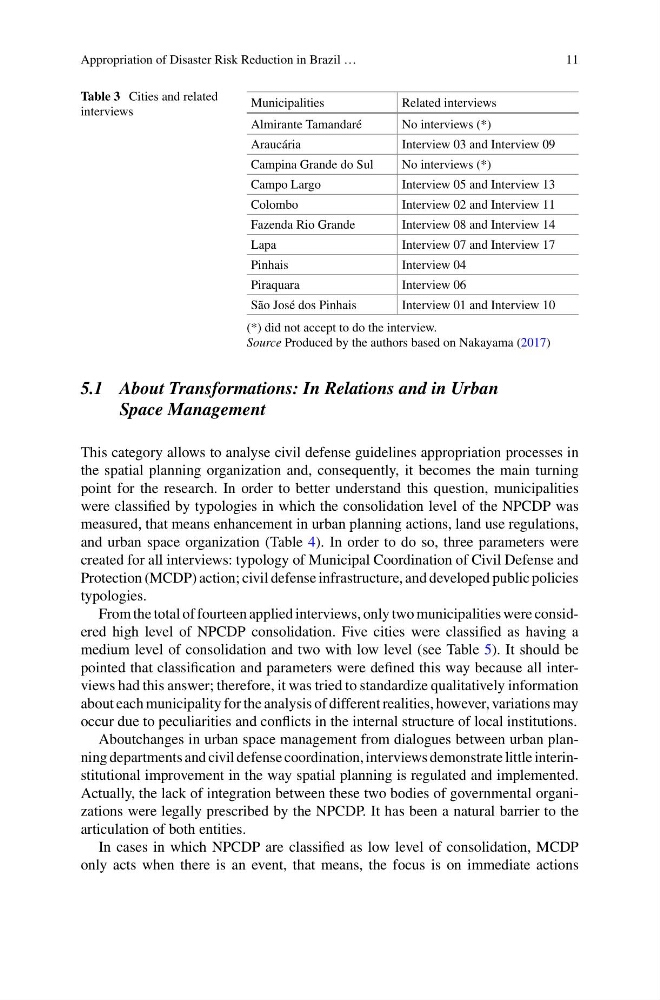
Table 3 Cities and related
interviews
Municipalities
Related interviews
Almirante Tamandaré
No interviews (*)
Araucária
Interview 03 and Interview 09
Campina Grande do Sul
No interviews (*)
Campo Largo
Interview 05 and Interview 13
Colombo
Interview 02 and Interview 11
Fazenda Rio Grande
Interview 08 and Interview 14
Lapa
Interview 07 and Interview 17
Pinhais
Interview 04
Piraquara
Interview 06
São José dos Pinhais
Interview 01 and Interview 10
(*) did not accept to do the interview.
Source Produced by the authors based on Nakayama (2017)
5.1 About Transformations: In Relations and in Urban
Space Management
This category allows to analyse civil defense guidelines appropriation processes in
the spatial planning organization and, consequently, it becomes the main turning
point for the research. In order to better understand this question, municipalities
were classified by typologies in which the consolidation level of the NPCDP was
measured, that means enhancement in urban planning actions, land use regulations,
and urban space organization (Table 4). In order to do so, three parameters were
created for all interviews: typology of Municipal Coordination of Civil Defense and
Protection (MCDP) action; civil defense infrastructure, and developed public policies
typologies.
From the total of fourteen applied interviews, only two municipalities were considered high level of NPCDP consolidation. Five cities were classified as having a
medium level of consolidation and two with low level (see Table 5). It should be
pointed that classification and parameters were defined this way because all interviews had this answer; therefore, it was tried to standardize qualitatively information
about each municipality for the analysis of different realities, however, variations may
occur due to peculiarities and conflicts in the internal structure of local institutions.
Aboutchanges in urban space management from dialogues between urban planning departments and civil defense coordination, interviews demonstrate little interinstitutional improvement in the way spatial planning is regulated and implemented.
Actually, the lack of integration between these two bodies of governmental organizations were legally prescribed by the NPCDP. It has been a natural barrier to the
articulation of both entities.
In cases in which NPCDP are classified as low level of consolidation, MCDP
only acts when there is an event, that means, the focus is on immediate actions
11
Table 3 Cities and related
interviews
Municipalities
Related interviews
Almirante Tamandaré
No interviews (*)
Araucária
Interview 03 and Interview 09
Campina Grande do Sul
No interviews (*)
Campo Largo
Interview 05 and Interview 13
Colombo
Interview 02 and Interview 11
Fazenda Rio Grande
Interview 08 and Interview 14
Lapa
Interview 07 and Interview 17
Pinhais
Interview 04
Piraquara
Interview 06
São José dos Pinhais
Interview 01 and Interview 10
(*) did not accept to do the interview.
Source Produced by the authors based on Nakayama (2017)
5.1 About Transformations: In Relations and in Urban
Space Management
This category allows to analyse civil defense guidelines appropriation processes in
the spatial planning organization and, consequently, it becomes the main turning
point for the research. In order to better understand this question, municipalities
were classified by typologies in which the consolidation level of the NPCDP was
measured, that means enhancement in urban planning actions, land use regulations,
and urban space organization (Table 4). In order to do so, three parameters were
created for all interviews: typology of Municipal Coordination of Civil Defense and
Protection (MCDP) action; civil defense infrastructure, and developed public policies
typologies.
From the total of fourteen applied interviews, only two municipalities were considered high level of NPCDP consolidation. Five cities were classified as having a
medium level of consolidation and two with low level (see Table 5). It should be
pointed that classification and parameters were defined this way because all interviews had this answer; therefore, it was tried to standardize qualitatively information
about each municipality for the analysis of different realities, however, variations may
occur due to peculiarities and conflicts in the internal structure of local institutions.
Aboutchanges in urban space management from dialogues between urban planning departments and civil defense coordination, interviews demonstrate little interinstitutional improvement in the way spatial planning is regulated and implemented.
Actually, the lack of integration between these two bodies of governmental organizations were legally prescribed by the NPCDP. It has been a natural barrier to the
articulation of both entities.
In cases in which NPCDP are classified as low level of consolidation, MCDP
only acts when there is an event, that means, the focus is on immediate actions