

Social Responsibility as a Competitive Advantage for Companies …
127
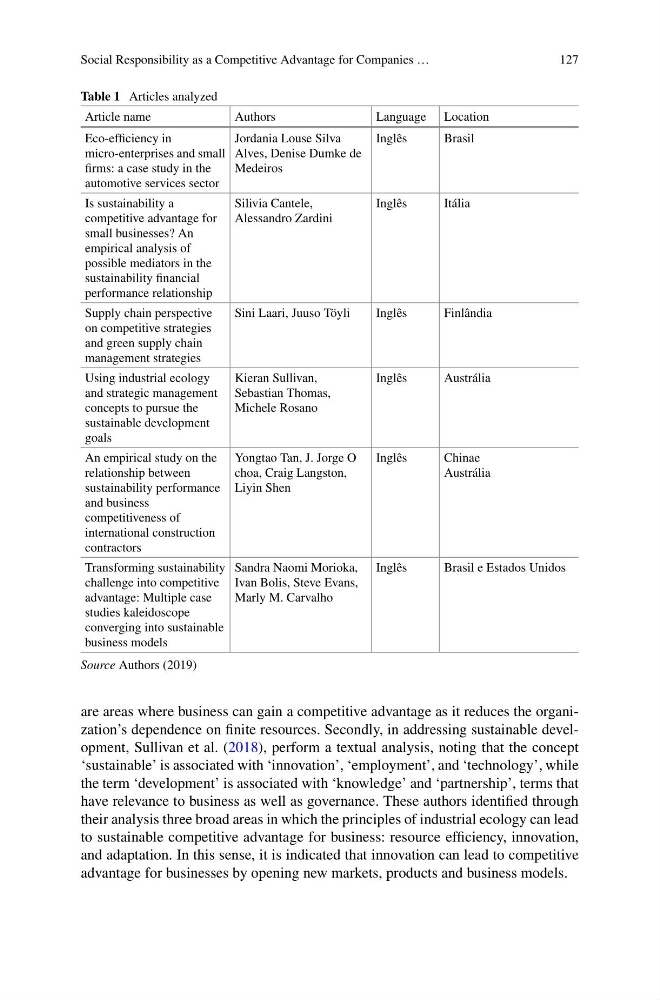
Table 1 Articles analyzed
Article name
Authors
Language Location
Eco-efficiency in
micro-enterprises and small
firms: a case study in the
automotive services sector
Jordania Louse Silva
Alves, Denise Dumke de
Medeiros
Inglês
Brasil
Is sustainability a
competitive advantage for
small businesses? An
empirical analysis of
possible mediators in the
sustainability financial
performance relationship
Silivia Cantele,
Alessandro Zardini
Inglês
Itália
Supply chain perspective
on competitive strategies
and green supply chain
management strategies
Sini Laari, Juuso Töyli
Inglês
Finlândia
Using industrial ecology
and strategic management
concepts to pursue the
sustainable development
goals
Kieran Sullivan,
Sebastian Thomas,
Michele Rosano
Inglês
Austrália
An empirical study on the
relationship between
sustainability performance
and business
competitiveness of
international construction
contractors
Yongtao Tan, J. Jorge O
choa, Craig Langston,
Liyin Shen
Inglês
Chinae
Austrália
Transforming sustainability
challenge into competitive
advantage: Multiple case
studies kaleidoscope
converging into sustainable
business models
Sandra Naomi Morioka,
Ivan Bolis, Steve Evans,
Marly M. Carvalho
Inglês
Brasil e Estados Unidos
Source Authors (2019)
are areas where business can gain a competitive advantage as it reduces the organization’s dependence on finite resources. Secondly, in addressing sustainable development, Sullivan et al. (2018), perform a textual analysis, noting that the concept
‘sustainable’ is associated with ‘innovation’, ‘employment’, and ‘technology’, while
the term ‘development’ is associated with ‘knowledge’ and ‘partnership’, terms that
have relevance to business as well as governance. These authors identified through
their analysis three broad areas in which the principles of industrial ecology can lead
to sustainable competitive advantage for business: resource efficiency, innovation,
and adaptation. In this sense, it is indicated that innovation can lead to competitive
advantage for businesses by opening new markets, products and business models.
127
Table 1 Articles analyzed
Article name
Authors
Language Location
Eco-efficiency in
micro-enterprises and small
firms: a case study in the
automotive services sector
Jordania Louse Silva
Alves, Denise Dumke de
Medeiros
Inglês
Brasil
Is sustainability a
competitive advantage for
small businesses? An
empirical analysis of
possible mediators in the
sustainability financial
performance relationship
Silivia Cantele,
Alessandro Zardini
Inglês
Itália
Supply chain perspective
on competitive strategies
and green supply chain
management strategies
Sini Laari, Juuso Töyli
Inglês
Finlândia
Using industrial ecology
and strategic management
concepts to pursue the
sustainable development
goals
Kieran Sullivan,
Sebastian Thomas,
Michele Rosano
Inglês
Austrália
An empirical study on the
relationship between
sustainability performance
and business
competitiveness of
international construction
contractors
Yongtao Tan, J. Jorge O
choa, Craig Langston,
Liyin Shen
Inglês
Chinae
Austrália
Transforming sustainability
challenge into competitive
advantage: Multiple case
studies kaleidoscope
converging into sustainable
business models
Sandra Naomi Morioka,
Ivan Bolis, Steve Evans,
Marly M. Carvalho
Inglês
Brasil e Estados Unidos
Source Authors (2019)
are areas where business can gain a competitive advantage as it reduces the organization’s dependence on finite resources. Secondly, in addressing sustainable development, Sullivan et al. (2018), perform a textual analysis, noting that the concept
‘sustainable’ is associated with ‘innovation’, ‘employment’, and ‘technology’, while
the term ‘development’ is associated with ‘knowledge’ and ‘partnership’, terms that
have relevance to business as well as governance. These authors identified through
their analysis three broad areas in which the principles of industrial ecology can lead
to sustainable competitive advantage for business: resource efficiency, innovation,
and adaptation. In this sense, it is indicated that innovation can lead to competitive
advantage for businesses by opening new markets, products and business models.