

�
� �
�
�
�
�
�
�
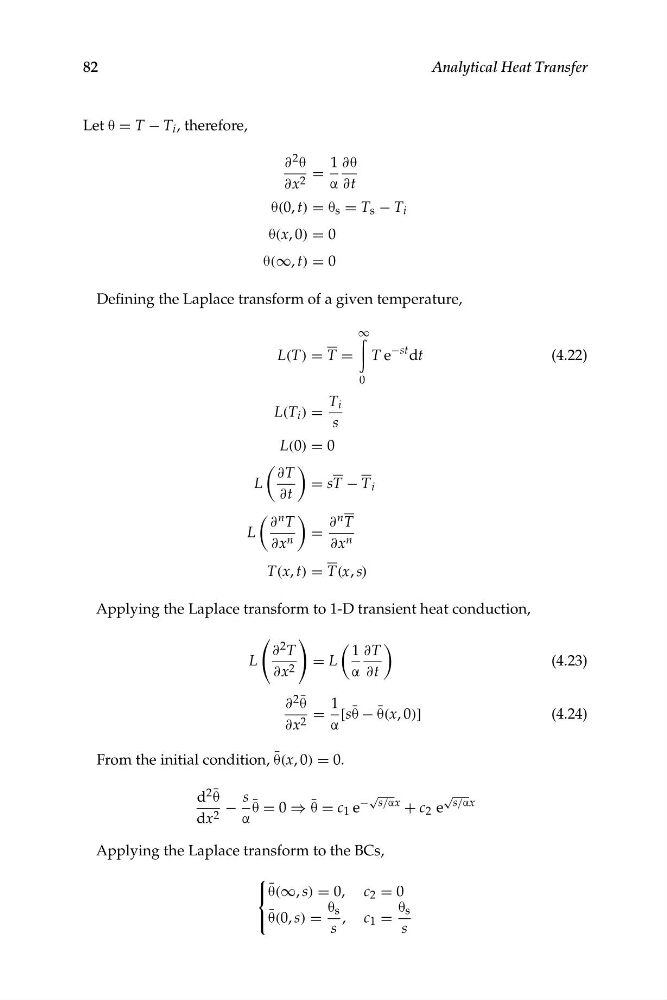
Let θ = T − T i , therefore,
∂ 2 θ
1 ∂θ
=
∂x 2
α ∂t
θ(0, t) = θ s = T s − T i
θ(x, 0) = 0
θ(∞, t) = 0
Defining the Laplace transform of a given temperature,
∞
−st dt
L(T) = T = T e
(4.22)
0
T i
L(T i ) = s
L(0) = 0
∂T
L
= sT − T i
∂t
∂ n T
∂ n T
L
=
∂x n
∂x n
T(x, t) = T(x, s)
Applying the Laplace transform to 1-D transient heat conduction,
∂ 2 T
1 ∂T
L
= L
(4.23)
∂x 2
α ∂t
∂ 2 θ ¯
1
= [sθ ¯ − θ ¯ (x, 0)]
(4.24)
∂x 2
α
From the initial condition, θ ¯ (x, 0) = 0.
d 2 ¯
√
√
θ
s θ ¯ = 0 ⇒ ¯
− s/αx
+ c 2 e
s/αx
−
θ = c 1 e
dx 2
α
Applying the Laplace transform to the BCs,
⎧
⎨ θ ¯ (∞, s) = 0, c 2 = 0
θ s
θ s
¯
⎩θ(0, s) = , c 1 =
s
s
82
Analytical Heat Transfer
� �
�
�
�
�
�
�
Let θ = T − T i , therefore,
∂ 2 θ
1 ∂θ
=
∂x 2
α ∂t
θ(0, t) = θ s = T s − T i
θ(x, 0) = 0
θ(∞, t) = 0
Defining the Laplace transform of a given temperature,
∞
−st dt
L(T) = T = T e
(4.22)
0
T i
L(T i ) = s
L(0) = 0
∂T
L
= sT − T i
∂t
∂ n T
∂ n T
L
=
∂x n
∂x n
T(x, t) = T(x, s)
Applying the Laplace transform to 1-D transient heat conduction,
∂ 2 T
1 ∂T
L
= L
(4.23)
∂x 2
α ∂t
∂ 2 θ ¯
1
= [sθ ¯ − θ ¯ (x, 0)]
(4.24)
∂x 2
α
From the initial condition, θ ¯ (x, 0) = 0.
d 2 ¯
√
√
θ
s θ ¯ = 0 ⇒ ¯
− s/αx
+ c 2 e
s/αx
−
θ = c 1 e
dx 2
α
Applying the Laplace transform to the BCs,
⎧
⎨ θ ¯ (∞, s) = 0, c 2 = 0
θ s
θ s
¯
⎩θ(0, s) = , c 1 =
s
s
82
Analytical Heat Transfer