

�
� �
�
�
�
(
−λ 2 αt
⇒ θ = T − T ∞ =
c n cos(λ n x) e n ,
θ
T − T ∞
2 sin λ n cos λ n (x/L) −λ 2
n Fo
⇒
=
=
· e
.
(4.6)
θ i
T i − T ∞
λ n + sin λ n cos λ n
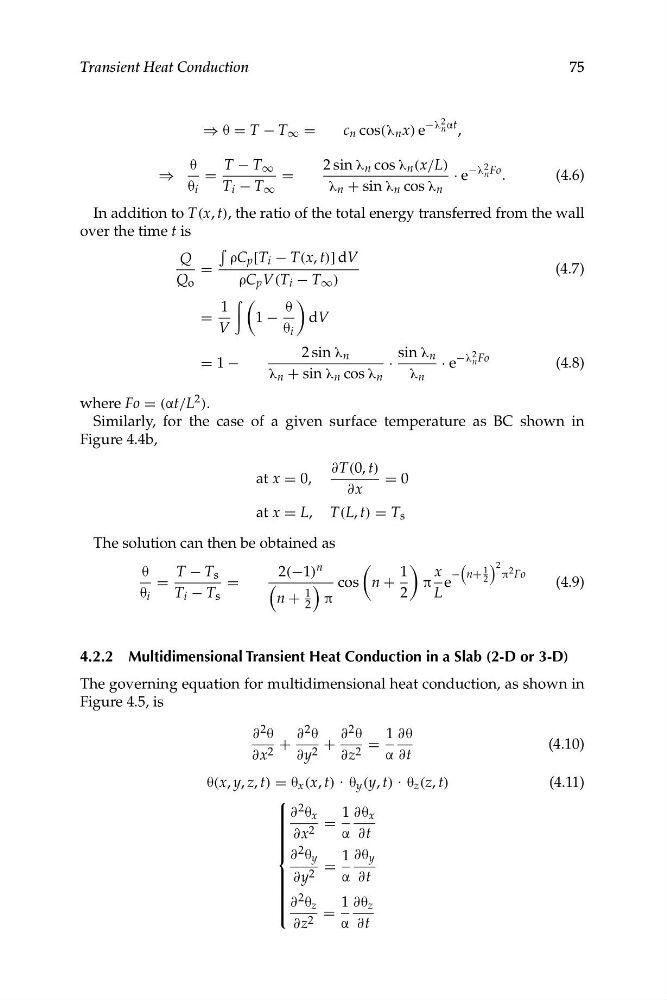
In addition to T(x, t), the ratio of the total energy transferred from the wall
over the time t is
Q
ρC p [T i − T(x, t)] dV
=
(4.7)
Q o
ρC p V(T i − T ∞ )
1
θ
=
1 −
dV
V
θ i
2 sin λ n
sin λ n −λ 2
n Fo
= 1 −
·
· e
(4.8)
λ n + sin λ n cos λ n
λ n
where Fo = (αt/L 2 ).
Similarly, for the case of a given surface temperature as BC shown in
Figure 4.4b,
∂T(0, t)
at x = 0,
= 0
∂x
at x = L, T(L, t) = T s
The solution can then be obtained as
θ
T − T s
2(−1) n
1
x − n+
1 π 2 Fo
=
=
(
) cos n +
π e
2
) 2
(4.9)
θ i
T i − T s
n +
1
π
2
L
2
4.2.2 Multidimensional Transient Heat Conduction in a Slab (2-D or 3-D)
The governing equation for multidimensional heat conduction, as shown in
Figure 4.5, is
∂ 2 θ
∂ 2 θ ∂ 2 θ
1 ∂θ
+
+
=
(4.10)
∂x 2
∂y 2
∂z 2
α ∂t
θ(x, y, z, t) = θ x (x, t) · θ y (y, t) · θ z (z, t)
(4.11)
⎧
⎪ ∂ 2 θ x
1 ∂θ x
⎪ ⎪ ⎪
=
⎪ ∂x 2
α
⎪
∂t
⎪ ⎪ ⎨ ∂ 2 θ y
1 ∂θ y
=
⎪ ∂y 2
α ∂t
⎪ ⎪ ⎪ ⎪ ⎪ ⎪ ∂ 2 θ z
1 ∂θ z
⎪
=
⎩
∂z 2
α ∂t
75
Transient Heat Conduction
� �
�
�
�
(
−λ 2 αt
⇒ θ = T − T ∞ =
c n cos(λ n x) e n ,
θ
T − T ∞
2 sin λ n cos λ n (x/L) −λ 2
n Fo
⇒
=
=
· e
.
(4.6)
θ i
T i − T ∞
λ n + sin λ n cos λ n
In addition to T(x, t), the ratio of the total energy transferred from the wall
over the time t is
Q
ρC p [T i − T(x, t)] dV
=
(4.7)
Q o
ρC p V(T i − T ∞ )
1
θ
=
1 −
dV
V
θ i
2 sin λ n
sin λ n −λ 2
n Fo
= 1 −
·
· e
(4.8)
λ n + sin λ n cos λ n
λ n
where Fo = (αt/L 2 ).
Similarly, for the case of a given surface temperature as BC shown in
Figure 4.4b,
∂T(0, t)
at x = 0,
= 0
∂x
at x = L, T(L, t) = T s
The solution can then be obtained as
θ
T − T s
2(−1) n
1
x − n+
1 π 2 Fo
=
=
(
) cos n +
π e
2
) 2
(4.9)
θ i
T i − T s
n +
1
π
2
L
2
4.2.2 Multidimensional Transient Heat Conduction in a Slab (2-D or 3-D)
The governing equation for multidimensional heat conduction, as shown in
Figure 4.5, is
∂ 2 θ
∂ 2 θ ∂ 2 θ
1 ∂θ
+
+
=
(4.10)
∂x 2
∂y 2
∂z 2
α ∂t
θ(x, y, z, t) = θ x (x, t) · θ y (y, t) · θ z (z, t)
(4.11)
⎧
⎪ ∂ 2 θ x
1 ∂θ x
⎪ ⎪ ⎪
=
⎪ ∂x 2
α
⎪
∂t
⎪ ⎪ ⎨ ∂ 2 θ y
1 ∂θ y
=
⎪ ∂y 2
α ∂t
⎪ ⎪ ⎪ ⎪ ⎪ ⎪ ∂ 2 θ z
1 ∂θ z
⎪
=
⎩
∂z 2
α ∂t
75
Transient Heat Conduction