

SOLUTIONS
a. Let θ = T − T 0 , then
∂ 2 θ
∂ 2 θ
+
= 0
∂x 2
∂y 2
x = 0; θ = 0
(
)
x = a; θ = T 1 sin (πy /b)
y = 0; θ = 0,
(
)
πx
y = b; θ = T 2 sin a
Let θ = θ 1 + θ 2 with θ 1 and θ 2 satisfying the following BCs at
x = 0, θ 1 = 0, θ 2 = 0
(
)
πy
x = a, θ 1 = 0, θ 2 = T 1 sin b
y = 0, θ 1 = 0, θ 2 = 0
(
)
πx
y = b, θ 1 = T 2 sin
θ 2 = 0
a
Solutions for θ 1 and θ 2 are obtained as
(
)
(
)
nπx
nπy
θ 1 =
C n1 sin
· sinh
a
a
(
)
(
)
nπy
nπx
θ 2 =
C n2 sin
· sinh
b
b
and T = T 0 + θ
T = T 0 + θ 1 + θ 2
63
2-D Steady-State Heat Conduction
x
y
b
a
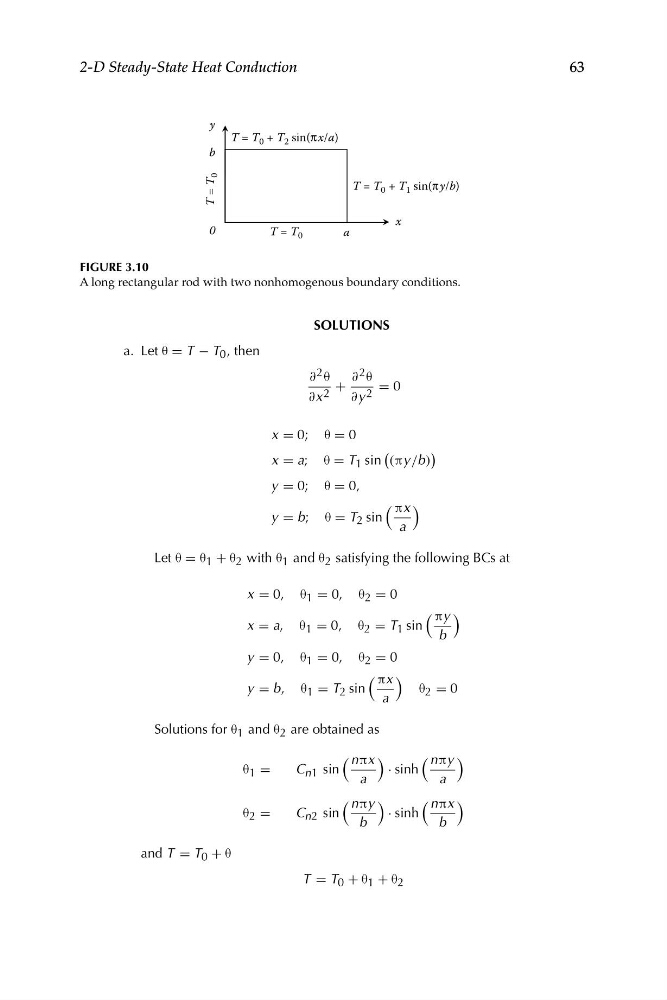
T = T 0 + T 2 sin(πx/a)
T = T 0 + T 1 sin(πy/b)
0
T = T 0
T = T
0
FIGURE 3.10
A long rectangular rod with two nonhomogenous boundary conditions.
a. Let θ = T − T 0 , then
∂ 2 θ
∂ 2 θ
+
= 0
∂x 2
∂y 2
x = 0; θ = 0
(
)
x = a; θ = T 1 sin (πy /b)
y = 0; θ = 0,
(
)
πx
y = b; θ = T 2 sin a
Let θ = θ 1 + θ 2 with θ 1 and θ 2 satisfying the following BCs at
x = 0, θ 1 = 0, θ 2 = 0
(
)
πy
x = a, θ 1 = 0, θ 2 = T 1 sin b
y = 0, θ 1 = 0, θ 2 = 0
(
)
πx
y = b, θ 1 = T 2 sin
θ 2 = 0
a
Solutions for θ 1 and θ 2 are obtained as
(
)
(
)
nπx
nπy
θ 1 =
C n1 sin
· sinh
a
a
(
)
(
)
nπy
nπx
θ 2 =
C n2 sin
· sinh
b
b
and T = T 0 + θ
T = T 0 + θ 1 + θ 2
63
2-D Steady-State Heat Conduction
x
y
b
a
T = T 0 + T 2 sin(πx/a)
T = T 0 + T 1 sin(πy/b)
0
T = T 0
T = T
0
FIGURE 3.10
A long rectangular rod with two nonhomogenous boundary conditions.