

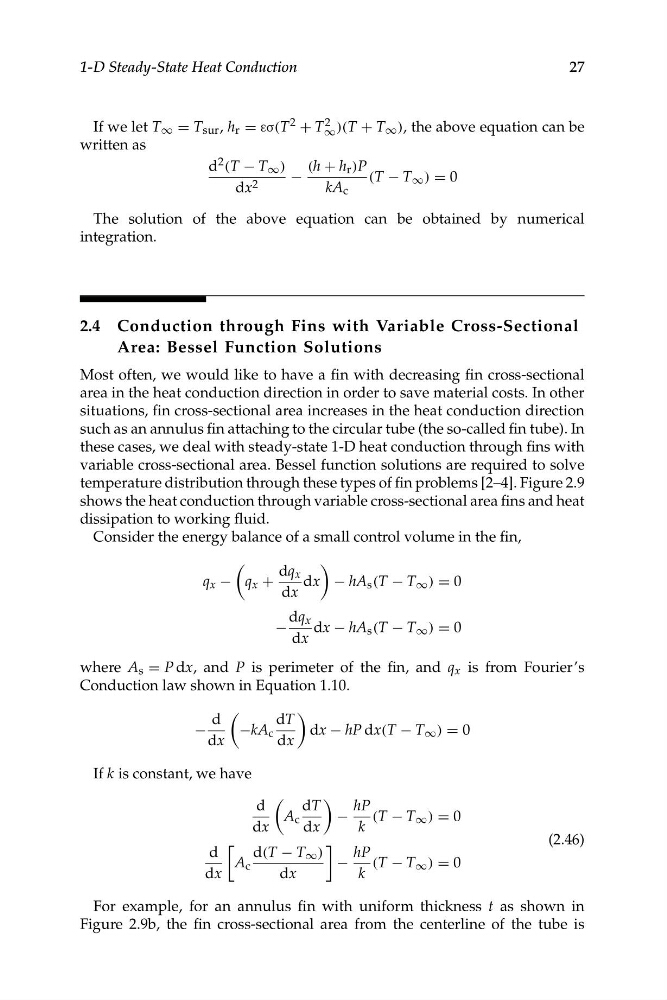
If we let T ∞ = T sur , h r = εσ(T 2 + T 2
∞ )(T + T ∞ ), the above equation can be
written as
d 2 (T − T ∞ )
dx 2
−
(h + h r )P
kA c
(T − T ∞ ) = 0
The solution of the above equation can be obtained by numerical
integration.
�
�
�
�
�
�
27
1-D Steady-State Heat Conduction
2.4 Conduction through Fins with Variable Cross-Sectional
Area: Bessel Function Solutions
Most often, we would like to have a fin with decreasing fin cross-sectional
area in the heat conduction direction in order to save material costs. In other
situations, fin cross-sectional area increases in the heat conduction direction
such as an annulus fin attaching to the circular tube (the so-called fin tube). In
these cases, we deal with steady-state 1-D heat conduction through fins with
variable cross-sectional area. Bessel function solutions are required to solve
temperature distribution through these types of fin problems [2–4]. Figure 2.9
shows the heat conduction through variable cross-sectional area fins and heat
dissipation to working fluid.
Consider the energy balance of a small control volume in the fin,
dq x
q x − q x +
dx − hA s (T − T ∞ ) = 0
dx
dq x
−
dx − hA s (T − T ∞ ) = 0
dx
where A s = P dx, and P is perimeter of the fin, and q x is from Fourier’s
Conduction law shown in Equation 1.10.
d
dT
−
−kA c
dx − hP dx(T − T ∞ ) = 0
dx
dx
If k is constant, we have
d
dT
hP
A c
−
(T − T ∞ ) = 0
dx
dx
k
�
�
(2.46)
d
d(T − T ∞ )
hP
A c
−
(T − T ∞ ) = 0
dx
dx
k
For example, for an annulus fin with uniform thickness t as shown in
Figure 2.9b, the fin cross-sectional area from the centerline of the tube is
∞ )(T + T ∞ ), the above equation can be
written as
d 2 (T − T ∞ )
dx 2
−
(h + h r )P
kA c
(T − T ∞ ) = 0
The solution of the above equation can be obtained by numerical
integration.
�
�
�
�
�
�
27
1-D Steady-State Heat Conduction
2.4 Conduction through Fins with Variable Cross-Sectional
Area: Bessel Function Solutions
Most often, we would like to have a fin with decreasing fin cross-sectional
area in the heat conduction direction in order to save material costs. In other
situations, fin cross-sectional area increases in the heat conduction direction
such as an annulus fin attaching to the circular tube (the so-called fin tube). In
these cases, we deal with steady-state 1-D heat conduction through fins with
variable cross-sectional area. Bessel function solutions are required to solve
temperature distribution through these types of fin problems [2–4]. Figure 2.9
shows the heat conduction through variable cross-sectional area fins and heat
dissipation to working fluid.
Consider the energy balance of a small control volume in the fin,
dq x
q x − q x +
dx − hA s (T − T ∞ ) = 0
dx
dq x
−
dx − hA s (T − T ∞ ) = 0
dx
where A s = P dx, and P is perimeter of the fin, and q x is from Fourier’s
Conduction law shown in Equation 1.10.
d
dT
−
−kA c
dx − hP dx(T − T ∞ ) = 0
dx
dx
If k is constant, we have
d
dT
hP
A c
−
(T − T ∞ ) = 0
dx
dx
k
�
�
(2.46)
d
d(T − T ∞ )
hP
A c
−
(T − T ∞ ) = 0
dx
dx
k
For example, for an annulus fin with uniform thickness t as shown in
Figure 2.9b, the fin cross-sectional area from the centerline of the tube is