

""
�
�
�
�
�
�
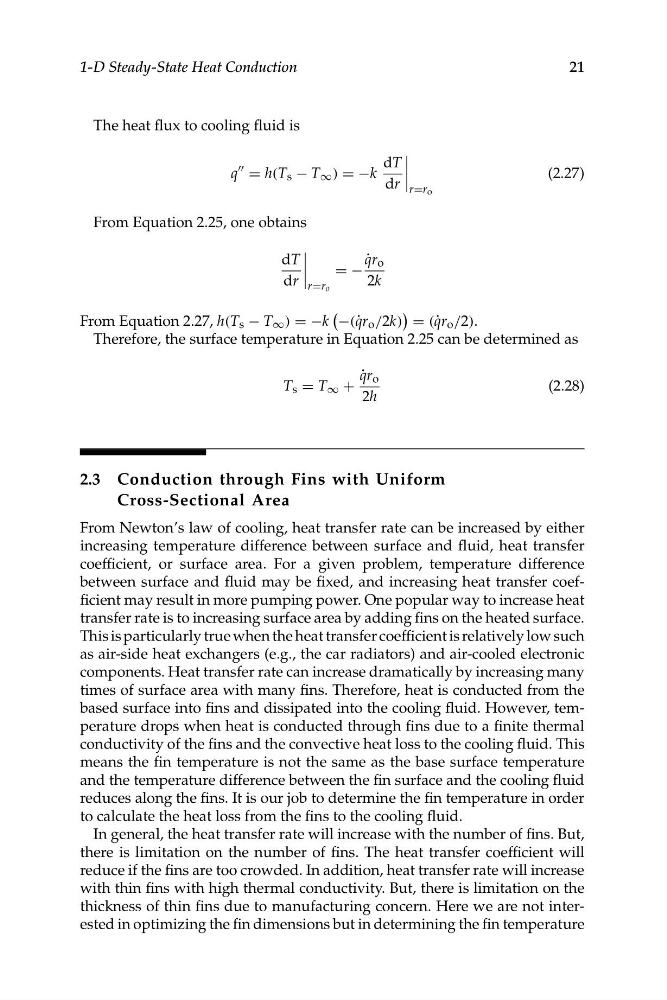
The heat flux to cooling fluid is
dT �
q = h(T s − T ∞ ) = −k
(2.27)
dr r=r o
From Equation 2.25, one obtains
dT �
˙
qr o
= −
dr r=r o
2k
(
)
From Equation 2.27, h(T s − T ∞ ) = −k −(˙
= (˙
qr o /2k)
qr o /2).
Therefore, the surface temperature in Equation 2.25 can be determined as
˙
qr o
T s = T ∞ +
(2.28)
2h
21
1-D Steady-State Heat Conduction
2.3 Conduction through Fins with Uniform
Cross-Sectional Area
From Newton’s law of cooling, heat transfer rate can be increased by either
increasing temperature difference between surface and fluid, heat transfer
coefficient, or surface area. For a given problem, temperature difference
between surface and fluid may be fixed, and increasing heat transfer coefficient may result in more pumping power. One popular way to increase heat
transfer rate is to increasing surface area by adding fins on the heated surface.
This is particularly true when the heat transfer coefficient is relatively low such
as air-side heat exchangers (e.g., the car radiators) and air-cooled electronic
components. Heat transfer rate can increase dramatically by increasing many
times of surface area with many fins. Therefore, heat is conducted from the
based surface into fins and dissipated into the cooling fluid. However, temperature drops when heat is conducted through fins due to a finite thermal
conductivity of the fins and the convective heat loss to the cooling fluid. This
means the fin temperature is not the same as the base surface temperature
and the temperature difference between the fin surface and the cooling fluid
reduces along the fins. It is our job to determine the fin temperature in order
to calculate the heat loss from the fins to the cooling fluid.
In general, the heat transfer rate will increase with the number of fins. But,
there is limitation on the number of fins. The heat transfer coefficient will
reduce if the fins are too crowded. In addition, heat transfer rate will increase
with thin fins with high thermal conductivity. But, there is limitation on the
thickness of thin fins due to manufacturing concern. Here we are not interested in optimizing the fin dimensions but in determining the fin temperature
�
�
�
�
�
�
The heat flux to cooling fluid is
dT �
q = h(T s − T ∞ ) = −k
(2.27)
dr r=r o
From Equation 2.25, one obtains
dT �
˙
qr o
= −
dr r=r o
2k
(
)
From Equation 2.27, h(T s − T ∞ ) = −k −(˙
= (˙
qr o /2k)
qr o /2).
Therefore, the surface temperature in Equation 2.25 can be determined as
˙
qr o
T s = T ∞ +
(2.28)
2h
21
1-D Steady-State Heat Conduction
2.3 Conduction through Fins with Uniform
Cross-Sectional Area
From Newton’s law of cooling, heat transfer rate can be increased by either
increasing temperature difference between surface and fluid, heat transfer
coefficient, or surface area. For a given problem, temperature difference
between surface and fluid may be fixed, and increasing heat transfer coefficient may result in more pumping power. One popular way to increase heat
transfer rate is to increasing surface area by adding fins on the heated surface.
This is particularly true when the heat transfer coefficient is relatively low such
as air-side heat exchangers (e.g., the car radiators) and air-cooled electronic
components. Heat transfer rate can increase dramatically by increasing many
times of surface area with many fins. Therefore, heat is conducted from the
based surface into fins and dissipated into the cooling fluid. However, temperature drops when heat is conducted through fins due to a finite thermal
conductivity of the fins and the convective heat loss to the cooling fluid. This
means the fin temperature is not the same as the base surface temperature
and the temperature difference between the fin surface and the cooling fluid
reduces along the fins. It is our job to determine the fin temperature in order
to calculate the heat loss from the fins to the cooling fluid.
In general, the heat transfer rate will increase with the number of fins. But,
there is limitation on the number of fins. The heat transfer coefficient will
reduce if the fins are too crowded. In addition, heat transfer rate will increase
with thin fins with high thermal conductivity. But, there is limitation on the
thickness of thin fins due to manufacturing concern. Here we are not interested in optimizing the fin dimensions but in determining the fin temperature