

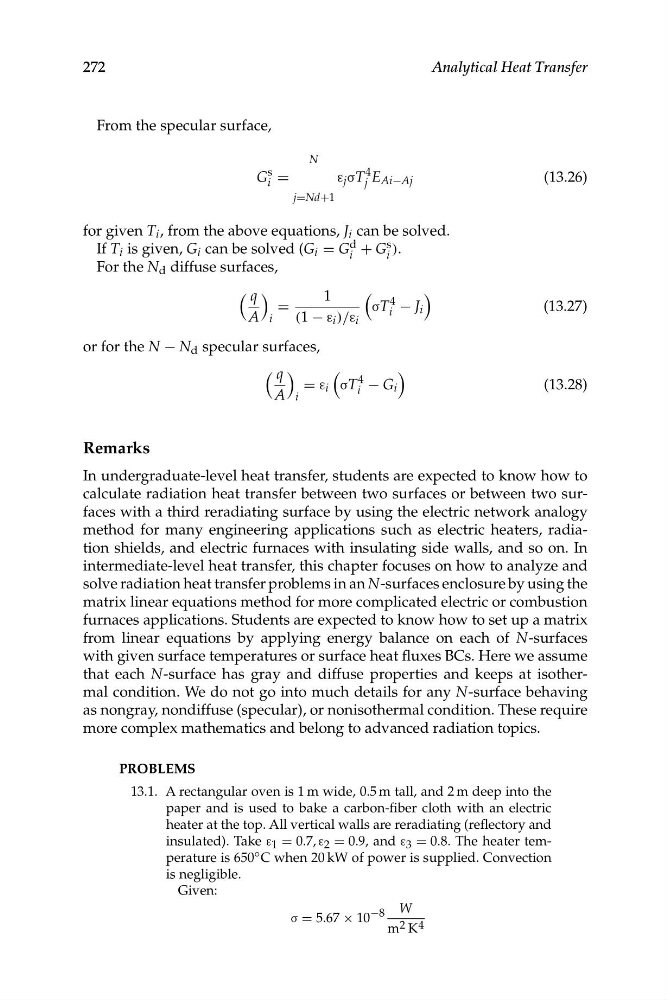
From the specular surface,
N
G
s
i =
ε j σT j
4 E Ai−Aj
(13.26)
j=Nd+1
for given T i , from the above equations, J i can be solved.
If T i is given, G i can be solved (G i = G i
d + G i
s ).
For the N d diffuse surfaces,
( )
(
)
q
1
=
σT i
4
− J i
(13.27)
A i
(1 − ε i )/ε i
or for the N − N d specular surfaces,
( )
(
)
A
q
i
= ε i σT
4
− G i
(13.28)
i
272
Analytical Heat Transfer
Remarks
In undergraduate-level heat transfer, students are expected to know how to
calculate radiation heat transfer between two surfaces or between two surfaces with a third reradiating surface by using the electric network analogy
method for many engineering applications such as electric heaters, radiation shields, and electric furnaces with insulating side walls, and so on. In
intermediate-level heat transfer, this chapter focuses on how to analyze and
solve radiation heat transfer problems in an N-surfaces enclosure by using the
matrix linear equations method for more complicated electric or combustion
furnaces applications. Students are expected to know how to set up a matrix
from linear equations by applying energy balance on each of N-surfaces
with given surface temperatures or surface heat fluxes BCs. Here we assume
that each N-surface has gray and diffuse properties and keeps at isothermal condition. We do not go into much details for any N-surface behaving
as nongray, nondiffuse (specular), or nonisothermal condition. These require
more complex mathematics and belong to advanced radiation topics.
PROBLEMS
13.1. A rectangular oven is 1 m wide, 0.5 m tall, and 2 m deep into the
paper and is used to bake a carbon-fiber cloth with an electric
heater at the top. All vertical walls are reradiating (reflectory and
insulated). Take ε 1 = 0.7, ε 2 = 0.9, and ε 3 = 0.8. The heater temperature is 650 ◦ C when 20 kW of power is supplied. Convection
is negligible.
Given:
W
σ = 5.67 × 10 −8
m 2 K 4
N
G
s
i =
ε j σT j
4 E Ai−Aj
(13.26)
j=Nd+1
for given T i , from the above equations, J i can be solved.
If T i is given, G i can be solved (G i = G i
d + G i
s ).
For the N d diffuse surfaces,
( )
(
)
q
1
=
σT i
4
− J i
(13.27)
A i
(1 − ε i )/ε i
or for the N − N d specular surfaces,
( )
(
)
A
q
i
= ε i σT
4
− G i
(13.28)
i
272
Analytical Heat Transfer
Remarks
In undergraduate-level heat transfer, students are expected to know how to
calculate radiation heat transfer between two surfaces or between two surfaces with a third reradiating surface by using the electric network analogy
method for many engineering applications such as electric heaters, radiation shields, and electric furnaces with insulating side walls, and so on. In
intermediate-level heat transfer, this chapter focuses on how to analyze and
solve radiation heat transfer problems in an N-surfaces enclosure by using the
matrix linear equations method for more complicated electric or combustion
furnaces applications. Students are expected to know how to set up a matrix
from linear equations by applying energy balance on each of N-surfaces
with given surface temperatures or surface heat fluxes BCs. Here we assume
that each N-surface has gray and diffuse properties and keeps at isothermal condition. We do not go into much details for any N-surface behaving
as nongray, nondiffuse (specular), or nonisothermal condition. These require
more complex mathematics and belong to advanced radiation topics.
PROBLEMS
13.1. A rectangular oven is 1 m wide, 0.5 m tall, and 2 m deep into the
paper and is used to bake a carbon-fiber cloth with an electric
heater at the top. All vertical walls are reradiating (reflectory and
insulated). Take ε 1 = 0.7, ε 2 = 0.9, and ε 3 = 0.8. The heater temperature is 650 ◦ C when 20 kW of power is supplied. Convection
is negligible.
Given:
W
σ = 5.67 × 10 −8
m 2 K 4