

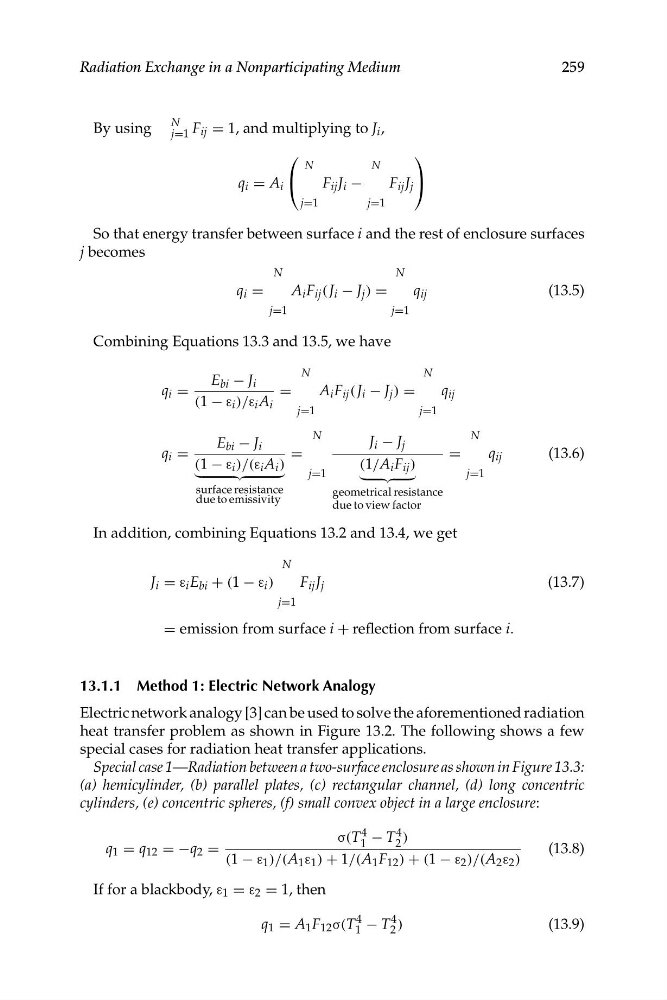
N
By using
1 F ij = 1, and multiplying to J i ,
j=
⎛
⎞
N
N
⎝
⎠
q i = A i
F ij J i −
F ij J j
j=1
j=1
So that energy transfer between surface i and the rest of enclosure surfaces
j becomes
N
N
q i =
A i F ij ( J i − J j ) =
q ij
(13.5)
j=1
j=1
Combining Equations 13.3 and 13.5, we have
E bi − J i
N
N
q i =
=
A i F ij ( J i − J j ) =
q ij
(1 − ε i )/ε i A i
j=1
j=1
E bi − J i
N
N
J i − J j
q i =
=
=
q ij
(13.6)
(1 − ε i )/(ε i A i )
(1/A i F ij )
'
-v
'
j=1
'
'
j=1
-v
surface resistance
geometrical resistance
due to emissivity
due to view factor
In addition, combining Equations 13.2 and 13.4, we get
N
J i = ε i E bi + (1 − ε i )
F ij J j
(13.7)
j=1
= emission from surface i + reflection from surface i.
13.1.1 Method 1: Electric Network Analogy
Electric network analogy [3] can be used to solve the aforementioned radiation
heat transfer problem as shown in Figure 13.2. The following shows a few
special cases for radiation heat transfer applications.
Special case 1—Radiation between a two-surface enclosure as shown in Figure 13.3:
(a) hemicylinder, (b) parallel plates, (c) rectangular channel, (d) long concentric
cylinders, (e) concentric spheres, (f) small convex object in a large enclosure:
σ(T 1
4 − T 2
4 )
q 1 = q 12 = −q 2 =
(13.8)
(1 − ε 1 )/(A 1 ε 1 ) + 1/(A 1 F 12 ) + (1 − ε 2 )/(A 2 ε 2 )
If for a blackbody, ε 1 = ε 2 = 1, then
q 1 = A 1 F 12 σ(T 1
4
− T 2
4 )
(13.9)
259
Radiation Exchange in a Nonparticipating Medium
By using
1 F ij = 1, and multiplying to J i ,
j=
⎛
⎞
N
N
⎝
⎠
q i = A i
F ij J i −
F ij J j
j=1
j=1
So that energy transfer between surface i and the rest of enclosure surfaces
j becomes
N
N
q i =
A i F ij ( J i − J j ) =
q ij
(13.5)
j=1
j=1
Combining Equations 13.3 and 13.5, we have
E bi − J i
N
N
q i =
=
A i F ij ( J i − J j ) =
q ij
(1 − ε i )/ε i A i
j=1
j=1
E bi − J i
N
N
J i − J j
q i =
=
=
q ij
(13.6)
(1 − ε i )/(ε i A i )
(1/A i F ij )
'
-v
'
j=1
'
'
j=1
-v
surface resistance
geometrical resistance
due to emissivity
due to view factor
In addition, combining Equations 13.2 and 13.4, we get
N
J i = ε i E bi + (1 − ε i )
F ij J j
(13.7)
j=1
= emission from surface i + reflection from surface i.
13.1.1 Method 1: Electric Network Analogy
Electric network analogy [3] can be used to solve the aforementioned radiation
heat transfer problem as shown in Figure 13.2. The following shows a few
special cases for radiation heat transfer applications.
Special case 1—Radiation between a two-surface enclosure as shown in Figure 13.3:
(a) hemicylinder, (b) parallel plates, (c) rectangular channel, (d) long concentric
cylinders, (e) concentric spheres, (f) small convex object in a large enclosure:
σ(T 1
4 − T 2
4 )
q 1 = q 12 = −q 2 =
(13.8)
(1 − ε 1 )/(A 1 ε 1 ) + 1/(A 1 F 12 ) + (1 − ε 2 )/(A 2 ε 2 )
If for a blackbody, ε 1 = ε 2 = 1, then
q 1 = A 1 F 12 σ(T 1
4
− T 2
4 )
(13.9)
259
Radiation Exchange in a Nonparticipating Medium