

q ''
radiation
G s
window−sky
q ''
convection
outside air
q ''
radiation
window−walls
q ''
convection
room air
233
Fundamental Radiation
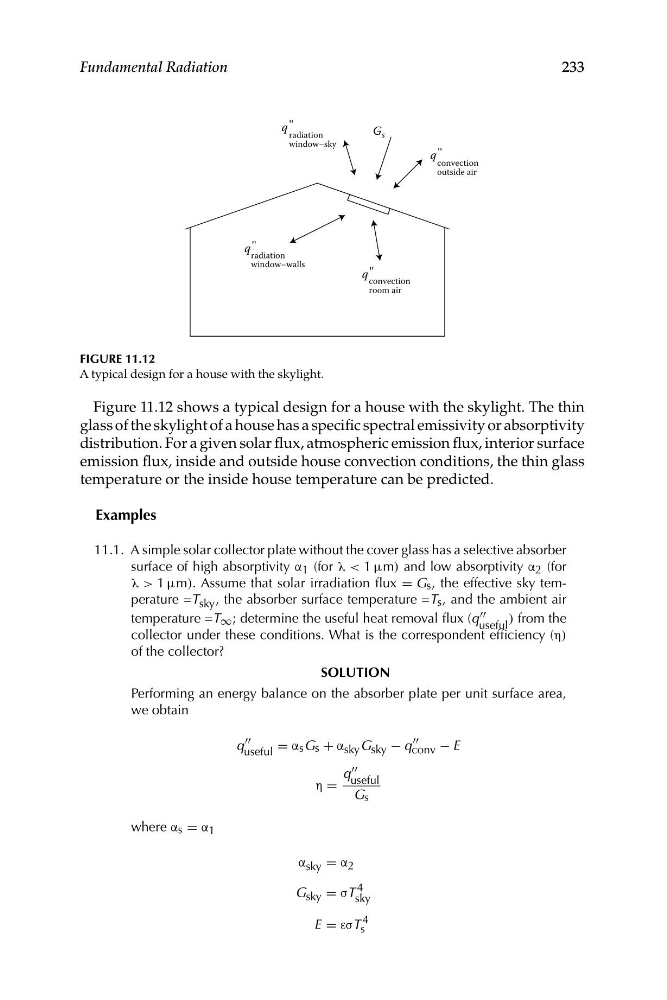
FIGURE 11.12
A typical design for a house with the skylight.
Figure 11.12 shows a typical design for a house with the skylight. The thin
glass of the skylight of a house has a specific spectral emissivity or absorptivity
distribution. For a given solar flux, atmospheric emission flux, interior surface
emission flux, inside and outside house convection conditions, the thin glass
temperature or the inside house temperature can be predicted.
Examples
11.1. A simple solar collector plate without the cover glass has a selective absorber
surface of high absorptivity α 1 (for λ < 1 μm) and low absorptivity α 2 (for
λ > 1 μm). Assume that solar irradiation flux = G s , the effective sky temperature =T sky , the absorber surface temperature =T s , and the ambient air
""
temperature =T ∞ ; determine the useful heat removal flux (q useful ) from the
collector under these conditions. What is the correspondent efficiency (η)
of the collector?
SOLUTION
Performing an energy balance on the absorber plate per unit surface area,
we obtain
""
""
q
− E
useful = α s G s + α sky G sky − q conv
""
q useful
η = G s
where α s = α 1
α sky = α 2
= σT 4
G sky
sky
E = εσT 4
s
radiation
G s
window−sky
q ''
convection
outside air
q ''
radiation
window−walls
q ''
convection
room air
233
Fundamental Radiation
FIGURE 11.12
A typical design for a house with the skylight.
Figure 11.12 shows a typical design for a house with the skylight. The thin
glass of the skylight of a house has a specific spectral emissivity or absorptivity
distribution. For a given solar flux, atmospheric emission flux, interior surface
emission flux, inside and outside house convection conditions, the thin glass
temperature or the inside house temperature can be predicted.
Examples
11.1. A simple solar collector plate without the cover glass has a selective absorber
surface of high absorptivity α 1 (for λ < 1 μm) and low absorptivity α 2 (for
λ > 1 μm). Assume that solar irradiation flux = G s , the effective sky temperature =T sky , the absorber surface temperature =T s , and the ambient air
""
temperature =T ∞ ; determine the useful heat removal flux (q useful ) from the
collector under these conditions. What is the correspondent efficiency (η)
of the collector?
SOLUTION
Performing an energy balance on the absorber plate per unit surface area,
we obtain
""
""
q
− E
useful = α s G s + α sky G sky − q conv
""
q useful
η = G s
where α s = α 1
α sky = α 2
= σT 4
G sky
sky
E = εσT 4
s