

Brick
wall
T c = 2000 K
T s = 500 K
0
1.5
10
λ, μm
0.1
0.5
0.8
ε(λ)
λ 1
ε 1
ε 2
ε 3
λ 2
Coal bed
227
Fundamental Radiation
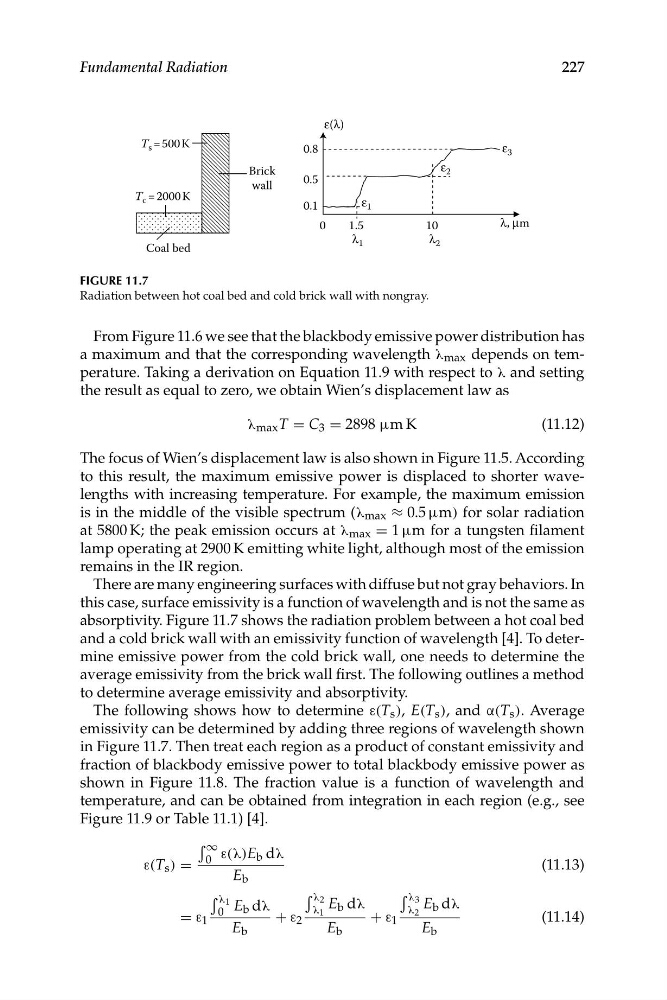
FIGURE 11.7
Radiation between hot coal bed and cold brick wall with nongray.
From Figure 11.6 we see that the blackbody emissive power distribution has
a maximum and that the corresponding wavelength λ max depends on temperature. Taking a derivation on Equation 11.9 with respect to λ and setting
the result as equal to zero, we obtain Wien’s displacement law as
λ max T = C 3 = 2898 μm K
(11.12)
The focus of Wien’s displacement law is also shown in Figure 11.5. According
to this result, the maximum emissive power is displaced to shorter wavelengths with increasing temperature. For example, the maximum emission
is in the middle of the visible spectrum (λ max ≈ 0.5 μm) for solar radiation
at 5800 K; the peak emission occurs at λ max = 1 μm for a tungsten filament
lamp operating at 2900 K emitting white light, although most of the emission
remains in the IR region.
There are many engineering surfaces with diffuse but not gray behaviors. In
this case, surface emissivity is a function of wavelength and is not the same as
absorptivity. Figure 11.7 shows the radiation problem between a hot coal bed
and a cold brick wall with an emissivity function of wavelength [4]. To determine emissive power from the cold brick wall, one needs to determine the
average emissivity from the brick wall first. The following outlines a method
to determine average emissivity and absorptivity.
The following shows how to determine ε(T s ), E(T s ), and α(T s ). Average
emissivity can be determined by adding three regions of wavelength shown
in Figure 11.7. Then treat each region as a product of constant emissivity and
fraction of blackbody emissive power to total blackbody emissive power as
shown in Figure 11.8. The fraction value is a function of wavelength and
temperature, and can be obtained from integration in each region (e.g., see
Figure 11.9 or Table 11.1) [4].
� ∞ ε(λ)E b dλ
ε(T s ) =
0
(11.13)
E b
� λ 1
� λ 2
� λ 3
E b dλ
E b dλ
E b dλ
0
λ 1
λ 2
= ε 1
+ ε 2
+ ε 1
(11.14)
E b
E b
E b
wall
T c = 2000 K
T s = 500 K
0
1.5
10
λ, μm
0.1
0.5
0.8
ε(λ)
λ 1
ε 1
ε 2
ε 3
λ 2
Coal bed
227
Fundamental Radiation
FIGURE 11.7
Radiation between hot coal bed and cold brick wall with nongray.
From Figure 11.6 we see that the blackbody emissive power distribution has
a maximum and that the corresponding wavelength λ max depends on temperature. Taking a derivation on Equation 11.9 with respect to λ and setting
the result as equal to zero, we obtain Wien’s displacement law as
λ max T = C 3 = 2898 μm K
(11.12)
The focus of Wien’s displacement law is also shown in Figure 11.5. According
to this result, the maximum emissive power is displaced to shorter wavelengths with increasing temperature. For example, the maximum emission
is in the middle of the visible spectrum (λ max ≈ 0.5 μm) for solar radiation
at 5800 K; the peak emission occurs at λ max = 1 μm for a tungsten filament
lamp operating at 2900 K emitting white light, although most of the emission
remains in the IR region.
There are many engineering surfaces with diffuse but not gray behaviors. In
this case, surface emissivity is a function of wavelength and is not the same as
absorptivity. Figure 11.7 shows the radiation problem between a hot coal bed
and a cold brick wall with an emissivity function of wavelength [4]. To determine emissive power from the cold brick wall, one needs to determine the
average emissivity from the brick wall first. The following outlines a method
to determine average emissivity and absorptivity.
The following shows how to determine ε(T s ), E(T s ), and α(T s ). Average
emissivity can be determined by adding three regions of wavelength shown
in Figure 11.7. Then treat each region as a product of constant emissivity and
fraction of blackbody emissive power to total blackbody emissive power as
shown in Figure 11.8. The fraction value is a function of wavelength and
temperature, and can be obtained from integration in each region (e.g., see
Figure 11.9 or Table 11.1) [4].
� ∞ ε(λ)E b dλ
ε(T s ) =
0
(11.13)
E b
� λ 1
� λ 2
� λ 3
E b dλ
E b dλ
E b dλ
0
λ 1
λ 2
= ε 1
+ ε 2
+ ε 1
(11.14)
E b
E b
E b