

�
�
��
�
�
mixing length theory, the following universal velocity profile
has been derived:
+
u = y + for the viscous sublayer region.
+
u = (1/κ) ln y + + C for the turbulent layer (the law of the
wall region).
Now, based on the heat and momentum transfer analogy,
derive and plot (T + versus y + for various Pr) the universal
+
temperature profile (i.e., temperature law of the wall, T + (y ,
Pr)] for a turbulent boundary layer on a flat plate? Make the
necessary assumptions.
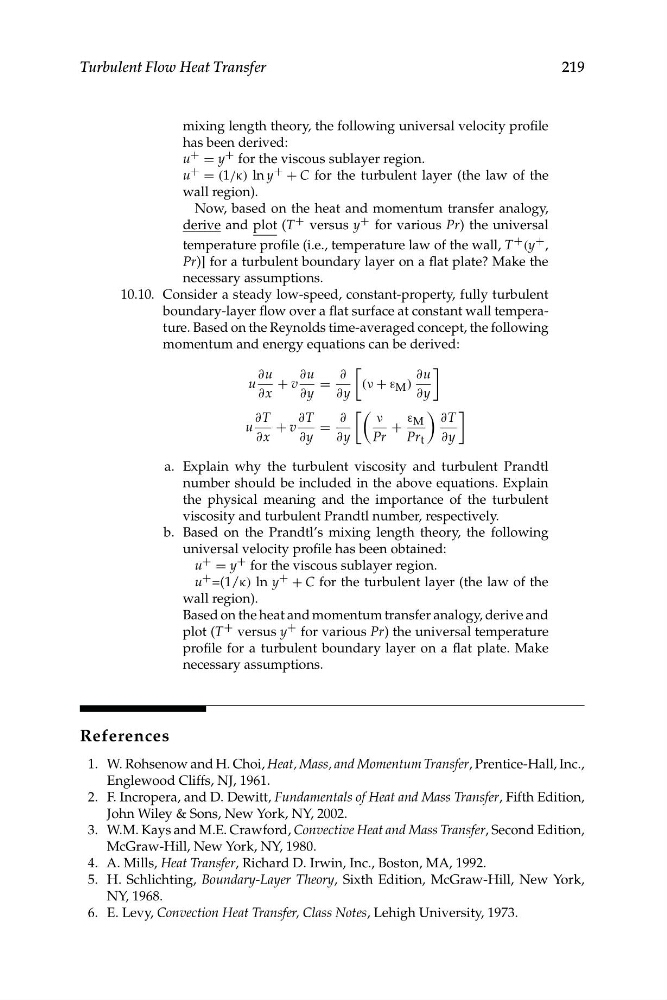
10.10. Consider a steady low-speed, constant-property, fully turbulent
boundary-layer flow over a flat surface at constant wall temperature. Based on the Reynolds time-averaged concept, the following
momentum and energy equations can be derived:
∂u
∂u
∂
∂u
u
+ v
=
(ν + ε M )
∂x
∂y
∂y
∂y
∂T
∂T
∂
ν
ε M ∂T
u
+ v
=
+
∂x
∂y
∂y
Pr
Pr t ∂y
a. Explain why the turbulent viscosity and turbulent Prandtl
number should be included in the above equations. Explain
the physical meaning and the importance of the turbulent
viscosity and turbulent Prandtl number, respectively.
b. Based on the Prandtl’s mixing length theory, the following
universal velocity profile has been obtained:
+
u = y + for the viscous sublayer region.
u + =(1/κ) ln y + + C for the turbulent layer (the law of the
wall region).
Based on the heat and momentum transfer analogy, derive and
plot (T + versus y + for various Pr) the universal temperature
profile for a turbulent boundary layer on a flat plate. Make
necessary assumptions.
219
Turbulent Flow Heat Transfer
References
1. W. Rohsenow and H. Choi, Heat, Mass, and Momentum Transfer, Prentice-Hall, Inc.,
Englewood Cliffs, NJ, 1961.
2. F. Incropera, and D. Dewitt, Fundamentals of Heat and Mass Transfer, Fifth Edition,
John Wiley & Sons, New York, NY, 2002.
3. W.M. Kays and M.E. Crawford, Convective Heat and Mass Transfer, Second Edition,
McGraw-Hill, New York, NY, 1980.
4. A. Mills, Heat Transfer, Richard D. Irwin, Inc., Boston, MA, 1992.
5. H. Schlichting, Boundary-Layer Theory, Sixth Edition, McGraw-Hill, New York,
NY, 1968.
6. E. Levy, Convection Heat Transfer, Class Notes, Lehigh University, 1973.
�
��
�
�
mixing length theory, the following universal velocity profile
has been derived:
+
u = y + for the viscous sublayer region.
+
u = (1/κ) ln y + + C for the turbulent layer (the law of the
wall region).
Now, based on the heat and momentum transfer analogy,
derive and plot (T + versus y + for various Pr) the universal
+
temperature profile (i.e., temperature law of the wall, T + (y ,
Pr)] for a turbulent boundary layer on a flat plate? Make the
necessary assumptions.
10.10. Consider a steady low-speed, constant-property, fully turbulent
boundary-layer flow over a flat surface at constant wall temperature. Based on the Reynolds time-averaged concept, the following
momentum and energy equations can be derived:
∂u
∂u
∂
∂u
u
+ v
=
(ν + ε M )
∂x
∂y
∂y
∂y
∂T
∂T
∂
ν
ε M ∂T
u
+ v
=
+
∂x
∂y
∂y
Pr
Pr t ∂y
a. Explain why the turbulent viscosity and turbulent Prandtl
number should be included in the above equations. Explain
the physical meaning and the importance of the turbulent
viscosity and turbulent Prandtl number, respectively.
b. Based on the Prandtl’s mixing length theory, the following
universal velocity profile has been obtained:
+
u = y + for the viscous sublayer region.
u + =(1/κ) ln y + + C for the turbulent layer (the law of the
wall region).
Based on the heat and momentum transfer analogy, derive and
plot (T + versus y + for various Pr) the universal temperature
profile for a turbulent boundary layer on a flat plate. Make
necessary assumptions.
219
Turbulent Flow Heat Transfer
References
1. W. Rohsenow and H. Choi, Heat, Mass, and Momentum Transfer, Prentice-Hall, Inc.,
Englewood Cliffs, NJ, 1961.
2. F. Incropera, and D. Dewitt, Fundamentals of Heat and Mass Transfer, Fifth Edition,
John Wiley & Sons, New York, NY, 2002.
3. W.M. Kays and M.E. Crawford, Convective Heat and Mass Transfer, Second Edition,
McGraw-Hill, New York, NY, 1980.
4. A. Mills, Heat Transfer, Richard D. Irwin, Inc., Boston, MA, 1992.
5. H. Schlichting, Boundary-Layer Theory, Sixth Edition, McGraw-Hill, New York,
NY, 1968.
6. E. Levy, Convection Heat Transfer, Class Notes, Lehigh University, 1973.