

�
�
�
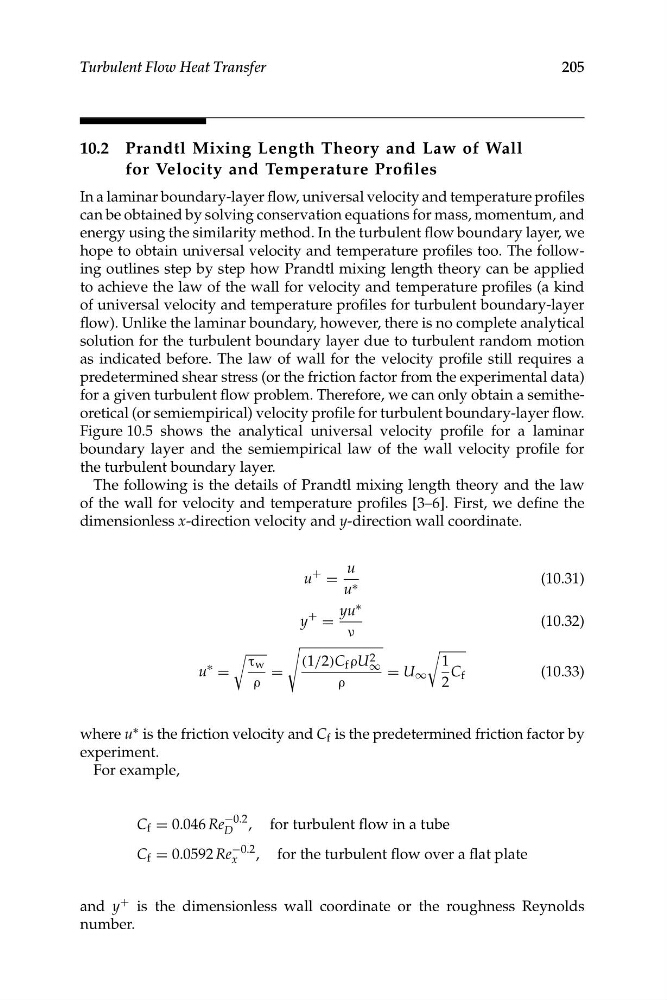
u
+
u =
(10.31)
u ∗
∗
yu
+
y =
(10.32)
ν
τ w
(1/2)C f ρU 2
1
u
∗
=
=
∞
= U ∞
C f
(10.33)
ρ
ρ
2
where u ∗ is the friction velocity and C f is the predetermined friction factor by
experiment.
For example,
= 0.046 Re
−0.2 , for turbulent flow in a tube
C f
D
C f = 0.0592 Re
−0.2 , for the turbulent flow over a flat plate
x
and y + is the dimensionless wall coordinate or the roughness Reynolds
number.
205
Turbulent Flow Heat Transfer
10.2 Prandtl Mixing Length Theory and Law of Wall
for Velocity and Temperature Profiles
In a laminar boundary-layer flow, universal velocity and temperature profiles
can be obtained by solving conservation equations for mass, momentum, and
energy using the similarity method. In the turbulent flow boundary layer, we
hope to obtain universal velocity and temperature profiles too. The following outlines step by step how Prandtl mixing length theory can be applied
to achieve the law of the wall for velocity and temperature profiles (a kind
of universal velocity and temperature profiles for turbulent boundary-layer
flow). Unlike the laminar boundary, however, there is no complete analytical
solution for the turbulent boundary layer due to turbulent random motion
as indicated before. The law of wall for the velocity profile still requires a
predetermined shear stress (or the friction factor from the experimental data)
for a given turbulent flow problem. Therefore, we can only obtain a semitheoretical (or semiempirical) velocity profile for turbulent boundary-layer flow.
Figure 10.5 shows the analytical universal velocity profile for a laminar
boundary layer and the semiempirical law of the wall velocity profile for
the turbulent boundary layer.
The following is the details of Prandtl mixing length theory and the law
of the wall for velocity and temperature profiles [3–6]. First, we define the
dimensionless x-direction velocity and y-direction wall coordinate.
�
�
u
+
u =
(10.31)
u ∗
∗
yu
+
y =
(10.32)
ν
τ w
(1/2)C f ρU 2
1
u
∗
=
=
∞
= U ∞
C f
(10.33)
ρ
ρ
2
where u ∗ is the friction velocity and C f is the predetermined friction factor by
experiment.
For example,
= 0.046 Re
−0.2 , for turbulent flow in a tube
C f
D
C f = 0.0592 Re
−0.2 , for the turbulent flow over a flat plate
x
and y + is the dimensionless wall coordinate or the roughness Reynolds
number.
205
Turbulent Flow Heat Transfer
10.2 Prandtl Mixing Length Theory and Law of Wall
for Velocity and Temperature Profiles
In a laminar boundary-layer flow, universal velocity and temperature profiles
can be obtained by solving conservation equations for mass, momentum, and
energy using the similarity method. In the turbulent flow boundary layer, we
hope to obtain universal velocity and temperature profiles too. The following outlines step by step how Prandtl mixing length theory can be applied
to achieve the law of the wall for velocity and temperature profiles (a kind
of universal velocity and temperature profiles for turbulent boundary-layer
flow). Unlike the laminar boundary, however, there is no complete analytical
solution for the turbulent boundary layer due to turbulent random motion
as indicated before. The law of wall for the velocity profile still requires a
predetermined shear stress (or the friction factor from the experimental data)
for a given turbulent flow problem. Therefore, we can only obtain a semitheoretical (or semiempirical) velocity profile for turbulent boundary-layer flow.
Figure 10.5 shows the analytical universal velocity profile for a laminar
boundary layer and the semiempirical law of the wall velocity profile for
the turbulent boundary layer.
The following is the details of Prandtl mixing length theory and the law
of the wall for velocity and temperature profiles [3–6]. First, we define the
dimensionless x-direction velocity and y-direction wall coordinate.