

Therefore,
v t
ε m
1 − (y + /R + )
=
=
− 1
(10.19)
v
ν
(du + /dy + )
Similarly, the turbulent diffusivity for momentum for a boundary-layer flow
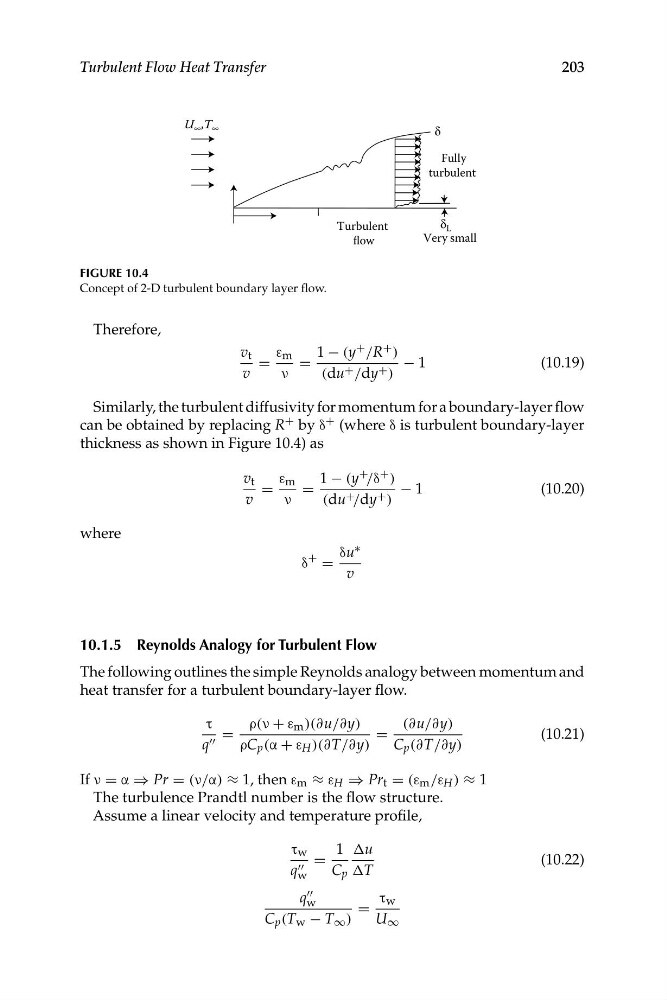
can be obtained by replacing R + by δ + (where δ is turbulent boundary-layer
thickness as shown in Figure 10.4) as
v t
ε m
1 − (y + /δ + )
=
=
− 1
(10.20)
v
ν
(du + /dy + )
where
∗
δ
+
δu
= v
10.1.5 Reynolds Analogy for Turbulent Flow
The following outlines the simple Reynolds analogy between momentum and
heat transfer for a turbulent boundary-layer flow.
τ
ρ(ν + ε m )(∂u/∂y)
(∂u/∂y)
=
=
(10.21)
q ""
ρC p (α + ε H )(∂T/∂y)
C p (∂T/∂y)
If ν = α ⇒ Pr = (ν/α) ≈ 1, then ε m ≈ ε H ⇒ Pr t = (ε m /ε H ) ≈ 1
The turbulence Prandtl number is the flow structure.
Assume a linear velocity and temperature profile,
τ w
1 Δu
=
(10.22)
q ""
w
C p ΔT
q ""
w
=
τ w
C p (T w − T ∞ )
U ∞
203
Turbulent Flow Heat Transfer
U ∞ ,T ∞
Turbulent
flow
Very small
Fully
turbulent
δ
δ L
FIGURE 10.4
Concept of 2-D turbulent boundary layer flow.
v t
ε m
1 − (y + /R + )
=
=
− 1
(10.19)
v
ν
(du + /dy + )
Similarly, the turbulent diffusivity for momentum for a boundary-layer flow
can be obtained by replacing R + by δ + (where δ is turbulent boundary-layer
thickness as shown in Figure 10.4) as
v t
ε m
1 − (y + /δ + )
=
=
− 1
(10.20)
v
ν
(du + /dy + )
where
∗
δ
+
δu
= v
10.1.5 Reynolds Analogy for Turbulent Flow
The following outlines the simple Reynolds analogy between momentum and
heat transfer for a turbulent boundary-layer flow.
τ
ρ(ν + ε m )(∂u/∂y)
(∂u/∂y)
=
=
(10.21)
q ""
ρC p (α + ε H )(∂T/∂y)
C p (∂T/∂y)
If ν = α ⇒ Pr = (ν/α) ≈ 1, then ε m ≈ ε H ⇒ Pr t = (ε m /ε H ) ≈ 1
The turbulence Prandtl number is the flow structure.
Assume a linear velocity and temperature profile,
τ w
1 Δu
=
(10.22)
q ""
w
C p ΔT
q ""
w
=
τ w
C p (T w − T ∞ )
U ∞
203
Turbulent Flow Heat Transfer
U ∞ ,T ∞
Turbulent
flow
Very small
Fully
turbulent
δ
δ L
FIGURE 10.4
Concept of 2-D turbulent boundary layer flow.