

200
Analytical Heat Transfer
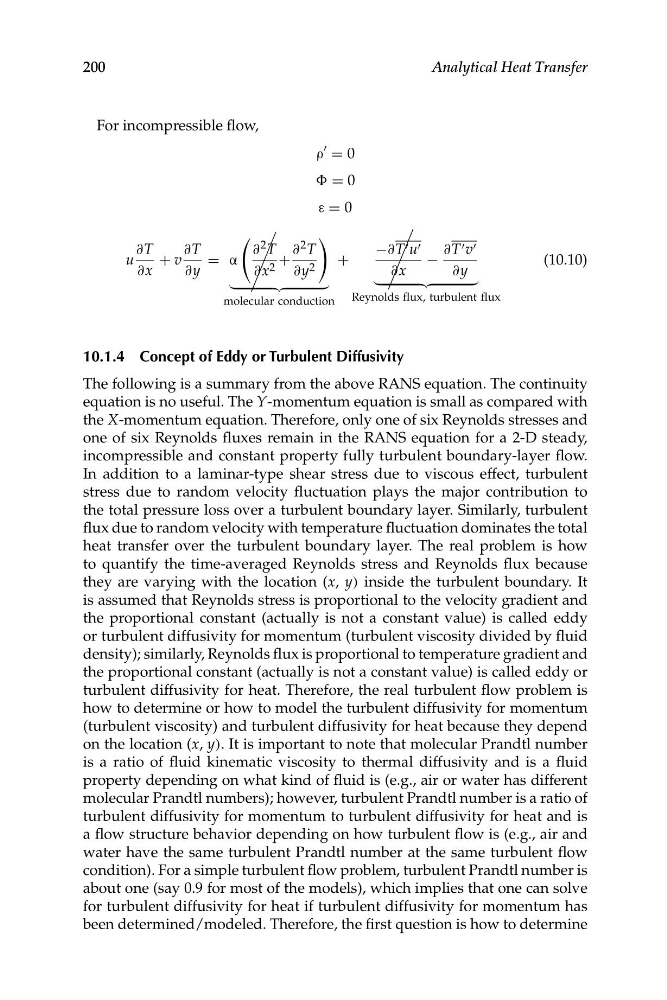
For incompressible flow,
"
ρ = 0
Φ = 0
ε = 0
10.1.4 Concept of Eddy or Turbulent Diffusivity
The following is a summary from the above RANS equation. The continuity
equation is no useful. The Y-momentum equation is small as compared with
the X-momentum equation. Therefore, only one of six Reynolds stresses and
one of six Reynolds fluxes remain in the RANS equation for a 2-D steady,
incompressible and constant property fully turbulent boundary-layer flow.
In addition to a laminar-type shear stress due to viscous effect, turbulent
stress due to random velocity fluctuation plays the major contribution to
the total pressure loss over a turbulent boundary layer. Similarly, turbulent
flux due to random velocity with temperature fluctuation dominates the total
heat transfer over the turbulent boundary layer. The real problem is how
to quantify the time-averaged Reynolds stress and Reynolds flux because
they are varying with the location (x, y) inside the turbulent boundary. It
is assumed that Reynolds stress is proportional to the velocity gradient and
the proportional constant (actually is not a constant value) is called eddy
or turbulent diffusivity for momentum (turbulent viscosity divided by fluid
density); similarly, Reynolds flux is proportional to temperature gradient and
the proportional constant (actually is not a constant value) is called eddy or
turbulent diffusivity for heat. Therefore, the real turbulent flow problem is
how to determine or how to model the turbulent diffusivity for momentum
(turbulent viscosity) and turbulent diffusivity for heat because they depend
on the location (x, y). It is important to note that molecular Prandtl number
is a ratio of fluid kinematic viscosity to thermal diffusivity and is a fluid
property depending on what kind of fluid is (e.g., air or water has different
molecular Prandtl numbers); however, turbulent Prandtl number is a ratio of
turbulent diffusivity for momentum to turbulent diffusivity for heat and is
a flow structure behavior depending on how turbulent flow is (e.g., air and
water have the same turbulent Prandtl number at the same turbulent flow
condition). For a simple turbulent flow problem, turbulent Prandtl number is
about one (say 0.9 for most of the models), which implies that one can solve
for turbulent diffusivity for heat if turbulent diffusivity for momentum has
been determined/modeled. Therefore, the first question is how to determine
Analytical Heat Transfer
For incompressible flow,
"
ρ = 0
Φ = 0
ε = 0
10.1.4 Concept of Eddy or Turbulent Diffusivity
The following is a summary from the above RANS equation. The continuity
equation is no useful. The Y-momentum equation is small as compared with
the X-momentum equation. Therefore, only one of six Reynolds stresses and
one of six Reynolds fluxes remain in the RANS equation for a 2-D steady,
incompressible and constant property fully turbulent boundary-layer flow.
In addition to a laminar-type shear stress due to viscous effect, turbulent
stress due to random velocity fluctuation plays the major contribution to
the total pressure loss over a turbulent boundary layer. Similarly, turbulent
flux due to random velocity with temperature fluctuation dominates the total
heat transfer over the turbulent boundary layer. The real problem is how
to quantify the time-averaged Reynolds stress and Reynolds flux because
they are varying with the location (x, y) inside the turbulent boundary. It
is assumed that Reynolds stress is proportional to the velocity gradient and
the proportional constant (actually is not a constant value) is called eddy
or turbulent diffusivity for momentum (turbulent viscosity divided by fluid
density); similarly, Reynolds flux is proportional to temperature gradient and
the proportional constant (actually is not a constant value) is called eddy or
turbulent diffusivity for heat. Therefore, the real turbulent flow problem is
how to determine or how to model the turbulent diffusivity for momentum
(turbulent viscosity) and turbulent diffusivity for heat because they depend
on the location (x, y). It is important to note that molecular Prandtl number
is a ratio of fluid kinematic viscosity to thermal diffusivity and is a fluid
property depending on what kind of fluid is (e.g., air or water has different
molecular Prandtl numbers); however, turbulent Prandtl number is a ratio of
turbulent diffusivity for momentum to turbulent diffusivity for heat and is
a flow structure behavior depending on how turbulent flow is (e.g., air and
water have the same turbulent Prandtl number at the same turbulent flow
condition). For a simple turbulent flow problem, turbulent Prandtl number is
about one (say 0.9 for most of the models), which implies that one can solve
for turbulent diffusivity for heat if turbulent diffusivity for momentum has
been determined/modeled. Therefore, the first question is how to determine