

PROBLEMS
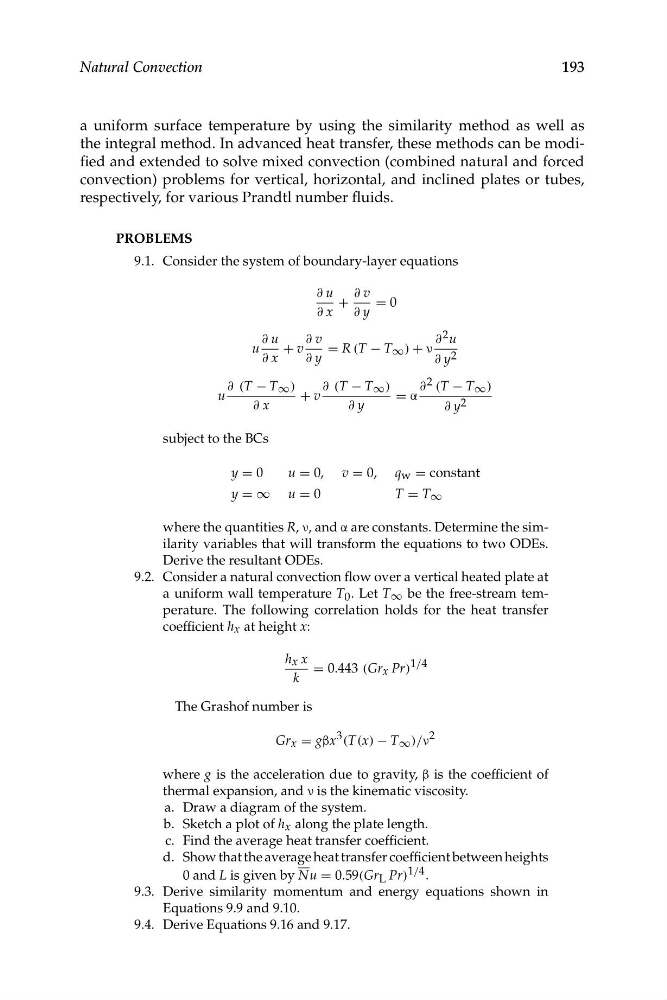
9.1. Consider the system of boundary-layer equations
∂ u ∂ v
+
= 0
∂ x
∂ y
∂ u
∂ v
∂ 2 u
u
+ v
= R (T − T ∞ ) + ν
∂ x
∂ y
∂ y 2
∂ (T − T ∞ )
∂ (T − T ∞ )
∂ 2 (T − T ∞ )
u
+ v
= α
∂ x
∂ y
∂ y 2
subject to the BCs
y = 0
u = 0, v = 0, q w = constant
y = ∞ u = 0
T = T ∞
where the quantities R, ν, and α are constants. Determine the similarity variables that will transform the equations to two ODEs.
Derive the resultant ODEs.
9.2. Consider a natural convection flow over a vertical heated plate at
a uniform wall temperature T 0 . Let T ∞ be the free-stream temperature. The following correlation holds for the heat transfer
coefficient h x at height x:
h x x
1/4
= 0.443 (Gr x Pr)
k
The Grashof number is
Gr x = gβx 3 (T(x) − T ∞ )/ν 2
where g is the acceleration due to gravity, β is the coefficient of
thermal expansion, and ν is the kinematic viscosity.
a. Draw a diagram of the system.
b. Sketch a plot of h x along the plate length.
c. Find the average heat transfer coefficient.
d. Show that the average heat transfer coefficient between heights
0 and L is given by Nu = 0.59(Gr L Pr) 1/4 .
9.3. Derive similarity momentum and energy equations shown in
Equations 9.9 and 9.10.
9.4. Derive Equations 9.16 and 9.17.
193
Natural Convection
a uniform surface temperature by using the similarity method as well as
the integral method. In advanced heat transfer, these methods can be modified and extended to solve mixed convection (combined natural and forced
convection) problems for vertical, horizontal, and inclined plates or tubes,
respectively, for various Prandtl number fluids.
9.1. Consider the system of boundary-layer equations
∂ u ∂ v
+
= 0
∂ x
∂ y
∂ u
∂ v
∂ 2 u
u
+ v
= R (T − T ∞ ) + ν
∂ x
∂ y
∂ y 2
∂ (T − T ∞ )
∂ (T − T ∞ )
∂ 2 (T − T ∞ )
u
+ v
= α
∂ x
∂ y
∂ y 2
subject to the BCs
y = 0
u = 0, v = 0, q w = constant
y = ∞ u = 0
T = T ∞
where the quantities R, ν, and α are constants. Determine the similarity variables that will transform the equations to two ODEs.
Derive the resultant ODEs.
9.2. Consider a natural convection flow over a vertical heated plate at
a uniform wall temperature T 0 . Let T ∞ be the free-stream temperature. The following correlation holds for the heat transfer
coefficient h x at height x:
h x x
1/4
= 0.443 (Gr x Pr)
k
The Grashof number is
Gr x = gβx 3 (T(x) − T ∞ )/ν 2
where g is the acceleration due to gravity, β is the coefficient of
thermal expansion, and ν is the kinematic viscosity.
a. Draw a diagram of the system.
b. Sketch a plot of h x along the plate length.
c. Find the average heat transfer coefficient.
d. Show that the average heat transfer coefficient between heights
0 and L is given by Nu = 0.59(Gr L Pr) 1/4 .
9.3. Derive similarity momentum and energy equations shown in
Equations 9.9 and 9.10.
9.4. Derive Equations 9.16 and 9.17.
193
Natural Convection
a uniform surface temperature by using the similarity method as well as
the integral method. In advanced heat transfer, these methods can be modified and extended to solve mixed convection (combined natural and forced
convection) problems for vertical, horizontal, and inclined plates or tubes,
respectively, for various Prandtl number fluids.