

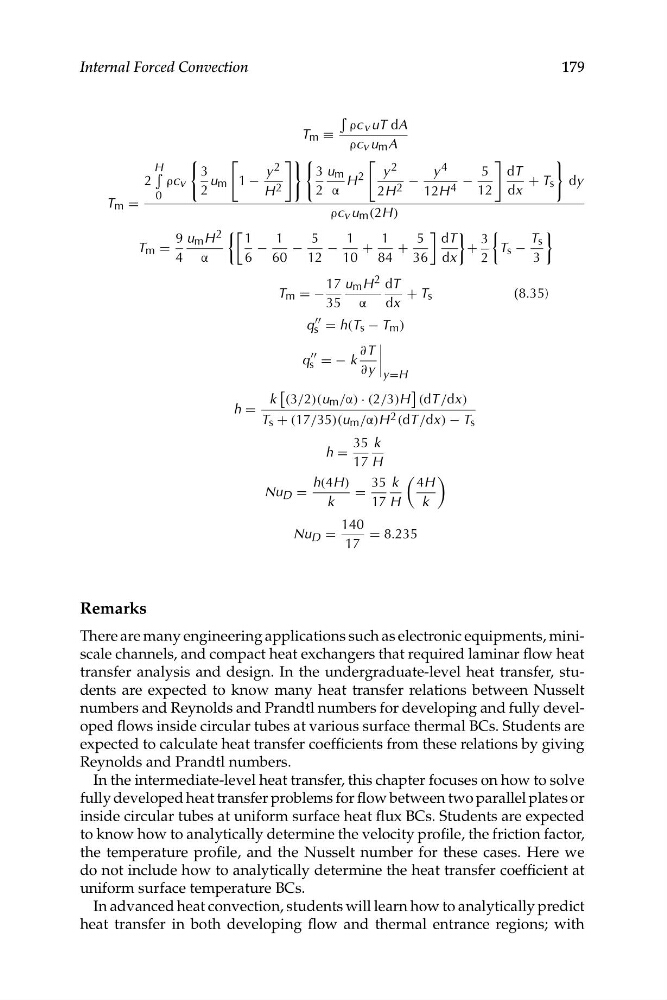
�
{�
�
�
{
�
""
�
�
�
�
ρc v uT dA
T m ≡ ρc v u m A
�
�
�� �
�
�
�
H
2
2
4
�
3
y
3 u m
y
y
5 dT
2 ρc v
u m 1 −
H 2
−
−
+ T s dy
2
H 2
2 α
2H 2
12H 4
12 dx
0
T m =
ρc v u m (2H)
9 u m H 2
1
1
5
1
1
5 dT
3
T s
T m =
−
−
−
+
+
+
T s −
4 α
6 60 12 10 84 36 dx
2
3
17 u m H 2 dT
T m = −
+ T s
(8.35)
35 α dx
""
q = h(T s − T m )
s
∂T �
q = − k
s
∂y �
y =H
[
]
k (3/2)(u m /α) · (2/3)H (dT /dx)
h =
T s + (17/35)(u m /α)H 2 (dT /dx) − T s
35 k
h = 17 H
h(4H)
35 k 4H
Nu D =
=
k
17 H
k
140
Nu D =
= 8.235
17
179
Internal Forced Convection
Remarks
There are many engineering applications such as electronic equipments, miniscale channels, and compact heat exchangers that required laminar flow heat
transfer analysis and design. In the undergraduate-level heat transfer, students are expected to know many heat transfer relations between Nusselt
numbers and Reynolds and Prandtl numbers for developing and fully developed flows inside circular tubes at various surface thermal BCs. Students are
expected to calculate heat transfer coefficients from these relations by giving
Reynolds and Prandtl numbers.
In the intermediate-level heat transfer, this chapter focuses on how to solve
fully developed heat transfer problems for flow between two parallel plates or
inside circular tubes at uniform surface heat flux BCs. Students are expected
to know how to analytically determine the velocity profile, the friction factor,
the temperature profile, and the Nusselt number for these cases. Here we
do not include how to analytically determine the heat transfer coefficient at
uniform surface temperature BCs.
In advanced heat convection, students will learn how to analytically predict
heat transfer in both developing flow and thermal entrance regions; with
{�
�
�
{
�
""
�
�
�
�
ρc v uT dA
T m ≡ ρc v u m A
�
�
�� �
�
�
�
H
2
2
4
�
3
y
3 u m
y
y
5 dT
2 ρc v
u m 1 −
H 2
−
−
+ T s dy
2
H 2
2 α
2H 2
12H 4
12 dx
0
T m =
ρc v u m (2H)
9 u m H 2
1
1
5
1
1
5 dT
3
T s
T m =
−
−
−
+
+
+
T s −
4 α
6 60 12 10 84 36 dx
2
3
17 u m H 2 dT
T m = −
+ T s
(8.35)
35 α dx
""
q = h(T s − T m )
s
∂T �
q = − k
s
∂y �
y =H
[
]
k (3/2)(u m /α) · (2/3)H (dT /dx)
h =
T s + (17/35)(u m /α)H 2 (dT /dx) − T s
35 k
h = 17 H
h(4H)
35 k 4H
Nu D =
=
k
17 H
k
140
Nu D =
= 8.235
17
179
Internal Forced Convection
Remarks
There are many engineering applications such as electronic equipments, miniscale channels, and compact heat exchangers that required laminar flow heat
transfer analysis and design. In the undergraduate-level heat transfer, students are expected to know many heat transfer relations between Nusselt
numbers and Reynolds and Prandtl numbers for developing and fully developed flows inside circular tubes at various surface thermal BCs. Students are
expected to calculate heat transfer coefficients from these relations by giving
Reynolds and Prandtl numbers.
In the intermediate-level heat transfer, this chapter focuses on how to solve
fully developed heat transfer problems for flow between two parallel plates or
inside circular tubes at uniform surface heat flux BCs. Students are expected
to know how to analytically determine the velocity profile, the friction factor,
the temperature profile, and the Nusselt number for these cases. Here we
do not include how to analytically determine the heat transfer coefficient at
uniform surface temperature BCs.
In advanced heat convection, students will learn how to analytically predict
heat transfer in both developing flow and thermal entrance regions; with