

�
�
�
�
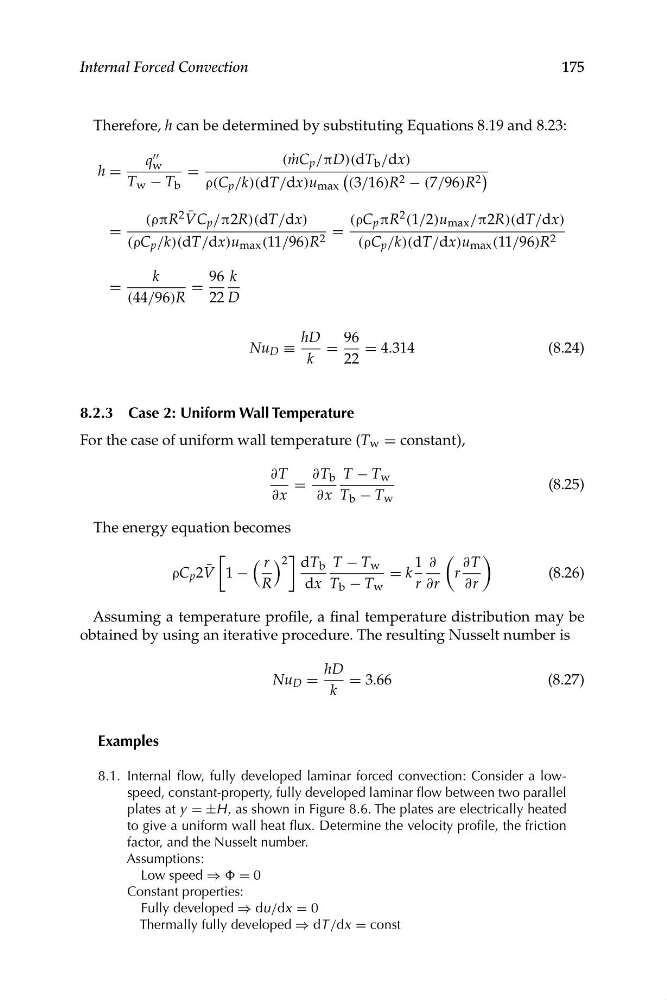
Therefore, h can be determined by substituting Equations 8.19 and 8.23:
""
mC p /πD)(dT b /dx)
q
( ˙
w
h =
=
(
T w − T b
ρ(C p /k)(dT/dx)u max (3/16)R 2 − (7/96)R 2
)
(ρπR 2 ¯
(ρC p πR 2 (1/2)u max /π2R)(dT/dx)
VC p /π2R)(dT/dx)
=
=
(ρC p /k)(dT/dx)u max (11/96)R 2
(ρC p /k)(dT/dx)u max (11/96)R 2
k
96 k
=
=
(44/96)R
22 D
hD
96
Nu D ≡
=
= 4.314
(8.24)
k
22
8.2.3 Case 2: Uniform Wall Temperature
For the case of uniform wall temperature (T w = constant),
∂T
∂T b T − T w
=
(8.25)
∂x
∂x T b − T w
The energy equation becomes
( ) 2
r
dT b T − T w
1 ∂
∂T
ρC p 2V ¯ 1 −
= k
r
(8.26)
R
dx T b − T w
r ∂r
∂r
Assuming a temperature profile, a final temperature distribution may be
obtained by using an iterative procedure. The resulting Nusselt number is
hD
Nu D =
= 3.66
(8.27)
k
175
Internal Forced Convection
Examples
8.1. Internal flow, fully developed laminar forced convection: Consider a lowspeed, constant-property, fully developed laminar flow between two parallel
plates at y = ±H, as shown in Figure 8.6. The plates are electrically heated
to give a uniform wall heat flux. Determine the velocity profile, the friction
factor, and the Nusselt number.
Assumptions:
Low speed ⇒ Φ = 0
Constant properties:
Fully developed ⇒ du/dx = 0
Thermally fully developed ⇒ dT /dx = const
�
�
�
Therefore, h can be determined by substituting Equations 8.19 and 8.23:
""
mC p /πD)(dT b /dx)
q
( ˙
w
h =
=
(
T w − T b
ρ(C p /k)(dT/dx)u max (3/16)R 2 − (7/96)R 2
)
(ρπR 2 ¯
(ρC p πR 2 (1/2)u max /π2R)(dT/dx)
VC p /π2R)(dT/dx)
=
=
(ρC p /k)(dT/dx)u max (11/96)R 2
(ρC p /k)(dT/dx)u max (11/96)R 2
k
96 k
=
=
(44/96)R
22 D
hD
96
Nu D ≡
=
= 4.314
(8.24)
k
22
8.2.3 Case 2: Uniform Wall Temperature
For the case of uniform wall temperature (T w = constant),
∂T
∂T b T − T w
=
(8.25)
∂x
∂x T b − T w
The energy equation becomes
( ) 2
r
dT b T − T w
1 ∂
∂T
ρC p 2V ¯ 1 −
= k
r
(8.26)
R
dx T b − T w
r ∂r
∂r
Assuming a temperature profile, a final temperature distribution may be
obtained by using an iterative procedure. The resulting Nusselt number is
hD
Nu D =
= 3.66
(8.27)
k
175
Internal Forced Convection
Examples
8.1. Internal flow, fully developed laminar forced convection: Consider a lowspeed, constant-property, fully developed laminar flow between two parallel
plates at y = ±H, as shown in Figure 8.6. The plates are electrically heated
to give a uniform wall heat flux. Determine the velocity profile, the friction
factor, and the Nusselt number.
Assumptions:
Low speed ⇒ Φ = 0
Constant properties:
Fully developed ⇒ du/dx = 0
Thermally fully developed ⇒ dT /dx = const