

�
�
� �
� �
� �
� �
3
u = a + by + cy 2 + dy
3
T = a + by + cy 2 + dy
2
2
y = 0 u = 0
∂ 2 u/∂y = 0 T = T w ∂ 2 T /∂y = 0
y = δ u = U ∞ ∂u/∂y = 0
T = T ∞ ∂T /∂y = 0
( )
( ) 3
u − 0
3 y
1 y
u
=
−
=
U ∞ − 0
2 δ
2 δ
U ∞
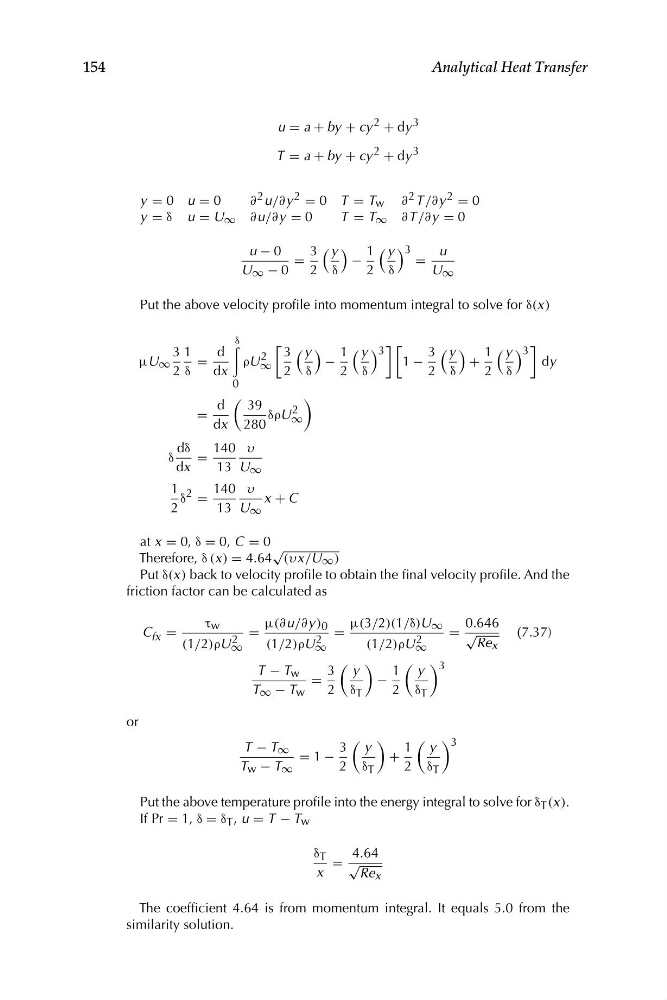
Put the above velocity profile into momentum integral to solve for δ(x)
� δ
� ( )
( ) 3
� �
( )
( ) 3
�
3 1
d
3 y
1 y
3 y
1 y
μU ∞
=
ρU 2
−
1 −
+
dy
∞
2 δ
dx
2 δ
2 δ
2 δ
2 δ
0
d
39
=
δρU 2
∞
dx 280
dδ
140 υ
δ
=
dx
13 U ∞
1
140 υ
2
δ =
x + C
2
13 U ∞
at x = 0, δ = 0, C = 0 √
Therefore, δ (x) = 4.64 (υx/U ∞ )
Put δ(x) back to velocity profile to obtain the final velocity profile. And the
friction factor can be calculated as
τ w
μ(∂u/∂y ) 0
μ(3/2)(1/δ)U ∞
0.646
=
=
=
= √
(7.37)
C fx
(1/2)ρU 2
(1/2)ρU 2
(1/2)ρU 2
Re x
∞
∞
∞
T − T w
3 y
1 y
3
=
−
T ∞ − T w
2 δ T
2 δ T
or
T − T ∞
3 y
1 y
3
= 1 −
+
T w − T ∞
2 δ T
2 δ T
Put the above temperature profile into the energy integral to solve for δ T (x).
If Pr = 1, δ = δ T , u = T − T w
δ T
4.64
= √
x
Re x
The coefficient 4.64 is from momentum integral. It equals 5.0 from the
similarity solution.
154
Analytical Heat Transfer
�
� �
� �
� �
� �
3
u = a + by + cy 2 + dy
3
T = a + by + cy 2 + dy
2
2
y = 0 u = 0
∂ 2 u/∂y = 0 T = T w ∂ 2 T /∂y = 0
y = δ u = U ∞ ∂u/∂y = 0
T = T ∞ ∂T /∂y = 0
( )
( ) 3
u − 0
3 y
1 y
u
=
−
=
U ∞ − 0
2 δ
2 δ
U ∞
Put the above velocity profile into momentum integral to solve for δ(x)
� δ
� ( )
( ) 3
� �
( )
( ) 3
�
3 1
d
3 y
1 y
3 y
1 y
μU ∞
=
ρU 2
−
1 −
+
dy
∞
2 δ
dx
2 δ
2 δ
2 δ
2 δ
0
d
39
=
δρU 2
∞
dx 280
dδ
140 υ
δ
=
dx
13 U ∞
1
140 υ
2
δ =
x + C
2
13 U ∞
at x = 0, δ = 0, C = 0 √
Therefore, δ (x) = 4.64 (υx/U ∞ )
Put δ(x) back to velocity profile to obtain the final velocity profile. And the
friction factor can be calculated as
τ w
μ(∂u/∂y ) 0
μ(3/2)(1/δ)U ∞
0.646
=
=
=
= √
(7.37)
C fx
(1/2)ρU 2
(1/2)ρU 2
(1/2)ρU 2
Re x
∞
∞
∞
T − T w
3 y
1 y
3
=
−
T ∞ − T w
2 δ T
2 δ T
or
T − T ∞
3 y
1 y
3
= 1 −
+
T w − T ∞
2 δ T
2 δ T
Put the above temperature profile into the energy integral to solve for δ T (x).
If Pr = 1, δ = δ T , u = T − T w
δ T
4.64
= √
x
Re x
The coefficient 4.64 is from momentum integral. It equals 5.0 from the
similarity solution.
154
Analytical Heat Transfer