

∂Ψ
u =
(7.1)
∂y
∂Ψ
v = −
(7.2)
∂x
The continuity equation is automatically satisfied.
∂
∂x
�
∂Ψ
∂y
�
+
∂
∂y
�
−
∂Ψ
∂x
�
= 0
The x-momentum equation becomes
∂Ψ
∂y
�
∂ 2 Ψ
∂x∂y
�
−
∂Ψ
∂x
∂ 2 Ψ
∂y 2 = υ
�
∂ 3 Ψ
∂y 3
�
Ψ(x, y) ⇒ Ψ(η)
(7.3)
(7.4)
141
7
External Forced Convection
7.1 Laminar Flow and Heat Transfer over a Flat Surface:
Similarity Solution
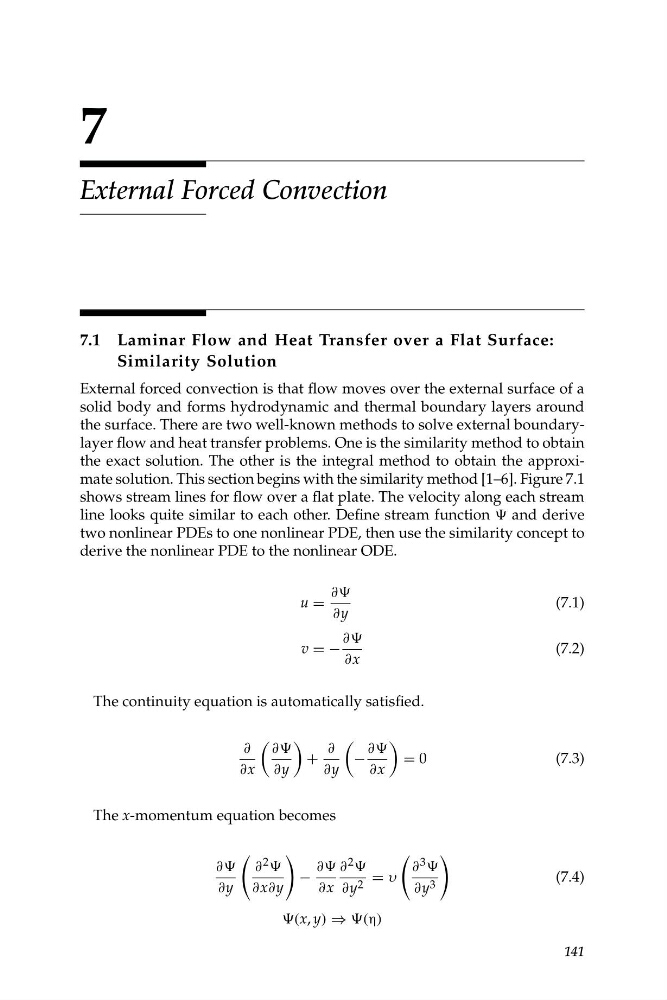
External forced convection is that flow moves over the external surface of a
solid body and forms hydrodynamic and thermal boundary layers around
the surface. There are two well-known methods to solve external boundarylayer flow and heat transfer problems. One is the similarity method to obtain
the exact solution. The other is the integral method to obtain the approximate solution. This section begins with the similarity method [1–6]. Figure 7.1
shows stream lines for flow over a flat plate. The velocity along each stream
line looks quite similar to each other. Define stream function Ψ and derive
two nonlinear PDEs to one nonlinear PDE, then use the similarity concept to
derive the nonlinear PDE to the nonlinear ODE.
u =
(7.1)
∂y
∂Ψ
v = −
(7.2)
∂x
The continuity equation is automatically satisfied.
∂
∂x
�
∂Ψ
∂y
�
+
∂
∂y
�
−
∂Ψ
∂x
�
= 0
The x-momentum equation becomes
∂Ψ
∂y
�
∂ 2 Ψ
∂x∂y
�
−
∂Ψ
∂x
∂ 2 Ψ
∂y 2 = υ
�
∂ 3 Ψ
∂y 3
�
Ψ(x, y) ⇒ Ψ(η)
(7.3)
(7.4)
141
7
External Forced Convection
7.1 Laminar Flow and Heat Transfer over a Flat Surface:
Similarity Solution
External forced convection is that flow moves over the external surface of a
solid body and forms hydrodynamic and thermal boundary layers around
the surface. There are two well-known methods to solve external boundarylayer flow and heat transfer problems. One is the similarity method to obtain
the exact solution. The other is the integral method to obtain the approximate solution. This section begins with the similarity method [1–6]. Figure 7.1
shows stream lines for flow over a flat plate. The velocity along each stream
line looks quite similar to each other. Define stream function Ψ and derive
two nonlinear PDEs to one nonlinear PDE, then use the similarity concept to
derive the nonlinear PDE to the nonlinear ODE.