

Velocity or thermal
boundary layer
Air flow
T ∞
Heated surface, A s
U ∞ T ∞
U ∞
q′
T s
x
�
�
�
2
Analytical Heat Transfer
x
T
T 1
T 2
A c
L
q"
FIGURE 1.1
1-D heat conduction through a building or container wall.
1.1.2 Convection
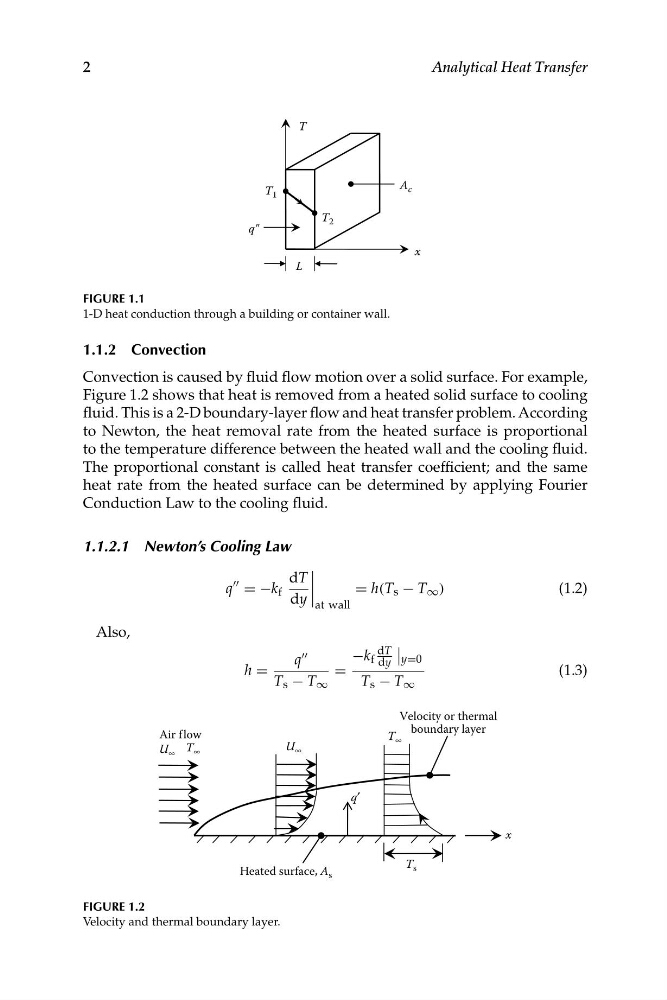
Convection is caused by fluid flow motion over a solid surface. For example,
Figure 1.2 shows that heat is removed from a heated solid surface to cooling
fluid. This is a 2-D boundary-layer flow and heat transfer problem. According
to Newton, the heat removal rate from the heated surface is proportional
to the temperature difference between the heated wall and the cooling fluid.
The proportional constant is called heat transfer coefficient; and the same
heat rate from the heated surface can be determined by applying Fourier
Conduction Law to the cooling fluid.
1.1.2.1 Newton’s Cooling Law
q
""
= −k f
d
d
T
y
�
�
= h(T s − T ∞ )
(1.2)
at wall
Also,
dT �
""
−k f
y=0
q
dy
h =
=
(1.3)
T s − T ∞
T s − T ∞
FIGURE 1.2
Velocity and thermal boundary layer.
boundary layer
Air flow
T ∞
Heated surface, A s
U ∞ T ∞
U ∞
q′
T s
x
�
�
�
2
Analytical Heat Transfer
x
T
T 1
T 2
A c
L
q"
FIGURE 1.1
1-D heat conduction through a building or container wall.
1.1.2 Convection
Convection is caused by fluid flow motion over a solid surface. For example,
Figure 1.2 shows that heat is removed from a heated solid surface to cooling
fluid. This is a 2-D boundary-layer flow and heat transfer problem. According
to Newton, the heat removal rate from the heated surface is proportional
to the temperature difference between the heated wall and the cooling fluid.
The proportional constant is called heat transfer coefficient; and the same
heat rate from the heated surface can be determined by applying Fourier
Conduction Law to the cooling fluid.
1.1.2.1 Newton’s Cooling Law
q
""
= −k f
d
d
T
y
�
�
= h(T s − T ∞ )
(1.2)
at wall
Also,
dT �
""
−k f
y=0
q
dy
h =
=
(1.3)
T s − T ∞
T s − T ∞
FIGURE 1.2
Velocity and thermal boundary layer.