

Pr > 1
Laminar
flow
Turbulent
flow
Transition
U ∞
w
"
h
q
0
x
δ
δ
δ T
δ T
Pr < 1
129
Heat Convection Equations
It is noted that heat flux is proportional to the heat transfer coefficient
and temperature difference between the free-stream and the surface. The
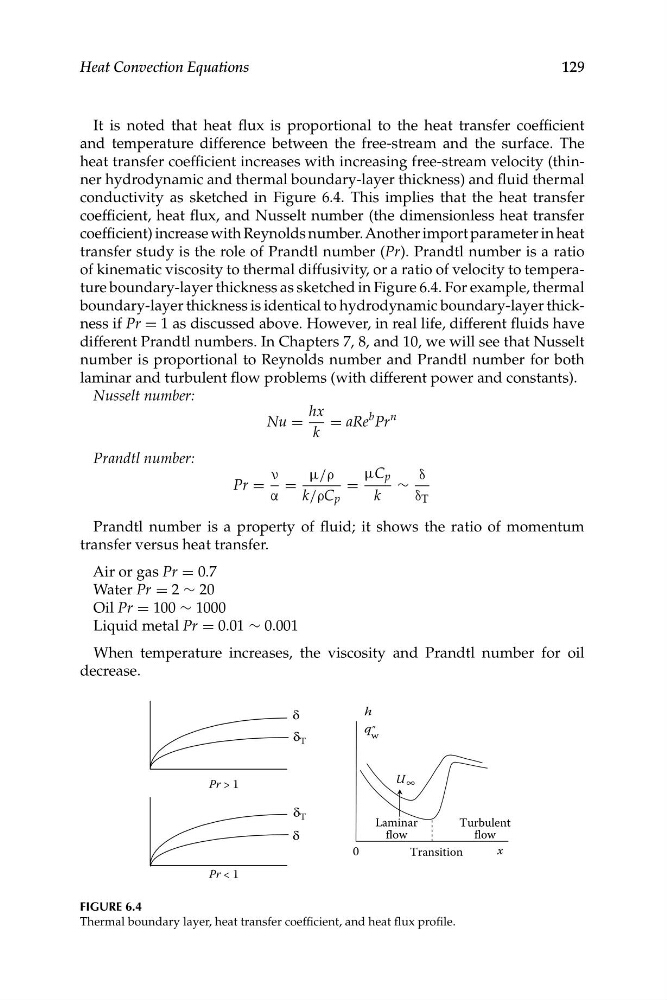
heat transfer coefficient increases with increasing free-stream velocity (thinner hydrodynamic and thermal boundary-layer thickness) and fluid thermal
conductivity as sketched in Figure 6.4. This implies that the heat transfer
coefficient, heat flux, and Nusselt number (the dimensionless heat transfer
coefficient) increase with Reynolds number. Another import parameter in heat
transfer study is the role of Prandtl number (Pr). Prandtl number is a ratio
of kinematic viscosity to thermal diffusivity, or a ratio of velocity to temperature boundary-layer thickness as sketched in Figure 6.4. For example, thermal
boundary-layer thickness is identical to hydrodynamic boundary-layer thickness if Pr = 1 as discussed above. However, in real life, different fluids have
different Prandtl numbers. In Chapters 7, 8, and 10, we will see that Nusselt
number is proportional to Reynolds number and Prandtl number for both
laminar and turbulent flow problems (with different power and constants).
Nusselt number:
hx
Nu =
= aRe
b Pr
n
k
Prandtl number:
ν
μ/ρ
μC p
δ
Pr = =
=
∼
α
k/ρC p
k
δ T
Prandtl number is a property of fluid; it shows the ratio of momentum
transfer versus heat transfer.
Air or gas Pr = 0.7
Water Pr = 2 ∼ 20
Oil Pr = 100 ∼ 1000
Liquid metal Pr = 0.01 ∼ 0.001
When temperature increases, the viscosity and Prandtl number for oil
decrease.
FIGURE 6.4
Thermal boundary layer, heat transfer coefficient, and heat flux profile.
Laminar
flow
Turbulent
flow
Transition
U ∞
w
"
h
q
0
x
δ
δ
δ T
δ T
Pr < 1
129
Heat Convection Equations
It is noted that heat flux is proportional to the heat transfer coefficient
and temperature difference between the free-stream and the surface. The
heat transfer coefficient increases with increasing free-stream velocity (thinner hydrodynamic and thermal boundary-layer thickness) and fluid thermal
conductivity as sketched in Figure 6.4. This implies that the heat transfer
coefficient, heat flux, and Nusselt number (the dimensionless heat transfer
coefficient) increase with Reynolds number. Another import parameter in heat
transfer study is the role of Prandtl number (Pr). Prandtl number is a ratio
of kinematic viscosity to thermal diffusivity, or a ratio of velocity to temperature boundary-layer thickness as sketched in Figure 6.4. For example, thermal
boundary-layer thickness is identical to hydrodynamic boundary-layer thickness if Pr = 1 as discussed above. However, in real life, different fluids have
different Prandtl numbers. In Chapters 7, 8, and 10, we will see that Nusselt
number is proportional to Reynolds number and Prandtl number for both
laminar and turbulent flow problems (with different power and constants).
Nusselt number:
hx
Nu =
= aRe
b Pr
n
k
Prandtl number:
ν
μ/ρ
μC p
δ
Pr = =
=
∼
α
k/ρC p
k
δ T
Prandtl number is a property of fluid; it shows the ratio of momentum
transfer versus heat transfer.
Air or gas Pr = 0.7
Water Pr = 2 ∼ 20
Oil Pr = 100 ∼ 1000
Liquid metal Pr = 0.01 ∼ 0.001
When temperature increases, the viscosity and Prandtl number for oil
decrease.
FIGURE 6.4
Thermal boundary layer, heat transfer coefficient, and heat flux profile.