

y
T a
x
T ∞ , h
1
2
3
4
5
6
7
8
9
T ∞ , h
T b
119
Numerical Analysis in Heat Conduction
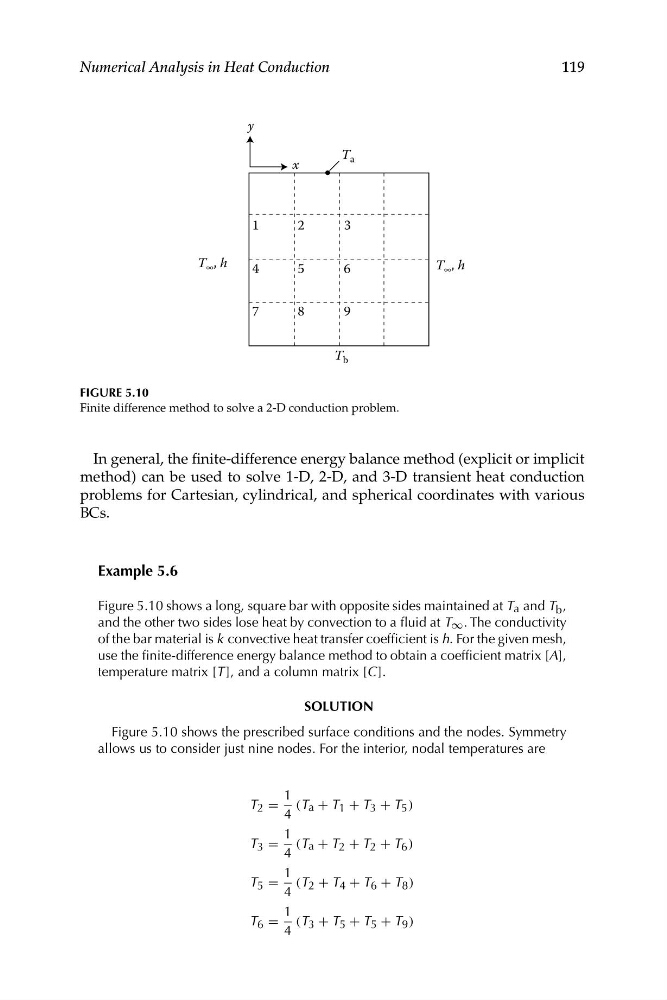
FIGURE 5.10
Finite difference method to solve a 2-D conduction problem.
In general, the finite-difference energy balance method (explicit or implicit
method) can be used to solve 1-D, 2-D, and 3-D transient heat conduction
problems for Cartesian, cylindrical, and spherical coordinates with various
BCs.
Example 5.6
Figure 5.10 shows a long, square bar with opposite sides maintained at T a and T b ,
and the other two sides lose heat by convection to a fluid at T ∞ . The conductivity
of the bar material is k convective heat transfer coefficient is h. For the given mesh,
use the finite-difference energy balance method to obtain a coefficient matrix [A],
temperature matrix [T ], and a column matrix [C ].
SOLUTION
Figure 5.10 shows the prescribed surface conditions and the nodes. Symmetry
allows us to consider just nine nodes. For the interior, nodal temperatures are
1
T 2 = (T a + T 1 + T 3 + T 5 )
4
1
T 3 = (T a + T 2 + T 2 + T 6 )
4
1
T 5 = (T 2 + T 4 + T 6 + T 8 )
4
1
T 6 = (T 3 + T 5 + T 5 + T 9 )
4
T a
x
T ∞ , h
1
2
3
4
5
6
7
8
9
T ∞ , h
T b
119
Numerical Analysis in Heat Conduction
FIGURE 5.10
Finite difference method to solve a 2-D conduction problem.
In general, the finite-difference energy balance method (explicit or implicit
method) can be used to solve 1-D, 2-D, and 3-D transient heat conduction
problems for Cartesian, cylindrical, and spherical coordinates with various
BCs.
Example 5.6
Figure 5.10 shows a long, square bar with opposite sides maintained at T a and T b ,
and the other two sides lose heat by convection to a fluid at T ∞ . The conductivity
of the bar material is k convective heat transfer coefficient is h. For the given mesh,
use the finite-difference energy balance method to obtain a coefficient matrix [A],
temperature matrix [T ], and a column matrix [C ].
SOLUTION
Figure 5.10 shows the prescribed surface conditions and the nodes. Symmetry
allows us to consider just nine nodes. For the interior, nodal temperatures are
1
T 2 = (T a + T 1 + T 3 + T 5 )
4
1
T 3 = (T a + T 2 + T 2 + T 6 )
4
1
T 5 = (T 2 + T 4 + T 6 + T 8 )
4
1
T 6 = (T 3 + T 5 + T 5 + T 9 )
4