

Outer
Inner
membrane
(∼nm)
membrane
(∼nm)
I 5 , A 5
I 1
I 2
I 4
I 1 , A 1
I , A
I 6 , A 6
I 2 , A 2
I 4 , A 4
j = 0, 1, 2...m
i = 0, 1, 2...n
Δθ
Δr
E 0
4
4
80
Electromagnetic Fields in Biological Systems
Data on the dielectric constants and conductivities of cell membranes and cytoplasm,
as well as other organelles (e.g., nuclear membrane and nucleoplasm), required for theoretical analyses have been obtained using dielectric spectroscopy of cells (Ermolina et al.
2001; Feldman, Ermolina, and Hayashi 2003). Aspects pertaining to dielectric spectroscopy are briefly in Section 2.6. The availability of cell parameters enables such distributed circuit computations. Typical values for the plasma membrane of mammalian cells
(e.g., B- or T-lymphocyte cells) are the relative permittivities on the order of 10 and
conductivities of approximately 10 −5 S/m. For the cytoplasm, the relative permittivity is
approximately that of water (i.e., 80), and the conductivity is typically one-fifth that of
seawater (i.e., ∼1 S/m).
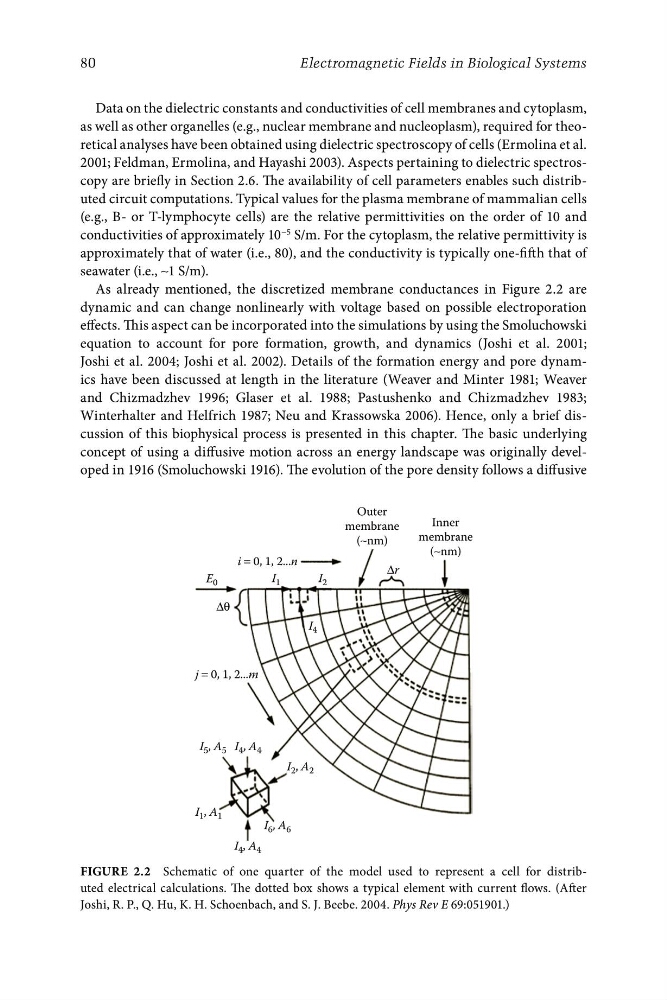
As already mentioned, the discretized membrane conductances in Figure 2.2 are
dynamic and can change nonlinearly with voltage based on possible electroporation
effects. This aspect can be incorporated into the simulations by using the Smoluchowski
equation to account for pore formation, growth, and dynamics (Joshi et al. 2001;
Joshi et al. 2004; Joshi et al. 2002). Details of the formation energy and pore dynamics have been discussed at length in the literature (Weaver and Minter 1981; Weaver
and Chizmadzhev 1996; Glaser et al. 1988; Pastushenko and Chizmadzhev 1983;
Winterhalter and Helfrich 1987; Neu and Krassowska 2006). Hence, only a brief discussion of this biophysical process is presented in this chapter. The basic underlying
concept of using a diffusive motion across an energy landscape was originally developed in 1916 (Smoluchowski 1916). The evolution of the pore density follows a diffusive
Figure 2.2 Schematic of one quarter of the model used to represent a cell for distributed electrical calculations. The dotted box shows a typical element with current flows. (After
Joshi, R. P., Q. Hu, K. H. Schoenbach, and S. J. Beebe. 2004. Phys Rev E 69:051901.)
Inner
membrane
(∼nm)
membrane
(∼nm)
I 5 , A 5
I 1
I 2
I 4
I 1 , A 1
I , A
I 6 , A 6
I 2 , A 2
I 4 , A 4
j = 0, 1, 2...m
i = 0, 1, 2...n
Δθ
Δr
E 0
4
4
80
Electromagnetic Fields in Biological Systems
Data on the dielectric constants and conductivities of cell membranes and cytoplasm,
as well as other organelles (e.g., nuclear membrane and nucleoplasm), required for theoretical analyses have been obtained using dielectric spectroscopy of cells (Ermolina et al.
2001; Feldman, Ermolina, and Hayashi 2003). Aspects pertaining to dielectric spectroscopy are briefly in Section 2.6. The availability of cell parameters enables such distributed circuit computations. Typical values for the plasma membrane of mammalian cells
(e.g., B- or T-lymphocyte cells) are the relative permittivities on the order of 10 and
conductivities of approximately 10 −5 S/m. For the cytoplasm, the relative permittivity is
approximately that of water (i.e., 80), and the conductivity is typically one-fifth that of
seawater (i.e., ∼1 S/m).
As already mentioned, the discretized membrane conductances in Figure 2.2 are
dynamic and can change nonlinearly with voltage based on possible electroporation
effects. This aspect can be incorporated into the simulations by using the Smoluchowski
equation to account for pore formation, growth, and dynamics (Joshi et al. 2001;
Joshi et al. 2004; Joshi et al. 2002). Details of the formation energy and pore dynamics have been discussed at length in the literature (Weaver and Minter 1981; Weaver
and Chizmadzhev 1996; Glaser et al. 1988; Pastushenko and Chizmadzhev 1983;
Winterhalter and Helfrich 1987; Neu and Krassowska 2006). Hence, only a brief discussion of this biophysical process is presented in this chapter. The basic underlying
concept of using a diffusive motion across an energy landscape was originally developed in 1916 (Smoluchowski 1916). The evolution of the pore density follows a diffusive
Figure 2.2 Schematic of one quarter of the model used to represent a cell for distributed electrical calculations. The dotted box shows a typical element with current flows. (After
Joshi, R. P., Q. Hu, K. H. Schoenbach, and S. J. Beebe. 2004. Phys Rev E 69:051901.)