

z (mA)
1.5
1.0
0.5
0.0
−0.5
−1.0
−1.5
Section through the eyes (height above the bottom
of the feet = 168.3 cm)
0
2
4
6
8
10 12 14 16 18 20
Time (ns)
(a)
Grounded man model with shoes
Ungrounded man model w/o shoes
Section through the bladder (height above the bottom
of the feet = 91.0 cm)
0
−4
z (mA)
−3
−2
−1
0
1
2
3
4
2
4
6
8
10 12 14 16 18 20
Grounded man model with shoes
Ungrounded man model w/o shoes
Time (ns)
55
Coupling of Electromagnetic Fields into Biological Systems
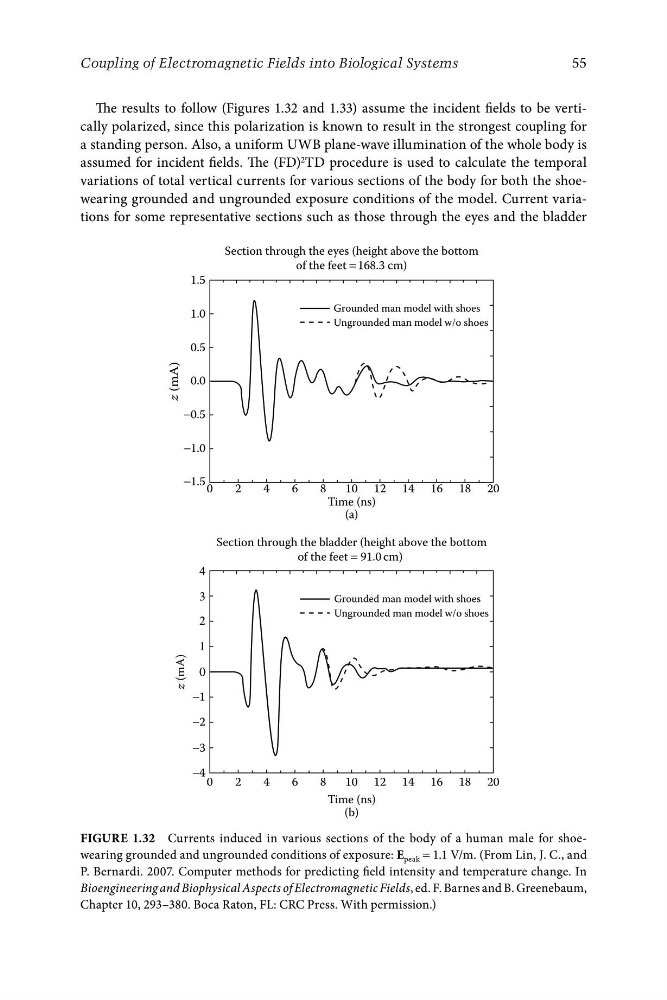
The results to follow (Figures 1.32 and 1.33) assume the incident fields to be vertically polarized, since this polarization is known to result in the strongest coupling for
a standing person. Also, a uniform UWB plane-wave illumination of the whole body is
assumed for incident fields. The (FD) 2 TD procedure is used to calculate the temporal
variations of total vertical currents for various sections of the body for both the shoewearing grounded and ungrounded exposure conditions of the model. Current variations for some representative sections such as those through the eyes and the bladder
(b)
FigurE 1.32 Currents induced in various sections of the body of a human male for shoewearing grounded and ungrounded conditions of exposure: E peak = 1.1 V/m. (From Lin, J. C., and
P. Bernardi. 2007. Computer methods for predicting field intensity and temperature change. In
Bioengineering and Biophysical Aspects of Electromagnetic Fields, ed. F. Barnes and B. Greenebaum,
Chapter 10, 293–380. Boca Raton, FL: CRC Press. With permission.)
1.5
1.0
0.5
0.0
−0.5
−1.0
−1.5
Section through the eyes (height above the bottom
of the feet = 168.3 cm)
0
2
4
6
8
10 12 14 16 18 20
Time (ns)
(a)
Grounded man model with shoes
Ungrounded man model w/o shoes
Section through the bladder (height above the bottom
of the feet = 91.0 cm)
0
−4
z (mA)
−3
−2
−1
0
1
2
3
4
2
4
6
8
10 12 14 16 18 20
Grounded man model with shoes
Ungrounded man model w/o shoes
Time (ns)
55
Coupling of Electromagnetic Fields into Biological Systems
The results to follow (Figures 1.32 and 1.33) assume the incident fields to be vertically polarized, since this polarization is known to result in the strongest coupling for
a standing person. Also, a uniform UWB plane-wave illumination of the whole body is
assumed for incident fields. The (FD) 2 TD procedure is used to calculate the temporal
variations of total vertical currents for various sections of the body for both the shoewearing grounded and ungrounded exposure conditions of the model. Current variations for some representative sections such as those through the eyes and the bladder
(b)
FigurE 1.32 Currents induced in various sections of the body of a human male for shoewearing grounded and ungrounded conditions of exposure: E peak = 1.1 V/m. (From Lin, J. C., and
P. Bernardi. 2007. Computer methods for predicting field intensity and temperature change. In
Bioengineering and Biophysical Aspects of Electromagnetic Fields, ed. F. Barnes and B. Greenebaum,
Chapter 10, 293–380. Boca Raton, FL: CRC Press. With permission.)