

Electric field (V/m) (×10 1
)
R = −10 cm
−5 cm
0 cm
5 cm
10 cm
.00
.04
.08
.12
.16
−.04
1×10
−2
5
5
5
5
1×10
−1
1×10
1
1×10
2
1
Time (nSEC)
R = −3.50 cm
−1.75 cm
0.00 cm
1.75 cm
3.50 cm
.00
.02
.05
.07
.10
−.03
Electric field
(V/m) (×10
1
)
1×10
−2
5
5
5
5
1×10
−1
1×10
1
1×10
2
1
43
Coupling of Electromagnetic Fields into Biological Systems
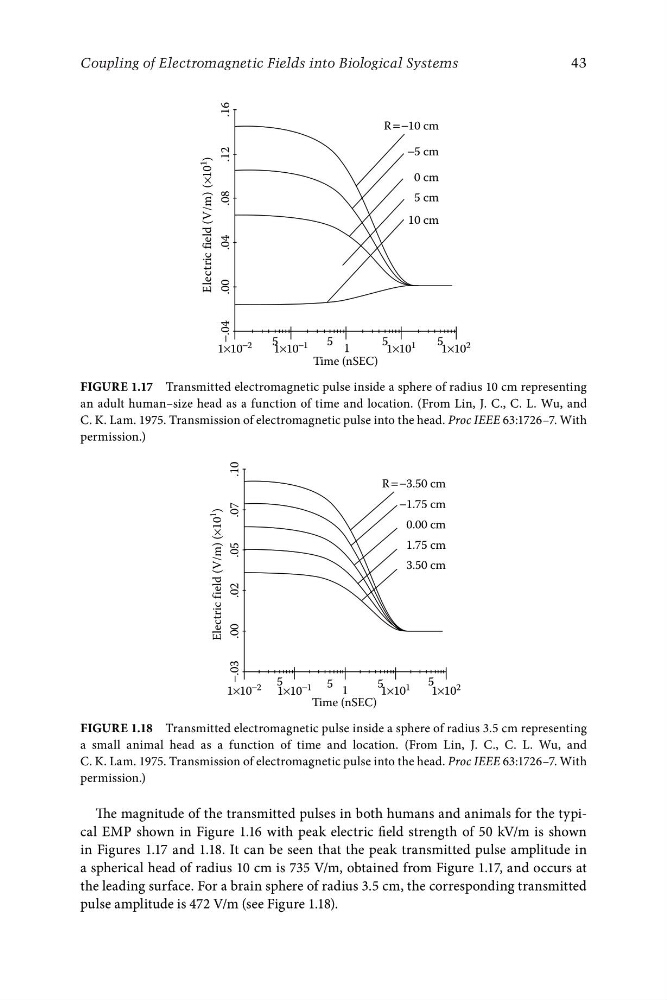
FigurE 1.17 Transmitted electromagnetic pulse inside a sphere of radius 10 cm representing
an adult human–size head as a function of time and location. (From Lin, J. C., C. L. Wu, and
C. K. Lam. 1975. Transmission of electromagnetic pulse into the head. Proc IEEE 63:1726–7. With
permission.)
Time (nSEC)
FigurE 1.18 Transmitted electromagnetic pulse inside a sphere of radius 3.5 cm representing
a small animal head as a function of time and location. (From Lin, J. C., C. L. Wu, and
C. K. Lam. 1975. Transmission of electromagnetic pulse into the head. Proc IEEE 63:1726–7. With
permission.)
The magnitude of the transmitted pulses in both humans and animals for the typical EMP shown in Figure 1.16 with peak electric field strength of 50 kV/m is shown
in Figures 1.17 and 1.18. It can be seen that the peak transmitted pulse amplitude in
a spherical head of radius 10 cm is 735 V/m, obtained from Figure 1.17, and occurs at
the leading surface. For a brain sphere of radius 3.5 cm, the corresponding transmitted
pulse amplitude is 472 V/m (see Figure 1.18).
)
R = −10 cm
−5 cm
0 cm
5 cm
10 cm
.00
.04
.08
.12
.16
−.04
1×10
−2
5
5
5
5
1×10
−1
1×10
1
1×10
2
1
Time (nSEC)
R = −3.50 cm
−1.75 cm
0.00 cm
1.75 cm
3.50 cm
.00
.02
.05
.07
.10
−.03
Electric field
(V/m) (×10
1
)
1×10
−2
5
5
5
5
1×10
−1
1×10
1
1×10
2
1
43
Coupling of Electromagnetic Fields into Biological Systems
FigurE 1.17 Transmitted electromagnetic pulse inside a sphere of radius 10 cm representing
an adult human–size head as a function of time and location. (From Lin, J. C., C. L. Wu, and
C. K. Lam. 1975. Transmission of electromagnetic pulse into the head. Proc IEEE 63:1726–7. With
permission.)
Time (nSEC)
FigurE 1.18 Transmitted electromagnetic pulse inside a sphere of radius 3.5 cm representing
a small animal head as a function of time and location. (From Lin, J. C., C. L. Wu, and
C. K. Lam. 1975. Transmission of electromagnetic pulse into the head. Proc IEEE 63:1726–7. With
permission.)
The magnitude of the transmitted pulses in both humans and animals for the typical EMP shown in Figure 1.16 with peak electric field strength of 50 kV/m is shown
in Figures 1.17 and 1.18. It can be seen that the peak transmitted pulse amplitude in
a spherical head of radius 10 cm is 735 V/m, obtained from Figure 1.17, and occurs at
the leading surface. For a brain sphere of radius 3.5 cm, the corresponding transmitted
pulse amplitude is 472 V/m (see Figure 1.18).