

Electromagnetic spectrum
10
5 10
6 10
7 10
8 10
9 10
10 10
11 10
12 10
13 10
14 10
15 10
16 10
17 10
18 10
19 10
20 10
21
Frequency (Hz)
Spectral bands
Radio waves
μ-wave THz IR V
UV
IS
X-rays
γ-rays
0.1
1.0
10.0
Frequency (THz):
ν
3000
300
30
Wavelength (μm):
λ = c/ν
3.3
3.34
334.0
Wave number (cm −1 ):
k = 1/λ
10.0
1.0
0.1
Period (picoseconds):
τ = 1/ν
0.4
4.1
41.0
Photon energy (meV):
E = hν
4.8
47.8
478.0
Temperature (K):
T = hν/k b
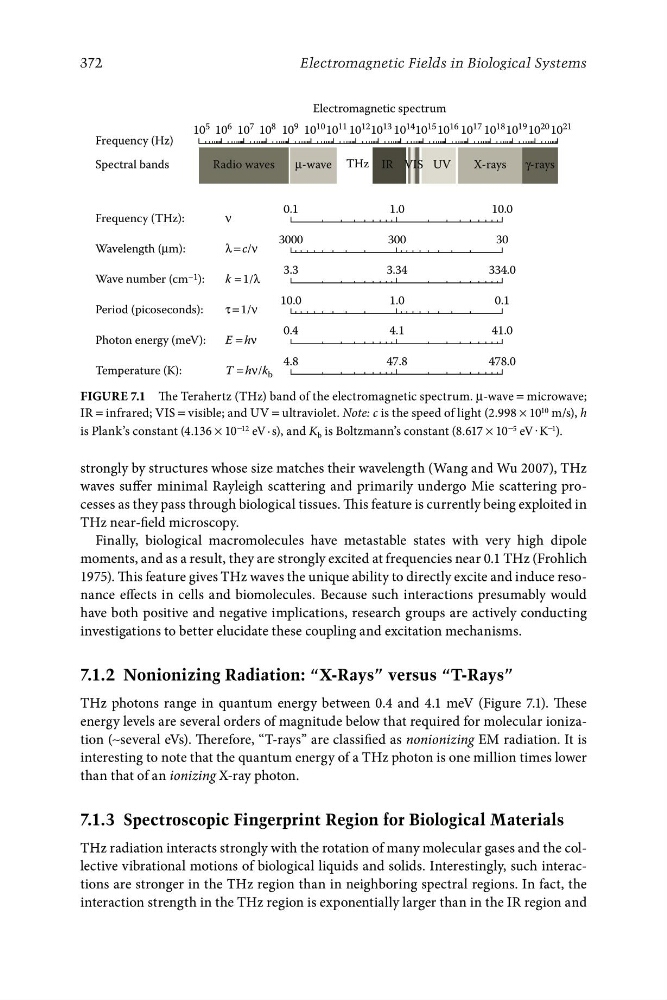
Figure 7.1 The Terahertz (THz) band of the electromagnetic spectrum. μ-wave = microwave;
IR = infrared; VIS = visible; and UV = ultraviolet. Note: c is the speed of light (2.998 × 10 10 m/s), h
is Plank’s constant (4.136 × 10 −12 eV · s), and K b is Boltzmann’s constant (8.617 × 10 −5 eV . K −1 ).
372
Electromagnetic Fields in Biological Systems
strongly by structures whose size matches their wavelength (Wang and Wu 2007), THz
waves suffer minimal Rayleigh scattering and primarily undergo Mie scattering processes as they pass through biological tissues. This feature is currently being exploited in
THz near-field microscopy.
Finally, biological macromolecules have metastable states with very high dipole
moments, and as a result, they are strongly excited at frequencies near 0.1 THz (Frohlich
1975). This feature gives THz waves the unique ability to directly excite and induce resonance effects in cells and biomolecules. Because such interactions presumably would
have both positive and negative implications, research groups are actively conducting
investigations to better elucidate these coupling and excitation mechanisms.
7.1.2 Nonionizing Radiation: “X-Rays” versus “T-Rays”
THz photons range in quantum energy between 0.4 and 4.1 meV (Figure 7.1). These
energy levels are several orders of magnitude below that required for molecular ionization (∼several eVs). Therefore, “T-rays” are classified as nonionizing EM radiation. It is
interesting to note that the quantum energy of a THz photon is one million times lower
than that of an ionizing X-ray photon.
7.1.3 Spectroscopic Fingerprint Region for Biological Materials
THz radiation interacts strongly with the rotation of many molecular gases and the collective vibrational motions of biological liquids and solids. Interestingly, such interactions are stronger in the THz region than in neighboring spectral regions. In fact, the
interaction strength in the THz region is exponentially larger than in the IR region and
10
5 10
6 10
7 10
8 10
9 10
10 10
11 10
12 10
13 10
14 10
15 10
16 10
17 10
18 10
19 10
20 10
21
Frequency (Hz)
Spectral bands
Radio waves
μ-wave THz IR V
UV
IS
X-rays
γ-rays
0.1
1.0
10.0
Frequency (THz):
ν
3000
300
30
Wavelength (μm):
λ = c/ν
3.3
3.34
334.0
Wave number (cm −1 ):
k = 1/λ
10.0
1.0
0.1
Period (picoseconds):
τ = 1/ν
0.4
4.1
41.0
Photon energy (meV):
E = hν
4.8
47.8
478.0
Temperature (K):
T = hν/k b
Figure 7.1 The Terahertz (THz) band of the electromagnetic spectrum. μ-wave = microwave;
IR = infrared; VIS = visible; and UV = ultraviolet. Note: c is the speed of light (2.998 × 10 10 m/s), h
is Plank’s constant (4.136 × 10 −12 eV · s), and K b is Boltzmann’s constant (8.617 × 10 −5 eV . K −1 ).
372
Electromagnetic Fields in Biological Systems
strongly by structures whose size matches their wavelength (Wang and Wu 2007), THz
waves suffer minimal Rayleigh scattering and primarily undergo Mie scattering processes as they pass through biological tissues. This feature is currently being exploited in
THz near-field microscopy.
Finally, biological macromolecules have metastable states with very high dipole
moments, and as a result, they are strongly excited at frequencies near 0.1 THz (Frohlich
1975). This feature gives THz waves the unique ability to directly excite and induce resonance effects in cells and biomolecules. Because such interactions presumably would
have both positive and negative implications, research groups are actively conducting
investigations to better elucidate these coupling and excitation mechanisms.
7.1.2 Nonionizing Radiation: “X-Rays” versus “T-Rays”
THz photons range in quantum energy between 0.4 and 4.1 meV (Figure 7.1). These
energy levels are several orders of magnitude below that required for molecular ionization (∼several eVs). Therefore, “T-rays” are classified as nonionizing EM radiation. It is
interesting to note that the quantum energy of a THz photon is one million times lower
than that of an ionizing X-ray photon.
7.1.3 Spectroscopic Fingerprint Region for Biological Materials
THz radiation interacts strongly with the rotation of many molecular gases and the collective vibrational motions of biological liquids and solids. Interestingly, such interactions are stronger in the THz region than in neighboring spectral regions. In fact, the
interaction strength in the THz region is exponentially larger than in the IR region and