

x Direction of wave
propagation
z
Air
y
Biological
tissue
medium
21
Coupling of Electromagnetic Fields into Biological Systems
impedance of the medium. Therefore, the determination of electric field behavior is sufficient to characterize the interaction. Accordingly, the following discussion will begin
with plane-wave RF field interactions.
For all practical and environmental purposes, human exposure to ELF electric and
magnetic fields always take place in the near-zone inductive region regardless of distance
from the source of such fields. An equivalent plane electromagnetic wave at ELF would
be two separate and independent quasistatic electric and magnetic fields with a constant
field impedance equal to that of free space, η 0 = 120π Ω. As previously indicated, at ELFs
the electric and magnetic field components are decoupled inside a biological body.
1.10.1 Radiofrequency Reflection and
Transmission at Planar Interfaces
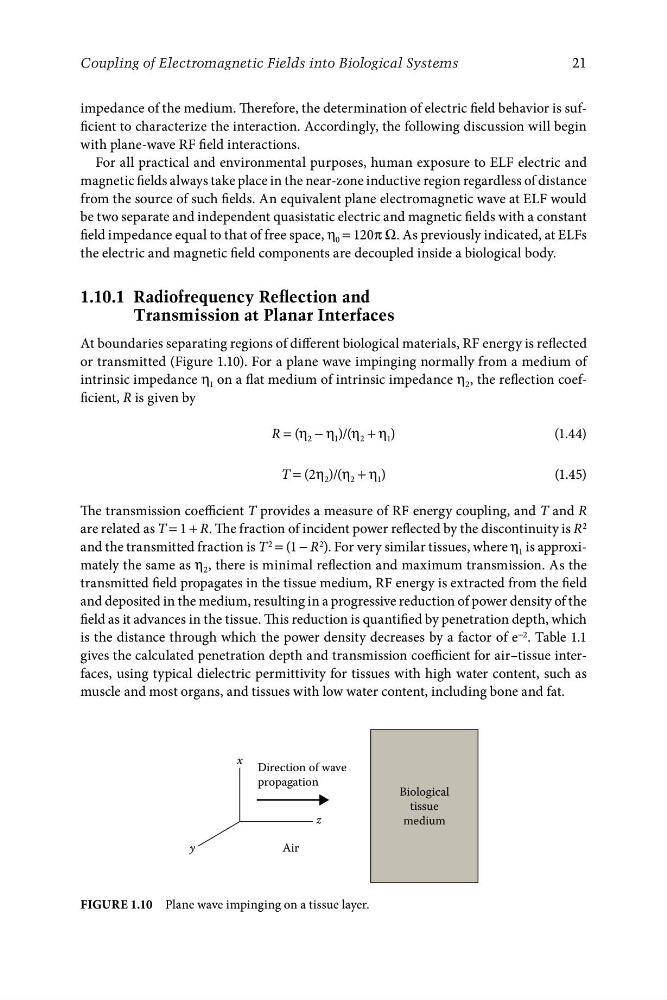
At boundaries separating regions of different biological materials, RF energy is reflected
or transmitted (Figure 1.10). For a plane wave impinging normally from a medium of
intrinsic impedance η 1 on a flat medium of intrinsic impedance η 2 , the reflection coefficient, R is given by
R = (η 2 − η 1 )/(η 2 + η 1 )
(1.44)
T = (2η 2 )/(η 2 + η 1 )
(1.45)
The transmission coefficient T provides a measure of RF energy coupling, and T and R
are related as T = 1 + R. The fraction of incident power reflected by the discontinuity is R 2
and the transmitted fraction is T 2 = (1 − R 2 ). For very similar tissues, where η 1 is approximately the same as η 2 , there is minimal reflection and maximum transmission. As the
transmitted field propagates in the tissue medium, RF energy is extracted from the field
and deposited in the medium, resulting in a progressive reduction of power density of the
field as it advances in the tissue. This reduction is quantified by penetration depth, which
is the distance through which the power density decreases by a factor of e −2 . Table 1.1
gives the calculated penetration depth and transmission coefficient for air–tissue interfaces, using typical dielectric permittivity for tissues with high water content, such as
muscle and most organs, and tissues with low water content, including bone and fat.
FigurE 1.10 Plane wave impinging on a tissue layer.