

341
Medical Devices and Systems Exposure and Dosimetry
magnetic therapy not eligible for reimbursement because of unproven efficiency (HMR
2004); and in an ordinance to the medical devices law, the Austrian government has
banned magnetic therapy devices from the lay market and restricted their distribution.
Magnetic therapy devices are allowed to be distributed only based on medical prescriptions for individual patients (MFTGV 2003).
6.2.3.1 Sinusoidal Fields
Devices are equipped with Helmholtz coils generating fairly homogenous magnetic
fields, or with pads, pillows, and mattresses with integrated flat spiral coils, which emit
very inhomogeneous alternating current (AC) magnetic fields. The used frequency
range is 1 Hz–1 kHz, and amplitudes are usually below limits of exposure guidelines
(ICNIRP 1998) and range from some nT to about 100 μT. The exceptions are devices for
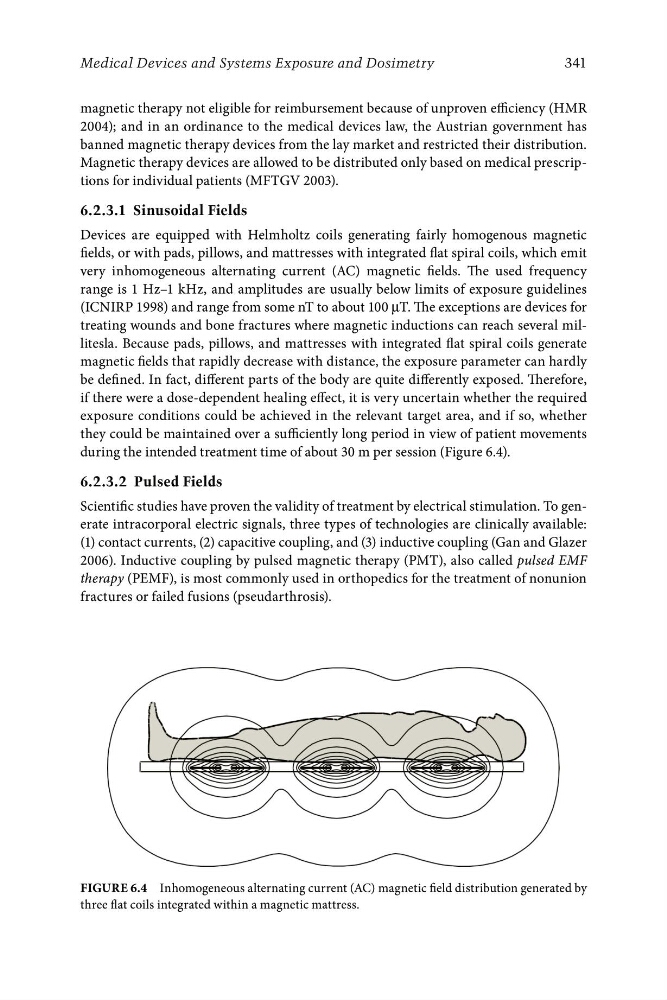
treating wounds and bone fractures where magnetic inductions can reach several millitesla. Because pads, pillows, and mattresses with integrated flat spiral coils generate
magnetic fields that rapidly decrease with distance, the exposure parameter can hardly
be defined. In fact, different parts of the body are quite differently exposed. Therefore,
if there were a dose-dependent healing effect, it is very uncertain whether the required
exposure conditions could be achieved in the relevant target area, and if so, whether
they could be maintained over a sufficiently long period in view of patient movements
during the intended treatment time of about 30 m per session (Figure 6.4).
6.2.3.2 Pulsed Fields
Scientific studies have proven the validity of treatment by electrical stimulation. To generate intracorporal electric signals, three types of technologies are clinically available:
(1) contact currents, (2) capacitive coupling, and (3) inductive coupling (Gan and Glazer
2006). Inductive coupling by pulsed magnetic therapy (PMT), also called pulsed EMF
therapy (PEMF), is most commonly used in orthopedics for the treatment of nonunion
fractures or failed fusions (pseudarthrosis).
Figure 6.4 Inhomogeneous alternating current (AC) magnetic field distribution generated by
three flat coils integrated within a magnetic mattress.
Medical Devices and Systems Exposure and Dosimetry
magnetic therapy not eligible for reimbursement because of unproven efficiency (HMR
2004); and in an ordinance to the medical devices law, the Austrian government has
banned magnetic therapy devices from the lay market and restricted their distribution.
Magnetic therapy devices are allowed to be distributed only based on medical prescriptions for individual patients (MFTGV 2003).
6.2.3.1 Sinusoidal Fields
Devices are equipped with Helmholtz coils generating fairly homogenous magnetic
fields, or with pads, pillows, and mattresses with integrated flat spiral coils, which emit
very inhomogeneous alternating current (AC) magnetic fields. The used frequency
range is 1 Hz–1 kHz, and amplitudes are usually below limits of exposure guidelines
(ICNIRP 1998) and range from some nT to about 100 μT. The exceptions are devices for
treating wounds and bone fractures where magnetic inductions can reach several millitesla. Because pads, pillows, and mattresses with integrated flat spiral coils generate
magnetic fields that rapidly decrease with distance, the exposure parameter can hardly
be defined. In fact, different parts of the body are quite differently exposed. Therefore,
if there were a dose-dependent healing effect, it is very uncertain whether the required
exposure conditions could be achieved in the relevant target area, and if so, whether
they could be maintained over a sufficiently long period in view of patient movements
during the intended treatment time of about 30 m per session (Figure 6.4).
6.2.3.2 Pulsed Fields
Scientific studies have proven the validity of treatment by electrical stimulation. To generate intracorporal electric signals, three types of technologies are clinically available:
(1) contact currents, (2) capacitive coupling, and (3) inductive coupling (Gan and Glazer
2006). Inductive coupling by pulsed magnetic therapy (PMT), also called pulsed EMF
therapy (PEMF), is most commonly used in orthopedics for the treatment of nonunion
fractures or failed fusions (pseudarthrosis).
Figure 6.4 Inhomogeneous alternating current (AC) magnetic field distribution generated by
three flat coils integrated within a magnetic mattress.