

339
Medical Devices and Systems Exposure and Dosimetry
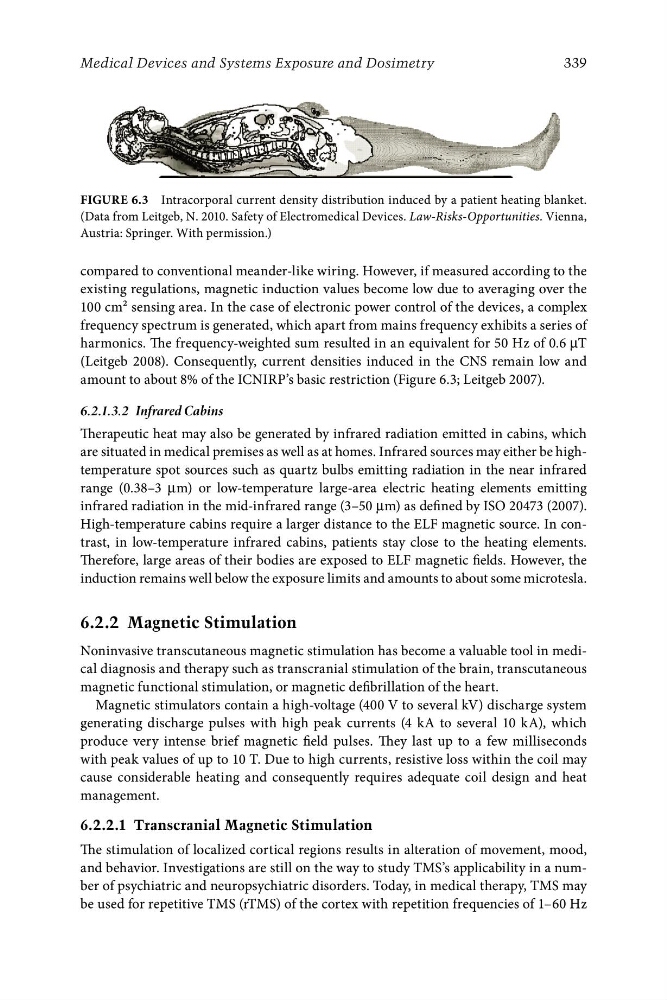
Figure 6.3 Intracorporal current density distribution induced by a patient heating blanket.
(Data from Leitgeb, N. 2010. Safety of Electromedical Devices. Law-Risks-Opportunities. Vienna,
Austria: Springer. With permission.)
compared to conventional meander-like wiring. However, if measured according to the
existing regulations, magnetic induction values become low due to averaging over the
100 cm² sensing area. In the case of electronic power control of the devices, a complex
frequency spectrum is generated, which apart from mains frequency exhibits a series of
harmonics. The frequency-weighted sum resulted in an equivalent for 50 Hz of 0.6 μT
(Leitgeb 2008). Consequently, current densities induced in the CNS remain low and
amount to about 8% of the ICNIRP’s basic restriction (Figure 6.3; Leitgeb 2007).
6.2.1.3.2 Infrared Cabins
Therapeutic heat may also be generated by infrared radiation emitted in cabins, which
are situated in medical premises as well as at homes. Infrared sources may either be hightemperature spot sources such as quartz bulbs emitting radiation in the near infrared
range (0.38–3 μm) or low-temperature large-area electric heating elements emitting
infrared radiation in the mid-infrared range (3–50 μm) as defined by ISO 20473 (2007).
High-temperature cabins require a larger distance to the ELF magnetic source. In contrast, in low-temperature infrared cabins, patients stay close to the heating elements.
Therefore, large areas of their bodies are exposed to ELF magnetic fields. However, the
induction remains well below the exposure limits and amounts to about some microtesla.
6.2.2 Magnetic Stimulation
Noninvasive transcutaneous magnetic stimulation has become a valuable tool in medical diagnosis and therapy such as transcranial stimulation of the brain, transcutaneous
magnetic functional stimulation, or magnetic defibrillation of the heart.
Magnetic stimulators contain a high-voltage (400 V to several kV) discharge system
generating discharge pulses with high peak currents (4 kA to several 10 kA), which
produce very intense brief magnetic field pulses. They last up to a few milliseconds
with peak values of up to 10 T. Due to high currents, resistive loss within the coil may
cause considerable heating and consequently requires adequate coil design and heat
management.
6.2.2.1 Transcranial Magnetic Stimulation
The stimulation of localized cortical regions results in alteration of movement, mood,
and behavior. Investigations are still on the way to study TMS’s applicability in a number of psychiatric and neuropsychiatric disorders. Today, in medical therapy, TMS may
be used for repetitive TMS (rTMS) of the cortex with repetition frequencies of 1–60 Hz