

285
Mobile Communication Fields in Biological Systems
Furthermore, the size of the field probe limits the resolution of the measurements by
several millimeters. Smaller field probes would therefore be needed for dosimetry at
higher wireless communication frequencies. Probe-size reduction generally raises the
upper frequency limit, improves spatial resolution, and reduces uncertainty due to
boundary effects, but it also results in lower sensitivity and mechanical robustness.
Several measurement devices and equipment have been described in the literature.
A measurement system (scanner) explicitly designed for the evaluation of human exposure to cellular phones was analyzed in Kuster, Kastle, and Schmid (1997b) and Schmid,
Egger, and Kuster (1996). The key components of the scanner are the probes. Several
kinds of probes that are based on diode-loaded field sensors and provide improved performance have been reported. They range from standard dosimetric probes to highly
specialized probes, such as those for in vitro and in vivo assessment, for assessment of
the field polarization, and others. Major advancements have been achieved in spherical
isotropy, spatial resolution, sensitivity, bandwidth, linearity, immunity against secondary modes of reception, calibration accuracy, uncertainty assessments, and more.
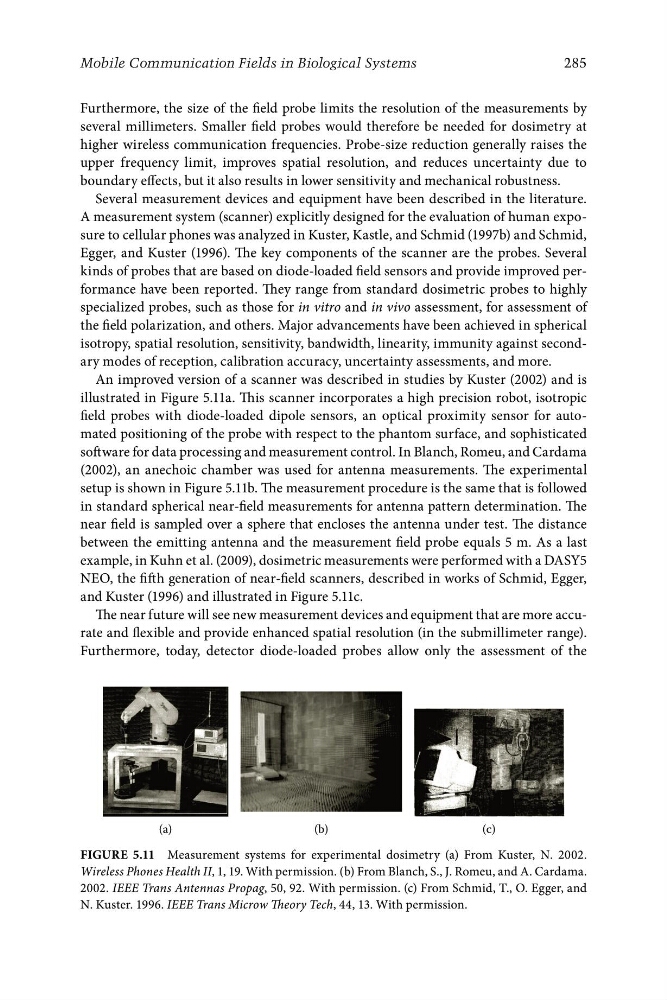
An improved version of a scanner was described in studies by Kuster (2002) and is
illustrated in Figure 5.11a. This scanner incorporates a high precision robot, isotropic
field probes with diode-loaded dipole sensors, an optical proximity sensor for automated positioning of the probe with respect to the phantom surface, and sophisticated
software for data processing and measurement control. In Blanch, Romeu, and Cardama
(2002), an anechoic chamber was used for antenna measurements. The experimental
setup is shown in Figure 5.11b. The measurement procedure is the same that is followed
in standard spherical near-field measurements for antenna pattern determination. The
near field is sampled over a sphere that encloses the antenna under test. The distance
between the emitting antenna and the measurement field probe equals 5 m. As a last
example, in Kuhn et al. (2009), dosimetric measurements were performed with a DASY5
NEO, the fifth generation of near-field scanners, described in works of Schmid, Egger,
and Kuster (1996) and illustrated in Figure 5.11c.
The near future will see new measurement devices and equipment that are more accurate and flexible and provide enhanced spatial resolution (in the submillimeter range).
Furthermore, today, detector diode-loaded probes allow only the assessment of the
(a)
(b)
(c)
Figure 5.11 Measurement systems for experimental dosimetry (a) From Kuster, N. 2002.
Wireless Phones Health II, 1, 19. With permission. (b) From Blanch, S., J. Romeu, and A. Cardama.
2002. IEEE Trans Antennas Propag, 50, 92. With permission. (c) From Schmid, T., O. Egger, and
N. Kuster. 1996. IEEE Trans Microw Theory Tech, 44, 13. With permission.
Mobile Communication Fields in Biological Systems
Furthermore, the size of the field probe limits the resolution of the measurements by
several millimeters. Smaller field probes would therefore be needed for dosimetry at
higher wireless communication frequencies. Probe-size reduction generally raises the
upper frequency limit, improves spatial resolution, and reduces uncertainty due to
boundary effects, but it also results in lower sensitivity and mechanical robustness.
Several measurement devices and equipment have been described in the literature.
A measurement system (scanner) explicitly designed for the evaluation of human exposure to cellular phones was analyzed in Kuster, Kastle, and Schmid (1997b) and Schmid,
Egger, and Kuster (1996). The key components of the scanner are the probes. Several
kinds of probes that are based on diode-loaded field sensors and provide improved performance have been reported. They range from standard dosimetric probes to highly
specialized probes, such as those for in vitro and in vivo assessment, for assessment of
the field polarization, and others. Major advancements have been achieved in spherical
isotropy, spatial resolution, sensitivity, bandwidth, linearity, immunity against secondary modes of reception, calibration accuracy, uncertainty assessments, and more.
An improved version of a scanner was described in studies by Kuster (2002) and is
illustrated in Figure 5.11a. This scanner incorporates a high precision robot, isotropic
field probes with diode-loaded dipole sensors, an optical proximity sensor for automated positioning of the probe with respect to the phantom surface, and sophisticated
software for data processing and measurement control. In Blanch, Romeu, and Cardama
(2002), an anechoic chamber was used for antenna measurements. The experimental
setup is shown in Figure 5.11b. The measurement procedure is the same that is followed
in standard spherical near-field measurements for antenna pattern determination. The
near field is sampled over a sphere that encloses the antenna under test. The distance
between the emitting antenna and the measurement field probe equals 5 m. As a last
example, in Kuhn et al. (2009), dosimetric measurements were performed with a DASY5
NEO, the fifth generation of near-field scanners, described in works of Schmid, Egger,
and Kuster (1996) and illustrated in Figure 5.11c.
The near future will see new measurement devices and equipment that are more accurate and flexible and provide enhanced spatial resolution (in the submillimeter range).
Furthermore, today, detector diode-loaded probes allow only the assessment of the
(a)
(b)
(c)
Figure 5.11 Measurement systems for experimental dosimetry (a) From Kuster, N. 2002.
Wireless Phones Health II, 1, 19. With permission. (b) From Blanch, S., J. Romeu, and A. Cardama.
2002. IEEE Trans Antennas Propag, 50, 92. With permission. (c) From Schmid, T., O. Egger, and
N. Kuster. 1996. IEEE Trans Microw Theory Tech, 44, 13. With permission.