

Conductivity (S/m)
Dielectric permittivity
10
−2
10
4
10
6
10
2
1
1
100
ε
α
σ
β
δ
γ
1
10 4
10
8
10
12
Frequency (Hz)
6
Electromagnetic Fields in Biological Systems
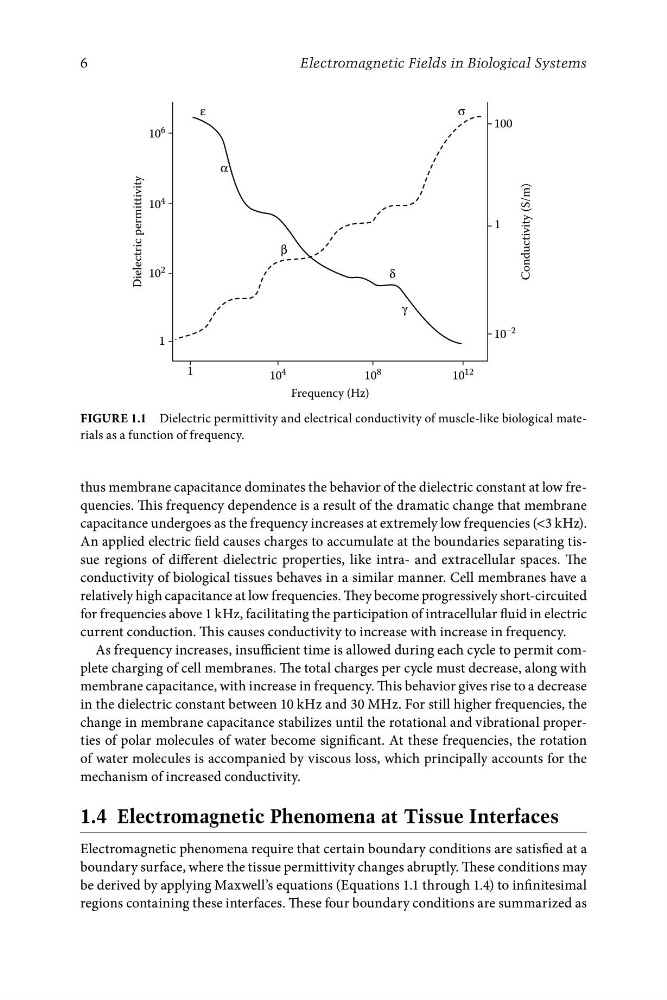
FigurE 1.1 Dielectric permittivity and electrical conductivity of muscle-like biological materials as a function of frequency.
thus membrane capacitance dominates the behavior of the dielectric constant at low frequencies. This frequency dependence is a result of the dramatic change that membrane
capacitance undergoes as the frequency increases at extremely low frequencies (<3 kHz).
An applied electric field causes charges to accumulate at the boundaries separating tissue regions of different dielectric properties, like intra- and extracellular spaces. The
conductivity of biological tissues behaves in a similar manner. Cell membranes have a
relatively high capacitance at low frequencies. They become progressively short-circuited
for frequencies above 1 kHz, facilitating the participation of intracellular fluid in electric
current conduction. This causes conductivity to increase with increase in frequency.
As frequency increases, insufficient time is allowed during each cycle to permit complete charging of cell membranes. The total charges per cycle must decrease, along with
membrane capacitance, with increase in frequency. This behavior gives rise to a decrease
in the dielectric constant between 10 kHz and 30 MHz. For still higher frequencies, the
change in membrane capacitance stabilizes until the rotational and vibrational properties of polar molecules of water become significant. At these frequencies, the rotation
of water molecules is accompanied by viscous loss, which principally accounts for the
mechanism of increased conductivity.
1.4 Electromagnetic Phenomena at Tissue Interfaces
Electromagnetic phenomena require that certain boundary conditions are satisfied at a
boundary surface, where the tissue permittivity changes abruptly. These conditions may
be derived by applying Maxwell’s equations (Equations 1.1 through 1.4) to infinitesimal
regions containing these interfaces. These four boundary conditions are summarized as