

201
Interaction of Extremely Low–Frequency Electromagnetic Fields
4.2.2 Coupling between EMF and Biological Systems
As the wavelength of the EMF in the ELF region (several thousands of kilometers)
exceeds the size of any biological object, exposure to electric and magnetic fields needs
to be considered separately (Durney and Christensen 2000; Furse, Christensen, and
Durney 2009). So, in the ELF region, since exposure to electric and magnetic fields needs
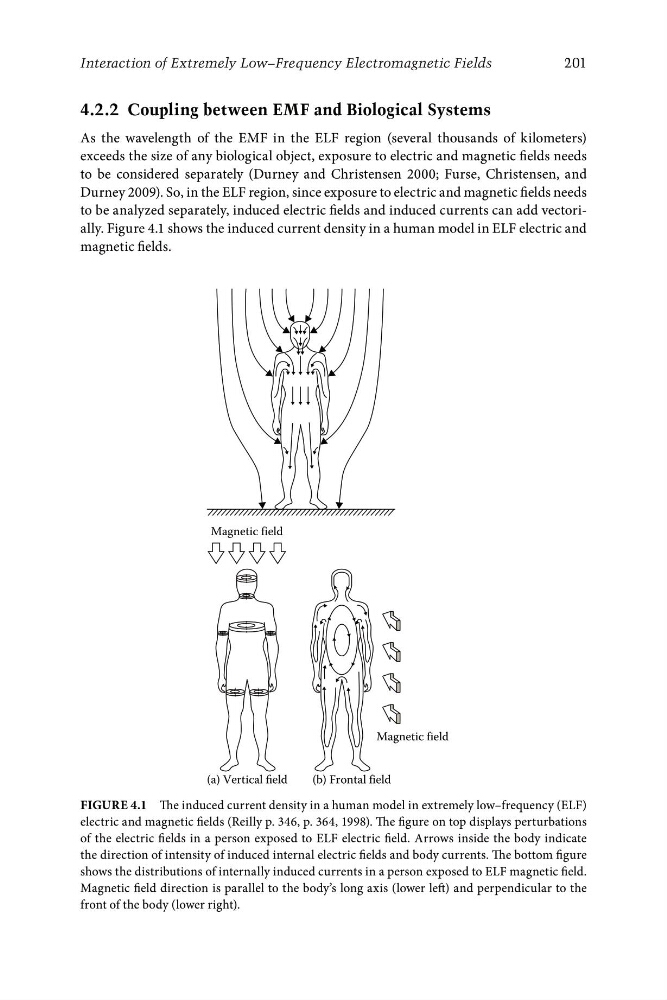
to be analyzed separately, induced electric fields and induced currents can add vectorially. Figure 4.1 shows the induced current density in a human model in ELF electric and
magnetic fields.
Magnetic field
Magnetic field
(a) Vertical field
(b) Frontal field
Figure 4.1 The induced current density in a human model in extremely low–frequency (ELF)
electric and magnetic fields (Reilly p. 346, p. 364, 1998). The figure on top displays perturbations
of the electric fields in a person exposed to ELF electric field. Arrows inside the body indicate
the direction of intensity of induced internal electric fields and body currents. The bottom figure
shows the distributions of internally induced currents in a person exposed to ELF magnetic field.
Magnetic field direction is parallel to the body’s long axis (lower left) and perpendicular to the
front of the body (lower right).
Interaction of Extremely Low–Frequency Electromagnetic Fields
4.2.2 Coupling between EMF and Biological Systems
As the wavelength of the EMF in the ELF region (several thousands of kilometers)
exceeds the size of any biological object, exposure to electric and magnetic fields needs
to be considered separately (Durney and Christensen 2000; Furse, Christensen, and
Durney 2009). So, in the ELF region, since exposure to electric and magnetic fields needs
to be analyzed separately, induced electric fields and induced currents can add vectorially. Figure 4.1 shows the induced current density in a human model in ELF electric and
magnetic fields.
Magnetic field
Magnetic field
(a) Vertical field
(b) Frontal field
Figure 4.1 The induced current density in a human model in extremely low–frequency (ELF)
electric and magnetic fields (Reilly p. 346, p. 364, 1998). The figure on top displays perturbations
of the electric fields in a person exposed to ELF electric field. Arrows inside the body indicate
the direction of intensity of induced internal electric fields and body currents. The bottom figure
shows the distributions of internally induced currents in a person exposed to ELF magnetic field.
Magnetic field direction is parallel to the body’s long axis (lower left) and perpendicular to the
front of the body (lower right).