

�
4
Electromagnetic Fields in Biological Systems
between spatially and temporally averaged electric and magnetic fields. They are relevant in regions or volumes whose dimensions are larger than atomic dimensions. The
time intervals of observation are typically long enough to allow the averaging of atomic
fluctuations. Solutions to Maxwell’s equations, with appropriate boundary conditions,
prescribe the behavior of electric and magnetic fields in material media. These equations
are valid for linear or nonlinear, isotropic or anisotropic, and homogeneous or inhomogeneous media in the frequency range from 0 Hz to 1 THz.
Maxwell’s four equations may be specified in either integral or differential form. They
are specified in the integral form since these lend to simple physical interpretations. The
differential equations may be derived by using Stokes’ and divergence theorems from
vector analysis (Jordan and Balmain 1968):
E × d
( B t)
l = − ∂ ∂ ×
/
ds
(1.1)
� ∫
∫
s
+ ∂ ∂
s
� ∫ H × dl = ∫ [ J ( D/ t) ] × d
(1.2)
s
� ∫ D × ds = ∫ ρ ν
d
(1.3)
v
∫ B × ds = 0
(1.4)
where
E = electric field strength (volt/meter)
H = magnetic field strength (ampere/meter)
D = electric flux density (coulomb/square meter)
B = magnetic flux density (tesla)
J = conduction current density (ampere/square meter)
ρ = electric charge density (coulomb/cubic meter)
v = volume
s = surface
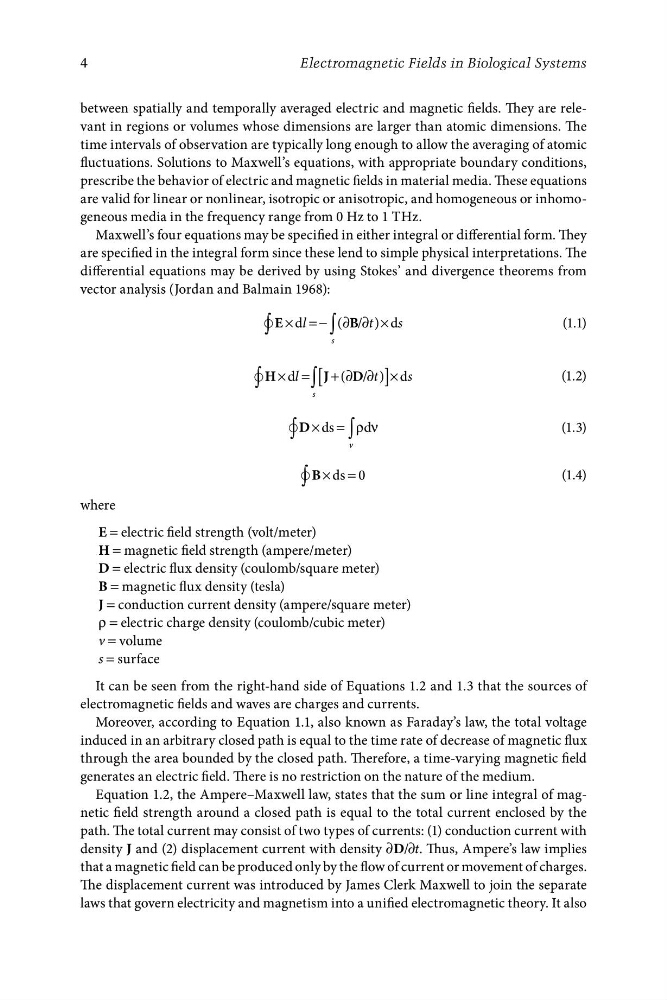
It can be seen from the right-hand side of Equations 1.2 and 1.3 that the sources of
electromagnetic fields and waves are charges and currents.
Moreover, according to Equation 1.1, also known as Faraday’s law, the total voltage
induced in an arbitrary closed path is equal to the time rate of decrease of magnetic flux
through the area bounded by the closed path. Therefore, a time-varying magnetic field
generates an electric field. There is no restriction on the nature of the medium.
Equation 1.2, the Ampere–Maxwell law, states that the sum or line integral of magnetic field strength around a closed path is equal to the total current enclosed by the
path. The total current may consist of two types of currents: (1) conduction current with
density J and (2) displacement current with density ∂D/∂t. Thus, Ampere’s law implies
that a magnetic field can be produced only by the flow of current or movement of charges.
The displacement current was introduced by James Clerk Maxwell to join the separate
laws that govern electricity and magnetism into a unified electromagnetic theory. It also
4
Electromagnetic Fields in Biological Systems
between spatially and temporally averaged electric and magnetic fields. They are relevant in regions or volumes whose dimensions are larger than atomic dimensions. The
time intervals of observation are typically long enough to allow the averaging of atomic
fluctuations. Solutions to Maxwell’s equations, with appropriate boundary conditions,
prescribe the behavior of electric and magnetic fields in material media. These equations
are valid for linear or nonlinear, isotropic or anisotropic, and homogeneous or inhomogeneous media in the frequency range from 0 Hz to 1 THz.
Maxwell’s four equations may be specified in either integral or differential form. They
are specified in the integral form since these lend to simple physical interpretations. The
differential equations may be derived by using Stokes’ and divergence theorems from
vector analysis (Jordan and Balmain 1968):
E × d
( B t)
l = − ∂ ∂ ×
/
ds
(1.1)
� ∫
∫
s
+ ∂ ∂
s
� ∫ H × dl = ∫ [ J ( D/ t) ] × d
(1.2)
s
� ∫ D × ds = ∫ ρ ν
d
(1.3)
v
∫ B × ds = 0
(1.4)
where
E = electric field strength (volt/meter)
H = magnetic field strength (ampere/meter)
D = electric flux density (coulomb/square meter)
B = magnetic flux density (tesla)
J = conduction current density (ampere/square meter)
ρ = electric charge density (coulomb/cubic meter)
v = volume
s = surface
It can be seen from the right-hand side of Equations 1.2 and 1.3 that the sources of
electromagnetic fields and waves are charges and currents.
Moreover, according to Equation 1.1, also known as Faraday’s law, the total voltage
induced in an arbitrary closed path is equal to the time rate of decrease of magnetic flux
through the area bounded by the closed path. Therefore, a time-varying magnetic field
generates an electric field. There is no restriction on the nature of the medium.
Equation 1.2, the Ampere–Maxwell law, states that the sum or line integral of magnetic field strength around a closed path is equal to the total current enclosed by the
path. The total current may consist of two types of currents: (1) conduction current with
density J and (2) displacement current with density ∂D/∂t. Thus, Ampere’s law implies
that a magnetic field can be produced only by the flow of current or movement of charges.
The displacement current was introduced by James Clerk Maxwell to join the separate
laws that govern electricity and magnetism into a unified electromagnetic theory. It also