

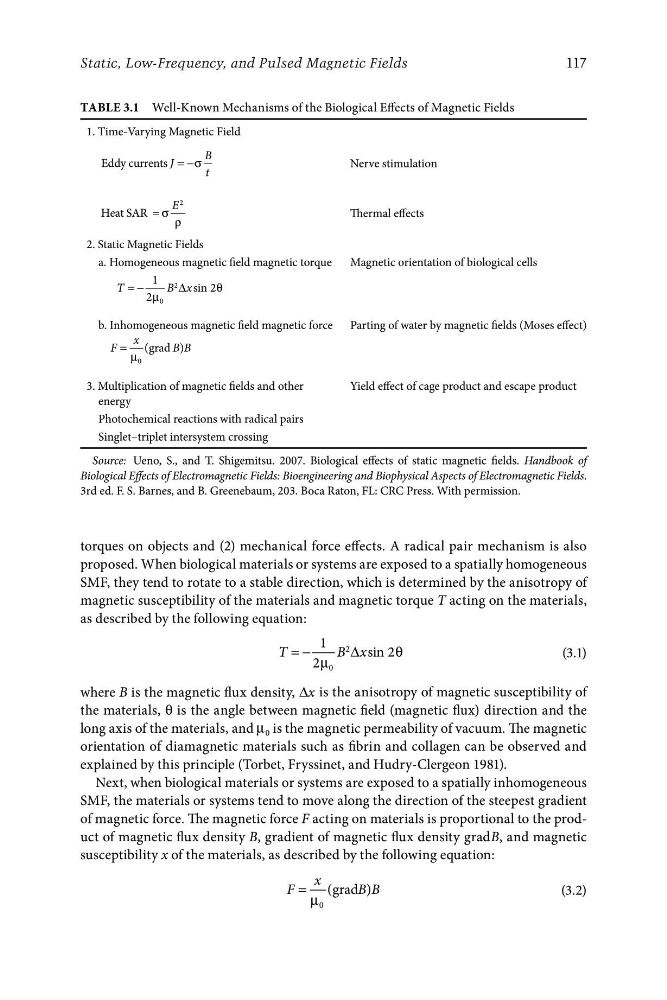
Table 3.1 Well-Known Mechanisms of the Biological Effects of Magnetic Fields
1. Time-Varying Magnetic Field
B
Eddy currents J = −σ t
Nerve stimulation
E
2
Heat SAR = σ ρ
Thermal effects
2. Static Magnetic Fields
a. Homogeneous magnetic field magnetic torque
Magnetic orientation of biological cells
1 2
T = −
B x
∆ sin 2θ
2µ 0
b. Inhomogeneous magnetic field magnetic force Parting of water by magnetic fields (Moses effect)
x
F = (grad B B
)
µ 0
3. Multiplication of magnetic fields and other
Yield effect of cage product and escape product
energy
Photochemical reactions with radical pairs
Singlet–triplet intersystem crossing
117
Static, Low-Frequency, and Pulsed Magnetic Fields
Source: Ueno, S., and T. Shigemitsu. 2007. Biological effects of static magnetic fields. Handbook of
Biological Effects of Electromagnetic Fields: Bioengineering and Biophysical Aspects of Electromagnetic Fields.
3rd ed. F. S. Barnes, and B. Greenebaum, 203. Boca Raton, FL: CRC Press. With permission.
torques on objects and (2) mechanical force effects. A radical pair mechanism is also
proposed. When biological materials or systems are exposed to a spatially homogeneous
SMF, they tend to rotate to a stable direction, which is determined by the anisotropy of
magnetic susceptibility of the materials and magnetic torque T acting on the materials,
as described by the following equation:
(3.1)
where B is the magnetic flux density, Δx is the anisotropy of magnetic susceptibility of
the materials, θ is the angle between magnetic field (magnetic flux) direction and the
long axis of the materials, and µ 0 is the magnetic permeability of vacuum. The magnetic
orientation of diamagnetic materials such as fibrin and collagen can be observed and
explained by this principle (Torbet, Fryssinet, and Hudry-Clergeon 1981).
Next, when biological materials or systems are exposed to a spatially inhomogeneous
SMF, the materials or systems tend to move along the direction of the steepest gradient
of magnetic force. The magnetic force F acting on materials is proportional to the product of magnetic flux density B, gradient of magnetic flux density gradB, and magnetic
susceptibility x of the materials, as described by the following equation:
x
F = (
B B
(3.2)
grad )
µ 0
T
B x
= −
1
2
2
0
2
µ
θ
∆ sin
1. Time-Varying Magnetic Field
B
Eddy currents J = −σ t
Nerve stimulation
E
2
Heat SAR = σ ρ
Thermal effects
2. Static Magnetic Fields
a. Homogeneous magnetic field magnetic torque
Magnetic orientation of biological cells
1 2
T = −
B x
∆ sin 2θ
2µ 0
b. Inhomogeneous magnetic field magnetic force Parting of water by magnetic fields (Moses effect)
x
F = (grad B B
)
µ 0
3. Multiplication of magnetic fields and other
Yield effect of cage product and escape product
energy
Photochemical reactions with radical pairs
Singlet–triplet intersystem crossing
117
Static, Low-Frequency, and Pulsed Magnetic Fields
Source: Ueno, S., and T. Shigemitsu. 2007. Biological effects of static magnetic fields. Handbook of
Biological Effects of Electromagnetic Fields: Bioengineering and Biophysical Aspects of Electromagnetic Fields.
3rd ed. F. S. Barnes, and B. Greenebaum, 203. Boca Raton, FL: CRC Press. With permission.
torques on objects and (2) mechanical force effects. A radical pair mechanism is also
proposed. When biological materials or systems are exposed to a spatially homogeneous
SMF, they tend to rotate to a stable direction, which is determined by the anisotropy of
magnetic susceptibility of the materials and magnetic torque T acting on the materials,
as described by the following equation:
(3.1)
where B is the magnetic flux density, Δx is the anisotropy of magnetic susceptibility of
the materials, θ is the angle between magnetic field (magnetic flux) direction and the
long axis of the materials, and µ 0 is the magnetic permeability of vacuum. The magnetic
orientation of diamagnetic materials such as fibrin and collagen can be observed and
explained by this principle (Torbet, Fryssinet, and Hudry-Clergeon 1981).
Next, when biological materials or systems are exposed to a spatially inhomogeneous
SMF, the materials or systems tend to move along the direction of the steepest gradient
of magnetic force. The magnetic force F acting on materials is proportional to the product of magnetic flux density B, gradient of magnetic flux density gradB, and magnetic
susceptibility x of the materials, as described by the following equation:
x
F = (
B B
(3.2)
grad )
µ 0
T
B x
= −
1
2
2
0
2
µ
θ
∆ sin