

⎪Δψorg⎪, ⎪Δψcell⎪ (mV)
800
600
400
200
ω (s
−1 )
0
10
10
0
10
5
10
6
10
7
10
8
10
9
83
Pulsed Electric Fields in Biological Cells and Membranes
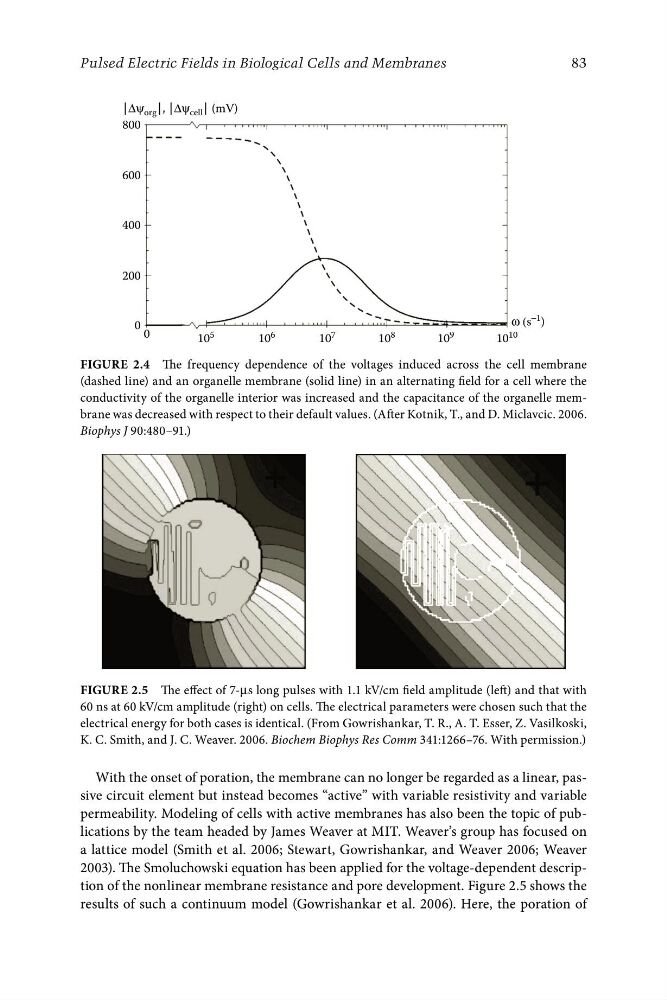
Figure 2.4 The frequency dependence of the voltages induced across the cell membrane
(dashed line) and an organelle membrane (solid line) in an alternating field for a cell where the
conductivity of the organelle interior was increased and the capacitance of the organelle membrane was decreased with respect to their default values. (After Kotnik, T., and D. Miclavcic. 2006.
Biophys J 90:480–91.)
Figure 2.5 The effect of 7-μs long pulses with 1.1 kV/cm field amplitude (left) and that with
60 ns at 60 kV/cm amplitude (right) on cells. The electrical parameters were chosen such that the
electrical energy for both cases is identical. (From Gowrishankar, T. R., A. T. Esser, Z. Vasilkoski,
K. C. Smith, and J. C. Weaver. 2006. Biochem Biophys Res Comm 341:1266–76. With permission.)
With the onset of poration, the membrane can no longer be regarded as a linear, passive circuit element but instead becomes “active” with variable resistivity and variable
permeability. Modeling of cells with active membranes has also been the topic of publications by the team headed by James Weaver at MIT. Weaver’s group has focused on
a lattice model (Smith et al. 2006; Stewart, Gowrishankar, and Weaver 2006; Weaver
2003). The Smoluchowski equation has been applied for the voltage-dependent description of the nonlinear membrane resistance and pore development. Figure 2.5 shows the
results of such a continuum model (Gowrishankar et al. 2006). Here, the poration of
800
600
400
200
ω (s
−1 )
0
10
10
0
10
5
10
6
10
7
10
8
10
9
83
Pulsed Electric Fields in Biological Cells and Membranes
Figure 2.4 The frequency dependence of the voltages induced across the cell membrane
(dashed line) and an organelle membrane (solid line) in an alternating field for a cell where the
conductivity of the organelle interior was increased and the capacitance of the organelle membrane was decreased with respect to their default values. (After Kotnik, T., and D. Miclavcic. 2006.
Biophys J 90:480–91.)
Figure 2.5 The effect of 7-μs long pulses with 1.1 kV/cm field amplitude (left) and that with
60 ns at 60 kV/cm amplitude (right) on cells. The electrical parameters were chosen such that the
electrical energy for both cases is identical. (From Gowrishankar, T. R., A. T. Esser, Z. Vasilkoski,
K. C. Smith, and J. C. Weaver. 2006. Biochem Biophys Res Comm 341:1266–76. With permission.)
With the onset of poration, the membrane can no longer be regarded as a linear, passive circuit element but instead becomes “active” with variable resistivity and variable
permeability. Modeling of cells with active membranes has also been the topic of publications by the team headed by James Weaver at MIT. Weaver’s group has focused on
a lattice model (Smith et al. 2006; Stewart, Gowrishankar, and Weaver 2006; Weaver
2003). The Smoluchowski equation has been applied for the voltage-dependent description of the nonlinear membrane resistance and pore development. Figure 2.5 shows the
results of such a continuum model (Gowrishankar et al. 2006). Here, the poration of