

4.10 Sustainability of Biohydrogen
The sustainability of biohydrogen production is driven by production rate and its
purity. The sustainability assessment concerns three aspects, including economics,
environmental performance, and social issues. Sustainability usually refers to simultaneously achieving economic prosperity, environmental cleanness, and social parity. In order to produce the biohydrogen economy, lots of researches are ongoing to
improve the method of synthesis (Patterson et al. 2013).
Though the biohydrogen production and its utilization seem to be an environmentally safe and feasible alternative for fossil-based fuel, shifting from the present
fuel economy to biohydrogen economy is still in its infancy stage. Despite having
several research groups working on it, its industrial production, storage, and transportation have not yet reached a satisfactory level. Important features that have to be
taken into consideration include the cost of feedstocks, yield, as well as heat energy
evolved (Choi and Ahn 2014). The technological challenges for the sustainable use
of biohydrogen fuel are:
• Low photochemical efficiency.
• Efficiency of employed bacterial strain.
• Instability of hydrogenase overexpression.
• Sensitivity of hydrogenase to oxygen and feedback inhibition.
• Suitability of low-cost substrates.
Advantages of Bio-hydrogen
Economic Effects
Effects on
Environment
Energy Security
*Imperishable fuel
diversity
*Increased manufacturing
jobs in rural areas
*Increase in plant,
equipment financing
*Decreased relying on
imported petroleum
*Non-carbon fuel
*Decrease in Air
pollution
*Reduced green house
gas emission
*Reduced fossil fuel usage
*Readily available
*Peaceful and domestic
targets
*Domestic distribution
*Sustainability
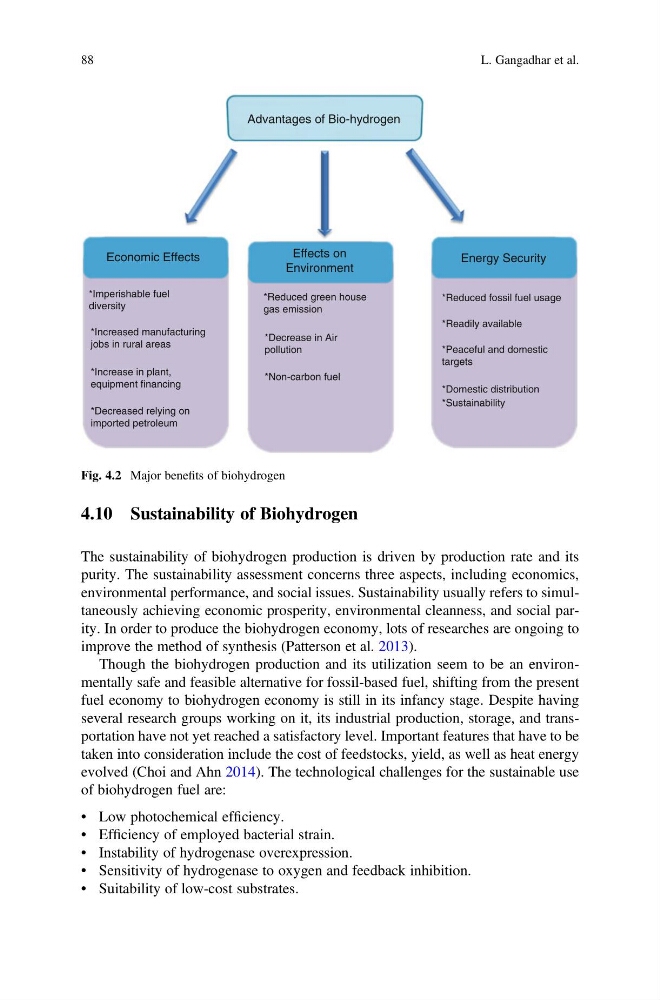
Fig. 4.2 Major benefits of biohydrogen
88
L. Gangadhar et al.
The sustainability of biohydrogen production is driven by production rate and its
purity. The sustainability assessment concerns three aspects, including economics,
environmental performance, and social issues. Sustainability usually refers to simultaneously achieving economic prosperity, environmental cleanness, and social parity. In order to produce the biohydrogen economy, lots of researches are ongoing to
improve the method of synthesis (Patterson et al. 2013).
Though the biohydrogen production and its utilization seem to be an environmentally safe and feasible alternative for fossil-based fuel, shifting from the present
fuel economy to biohydrogen economy is still in its infancy stage. Despite having
several research groups working on it, its industrial production, storage, and transportation have not yet reached a satisfactory level. Important features that have to be
taken into consideration include the cost of feedstocks, yield, as well as heat energy
evolved (Choi and Ahn 2014). The technological challenges for the sustainable use
of biohydrogen fuel are:
• Low photochemical efficiency.
• Efficiency of employed bacterial strain.
• Instability of hydrogenase overexpression.
• Sensitivity of hydrogenase to oxygen and feedback inhibition.
• Suitability of low-cost substrates.
Advantages of Bio-hydrogen
Economic Effects
Effects on
Environment
Energy Security
*Imperishable fuel
diversity
*Increased manufacturing
jobs in rural areas
*Increase in plant,
equipment financing
*Decreased relying on
imported petroleum
*Non-carbon fuel
*Decrease in Air
pollution
*Reduced green house
gas emission
*Reduced fossil fuel usage
*Readily available
*Peaceful and domestic
targets
*Domestic distribution
*Sustainability
Fig. 4.2 Major benefits of biohydrogen
88
L. Gangadhar et al.