

3.2 Hydrolytic Organisms
Figure 3.3 shows the sequential phases of anaerobic digestion process. Güllert et al.
(2016) adapted farming biogas reactors for the production of methane from plants
using a variety of microbes in the absence of oxygen. When assessed between
natural and artificial schemes, biogas fermenters are inadequate in their capability
of hydrolysis. The causes are not understood for the same. They showed that a
representative commercial biogas reaction system added by way of chicken manure,
manure of cow, as well as maize silage has shown comparatively lesser conversion
in hydrolysis reactions against herbivores’ feces samples. Also, they provided
evidence that on average, 2.5 genes encoding cellulolytic GHs/Mbp were identified
in the biogas fermenter compared to 3.8 in the elephant feces and 3.2 in the cow
rumen data sets. Coding of genes for cellulose-degrading GH enzyme ratio associated with the Bacteroidetes versus the Firmicutes was 1:2.8. Besides, RNA sequencing data designated that more copied sequencing of cellulases in the biogas reactor
were quadrapulated when associated with the Firmicutes equated to the
Bacteroidetes, whereas a same spreading of these types of enzymes was seen in
the case of the sample of excreta of elephant. The results indicated that a bacterial
population has comparatively reduced association with the Bacteroidetes phylum
and, to a certain level, Fibrobacteres is affiliated with a reduced activity of projected
lignin- as well as cellulose-degrading enzymatic constituents in biogas reactors. This
change may be ascribed to an incomplete coding of genes for cellulose-degrading
bacterial GH enzymatic constituents which are associated with the Bacteroidetes as
well as the Fibrobacteres. The fractional lack of these genetic constructions infers a
possibly essential constraint in this biogas reactor with respect to the starting time of
biomass hydrolysis. The results predicted that enhancing the participants of
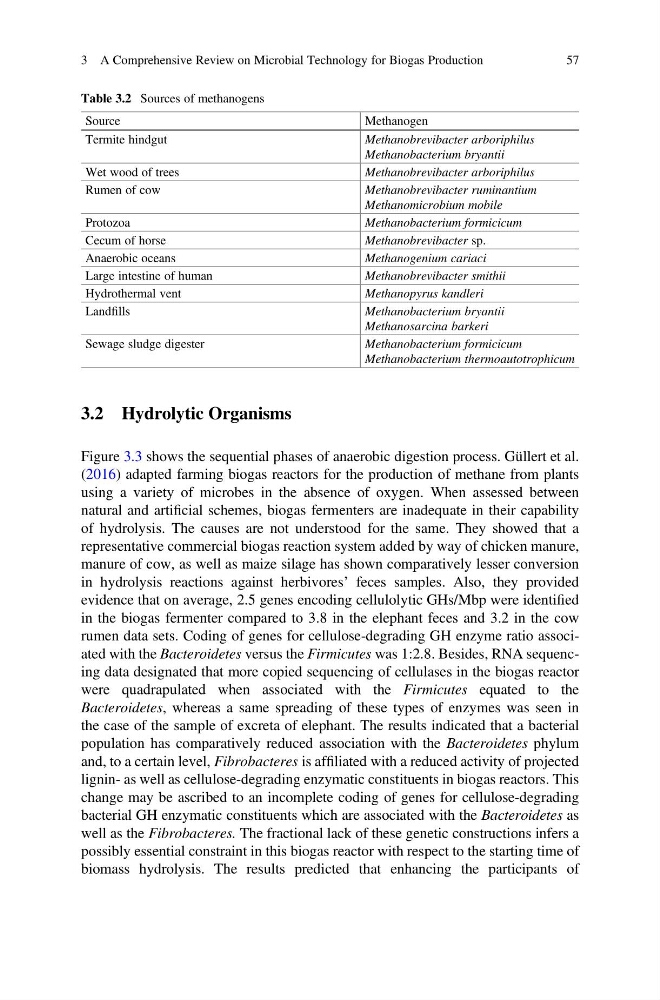
Table 3.2 Sources of methanogens
Source
Methanogen
Termite hindgut
Methanobrevibacter arboriphilus
Methanobacterium bryantii
Wet wood of trees
Methanobrevibacter arboriphilus
Rumen of cow
Methanobrevibacter ruminantium
Methanomicrobium mobile
Protozoa
Methanobacterium formicicum
Cecum of horse
Methanobrevibacter sp.
Anaerobic oceans
Methanogenium cariaci
Large intestine of human
Methanobrevibacter smithii
Hydrothermal vent
Methanopyrus kandleri
Landfills
Methanobacterium bryantii
Methanosarcina barkeri
Sewage sludge digester
Methanobacterium formicicum
Methanobacterium thermoautotrophicum
3 A Comprehensive Review on Microbial Technology for Biogas Production
57
Figure 3.3 shows the sequential phases of anaerobic digestion process. Güllert et al.
(2016) adapted farming biogas reactors for the production of methane from plants
using a variety of microbes in the absence of oxygen. When assessed between
natural and artificial schemes, biogas fermenters are inadequate in their capability
of hydrolysis. The causes are not understood for the same. They showed that a
representative commercial biogas reaction system added by way of chicken manure,
manure of cow, as well as maize silage has shown comparatively lesser conversion
in hydrolysis reactions against herbivores’ feces samples. Also, they provided
evidence that on average, 2.5 genes encoding cellulolytic GHs/Mbp were identified
in the biogas fermenter compared to 3.8 in the elephant feces and 3.2 in the cow
rumen data sets. Coding of genes for cellulose-degrading GH enzyme ratio associated with the Bacteroidetes versus the Firmicutes was 1:2.8. Besides, RNA sequencing data designated that more copied sequencing of cellulases in the biogas reactor
were quadrapulated when associated with the Firmicutes equated to the
Bacteroidetes, whereas a same spreading of these types of enzymes was seen in
the case of the sample of excreta of elephant. The results indicated that a bacterial
population has comparatively reduced association with the Bacteroidetes phylum
and, to a certain level, Fibrobacteres is affiliated with a reduced activity of projected
lignin- as well as cellulose-degrading enzymatic constituents in biogas reactors. This
change may be ascribed to an incomplete coding of genes for cellulose-degrading
bacterial GH enzymatic constituents which are associated with the Bacteroidetes as
well as the Fibrobacteres. The fractional lack of these genetic constructions infers a
possibly essential constraint in this biogas reactor with respect to the starting time of
biomass hydrolysis. The results predicted that enhancing the participants of
Table 3.2 Sources of methanogens
Source
Methanogen
Termite hindgut
Methanobrevibacter arboriphilus
Methanobacterium bryantii
Wet wood of trees
Methanobrevibacter arboriphilus
Rumen of cow
Methanobrevibacter ruminantium
Methanomicrobium mobile
Protozoa
Methanobacterium formicicum
Cecum of horse
Methanobrevibacter sp.
Anaerobic oceans
Methanogenium cariaci
Large intestine of human
Methanobrevibacter smithii
Hydrothermal vent
Methanopyrus kandleri
Landfills
Methanobacterium bryantii
Methanosarcina barkeri
Sewage sludge digester
Methanobacterium formicicum
Methanobacterium thermoautotrophicum
3 A Comprehensive Review on Microbial Technology for Biogas Production
57