

bacteria (Zhou et al. 2010). Maximum characters of cyanobacteria are very similar to
bacteria, and this is the reason why cyanobacteria and bacteria exist in the same
kingdom Monera. Cyanobacteria grow very rapidly without the requirement of
arable land. Cyanobacteria can uptake CO 2 from the atmosphere and prepare their
own food; hence, they are considered as autotrophic organisms (Lu et al. 2010). Due
to their photosynthetic properties and being a good source of carbon, cyanobacteria
are used for biofuel production (Bandyopadhyay et al. 2010). The biofuel production
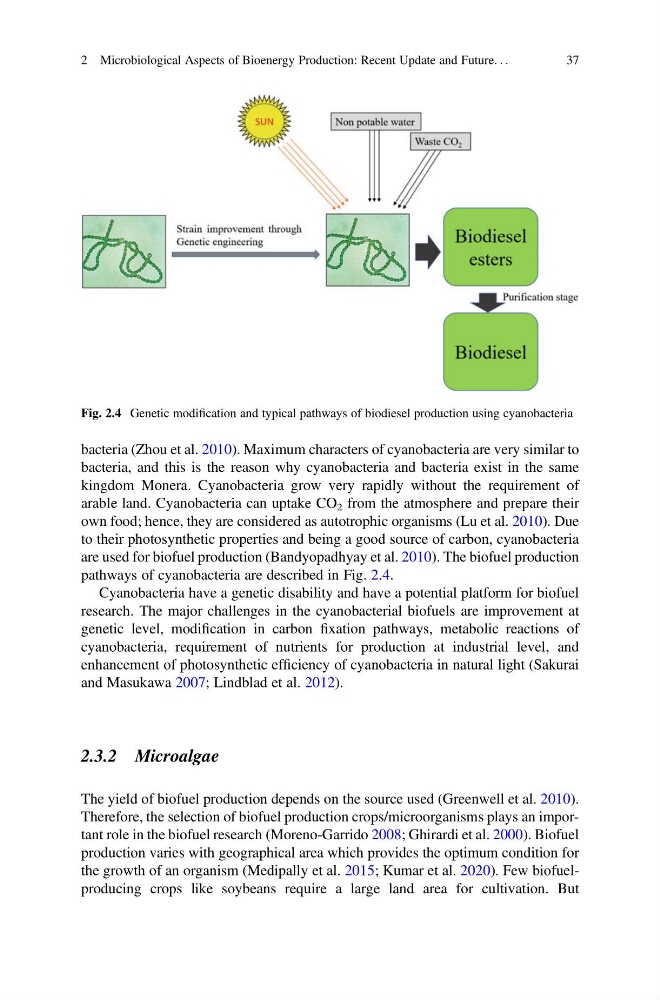
pathways of cyanobacteria are described in Fig. 2.4.
Cyanobacteria have a genetic disability and have a potential platform for biofuel
research. The major challenges in the cyanobacterial biofuels are improvement at
genetic level, modification in carbon fixation pathways, metabolic reactions of
cyanobacteria, requirement of nutrients for production at industrial level, and
enhancement of photosynthetic efficiency of cyanobacteria in natural light (Sakurai
and Masukawa 2007; Lindblad et al. 2012).
2.3.2 Microalgae
The yield of biofuel production depends on the source used (Greenwell et al. 2010).
Therefore, the selection of biofuel production crops/microorganisms plays an important role in the biofuel research (Moreno-Garrido 2008; Ghirardi et al. 2000). Biofuel
production varies with geographical area which provides the optimum condition for
the growth of an organism (Medipally et al. 2015; Kumar et al. 2020). Few biofuelproducing crops like soybeans require a large land area for cultivation. But
Fig. 2.4 Genetic modification and typical pathways of biodiesel production using cyanobacteria
2 Microbiological Aspects of Bioenergy Production: Recent Update and Future. . .
37
bacteria, and this is the reason why cyanobacteria and bacteria exist in the same
kingdom Monera. Cyanobacteria grow very rapidly without the requirement of
arable land. Cyanobacteria can uptake CO 2 from the atmosphere and prepare their
own food; hence, they are considered as autotrophic organisms (Lu et al. 2010). Due
to their photosynthetic properties and being a good source of carbon, cyanobacteria
are used for biofuel production (Bandyopadhyay et al. 2010). The biofuel production
pathways of cyanobacteria are described in Fig. 2.4.
Cyanobacteria have a genetic disability and have a potential platform for biofuel
research. The major challenges in the cyanobacterial biofuels are improvement at
genetic level, modification in carbon fixation pathways, metabolic reactions of
cyanobacteria, requirement of nutrients for production at industrial level, and
enhancement of photosynthetic efficiency of cyanobacteria in natural light (Sakurai
and Masukawa 2007; Lindblad et al. 2012).
2.3.2 Microalgae
The yield of biofuel production depends on the source used (Greenwell et al. 2010).
Therefore, the selection of biofuel production crops/microorganisms plays an important role in the biofuel research (Moreno-Garrido 2008; Ghirardi et al. 2000). Biofuel
production varies with geographical area which provides the optimum condition for
the growth of an organism (Medipally et al. 2015; Kumar et al. 2020). Few biofuelproducing crops like soybeans require a large land area for cultivation. But
Fig. 2.4 Genetic modification and typical pathways of biodiesel production using cyanobacteria
2 Microbiological Aspects of Bioenergy Production: Recent Update and Future. . .
37