

and formation of gels. Still, its viscosity increased (Atadashi et al. 2012; Canakci and
Gerpen 2001).
Free fatty acids are transformed to esters over the pretreatment, and thereby, the
free fatty acids’ level reduces (Alptekin et al. 2012).
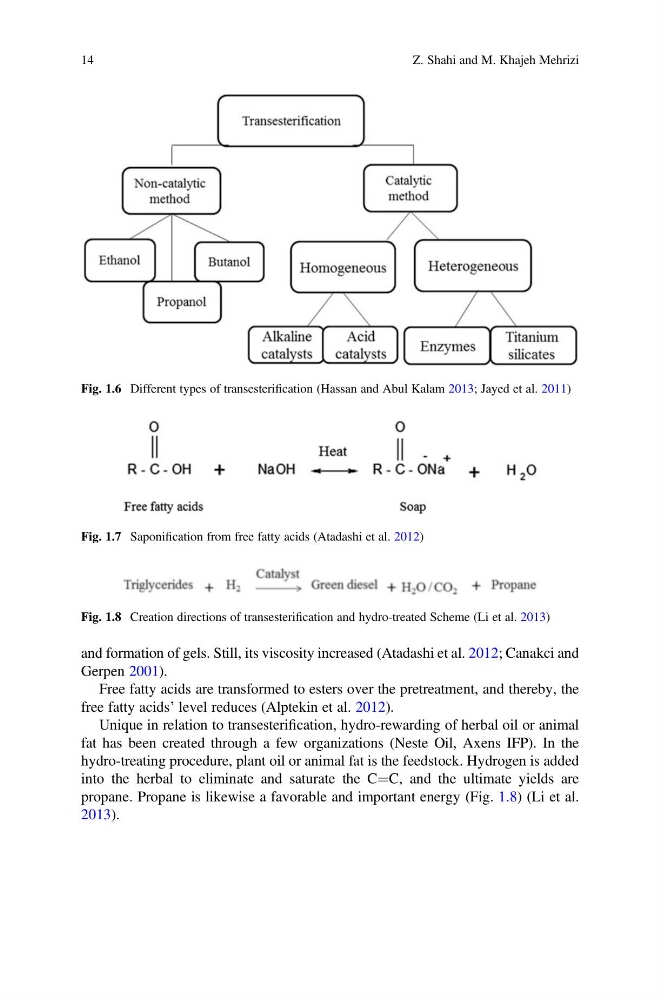
Unique in relation to transesterification, hydro-rewarding of herbal oil or animal
fat has been created through a few organizations (Neste Oil, Axens IFP). In the
hydro-treating procedure, plant oil or animal fat is the feedstock. Hydrogen is added
into the herbal to eliminate and saturate the C¼C, and the ultimate yields are
propane. Propane is likewise a favorable and important energy (Fig. 1.8) (Li et al.
2013).
Fig. 1.6 Different types of transesterification (Hassan and Abul Kalam 2013; Jayed et al. 2011)
Fig. 1.7 Saponification from free fatty acids (Atadashi et al. 2012)
Fig. 1.8 Creation directions of transesterification and hydro-treated Scheme (Li et al. 2013)
14
Z. Shahi and M. Khajeh Mehrizi
Gerpen 2001).
Free fatty acids are transformed to esters over the pretreatment, and thereby, the
free fatty acids’ level reduces (Alptekin et al. 2012).
Unique in relation to transesterification, hydro-rewarding of herbal oil or animal
fat has been created through a few organizations (Neste Oil, Axens IFP). In the
hydro-treating procedure, plant oil or animal fat is the feedstock. Hydrogen is added
into the herbal to eliminate and saturate the C¼C, and the ultimate yields are
propane. Propane is likewise a favorable and important energy (Fig. 1.8) (Li et al.
2013).
Fig. 1.6 Different types of transesterification (Hassan and Abul Kalam 2013; Jayed et al. 2011)
Fig. 1.7 Saponification from free fatty acids (Atadashi et al. 2012)
Fig. 1.8 Creation directions of transesterification and hydro-treated Scheme (Li et al. 2013)
14
Z. Shahi and M. Khajeh Mehrizi