

same process conditions. But, methanol is toxic to human and hygroscopic. So,
comprising between production cost and toxic level, ethanol is a widely reported
alcohol, next to methanol. Higher alcohols are not recommended for biodiesel
production because of their steric hindrance effect (Musa 2016).
6.3.3 Nature of Catalyst
Catalyst is one of the important components involved in the transesterification
reaction. Catalyst enhances the reaction rate without taking part in it. Catalysts
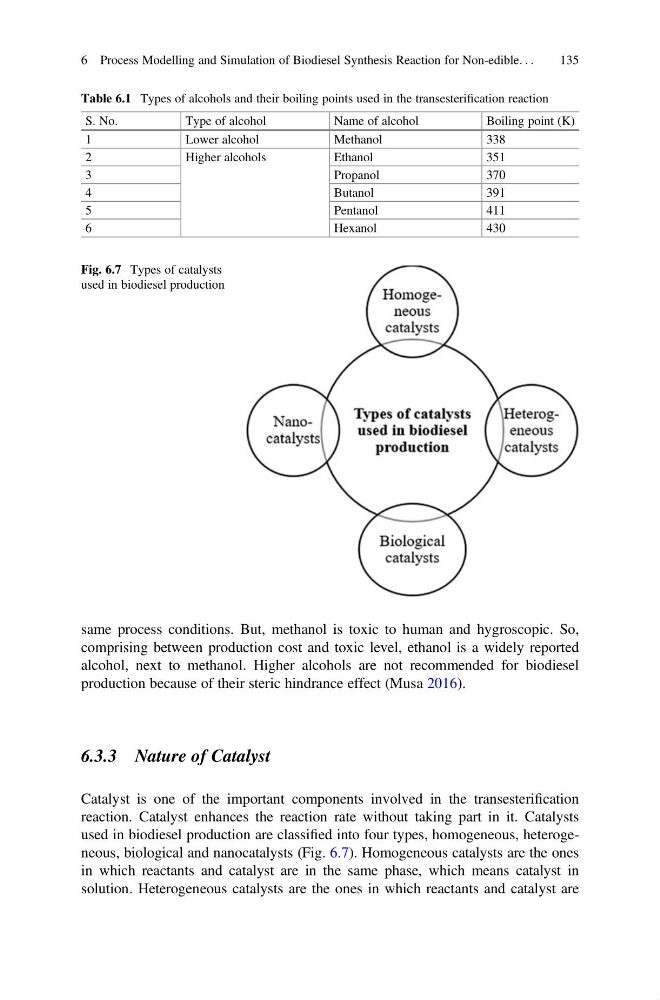
used in biodiesel production are classified into four types, homogeneous, heterogeneous, biological and nanocatalysts (Fig. 6.7). Homogeneous catalysts are the ones
in which reactants and catalyst are in the same phase, which means catalyst in
solution. Heterogeneous catalysts are the ones in which reactants and catalyst are
Table 6.1 Types of alcohols and their boiling points used in the transesterification reaction
S. No.
Type of alcohol
Name of alcohol
Boiling point (K)
1
Lower alcohol
Methanol
338
2
Higher alcohols
Ethanol
351
3
Propanol
370
4
Butanol
391
5
Pentanol
411
6
Hexanol
430
Fig. 6.7 Types of catalysts
used in biodiesel production
6 Process Modelling and Simulation of Biodiesel Synthesis Reaction for Non-edible. . .
135
comprising between production cost and toxic level, ethanol is a widely reported
alcohol, next to methanol. Higher alcohols are not recommended for biodiesel
production because of their steric hindrance effect (Musa 2016).
6.3.3 Nature of Catalyst
Catalyst is one of the important components involved in the transesterification
reaction. Catalyst enhances the reaction rate without taking part in it. Catalysts
used in biodiesel production are classified into four types, homogeneous, heterogeneous, biological and nanocatalysts (Fig. 6.7). Homogeneous catalysts are the ones
in which reactants and catalyst are in the same phase, which means catalyst in
solution. Heterogeneous catalysts are the ones in which reactants and catalyst are
Table 6.1 Types of alcohols and their boiling points used in the transesterification reaction
S. No.
Type of alcohol
Name of alcohol
Boiling point (K)
1
Lower alcohol
Methanol
338
2
Higher alcohols
Ethanol
351
3
Propanol
370
4
Butanol
391
5
Pentanol
411
6
Hexanol
430
Fig. 6.7 Types of catalysts
used in biodiesel production
6 Process Modelling and Simulation of Biodiesel Synthesis Reaction for Non-edible. . .
135