

• Characteristics of feedstock
• Type of alcohol
• Nature of catalyst
• Molar ratio of alcohol to oil
• Mass ratio of catalyst to oil
• Feed/reaction temperature
• Residence time
• Agitation speed
6.3.1 Characteristics of Feedstock
The feedstocks used to produce biodiesel are insoluble in polar solvents and soluble
in weak- to non-polar solvents. Chemically, feedstocks are triglycerides, which are
made from 3 moles of the same or different fatty acids and 1 mole of glycerol
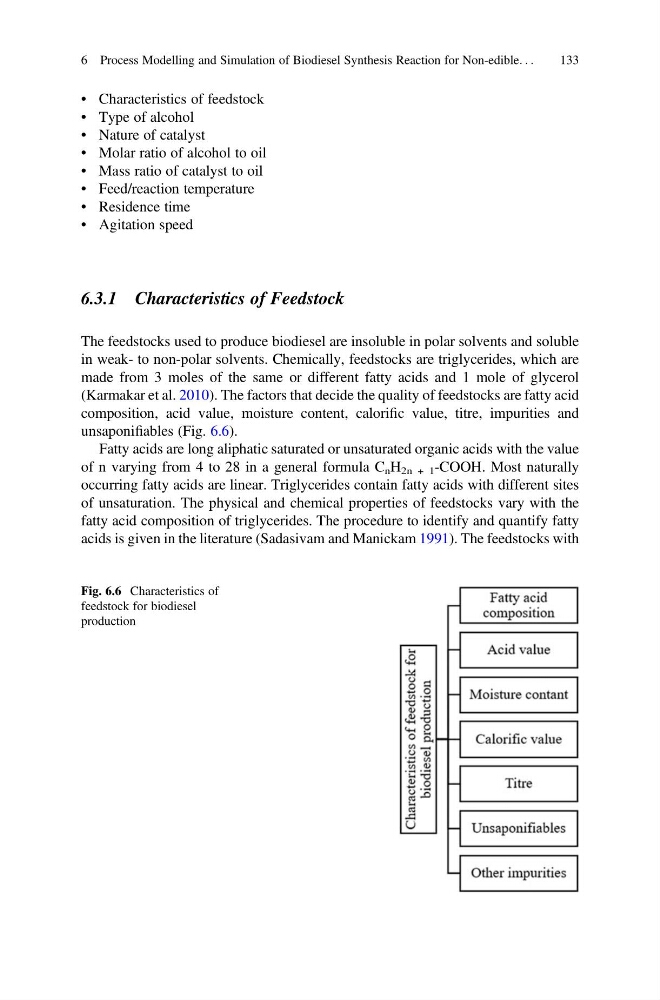
(Karmakar et al. 2010). The factors that decide the quality of feedstocks are fatty acid
composition, acid value, moisture content, calorific value, titre, impurities and
unsaponifiables (Fig. 6.6).
Fatty acids are long aliphatic saturated or unsaturated organic acids with the value
of n varying from 4 to 28 in a general formula C n H 2n + 1 -COOH. Most naturally
occurring fatty acids are linear. Triglycerides contain fatty acids with different sites
of unsaturation. The physical and chemical properties of feedstocks vary with the
fatty acid composition of triglycerides. The procedure to identify and quantify fatty
acids is given in the literature (Sadasivam and Manickam 1991). The feedstocks with
Fig. 6.6 Characteristics of
feedstock for biodiesel
production
6 Process Modelling and Simulation of Biodiesel Synthesis Reaction for Non-edible. . .
133
• Type of alcohol
• Nature of catalyst
• Molar ratio of alcohol to oil
• Mass ratio of catalyst to oil
• Feed/reaction temperature
• Residence time
• Agitation speed
6.3.1 Characteristics of Feedstock
The feedstocks used to produce biodiesel are insoluble in polar solvents and soluble
in weak- to non-polar solvents. Chemically, feedstocks are triglycerides, which are
made from 3 moles of the same or different fatty acids and 1 mole of glycerol
(Karmakar et al. 2010). The factors that decide the quality of feedstocks are fatty acid
composition, acid value, moisture content, calorific value, titre, impurities and
unsaponifiables (Fig. 6.6).
Fatty acids are long aliphatic saturated or unsaturated organic acids with the value
of n varying from 4 to 28 in a general formula C n H 2n + 1 -COOH. Most naturally
occurring fatty acids are linear. Triglycerides contain fatty acids with different sites
of unsaturation. The physical and chemical properties of feedstocks vary with the
fatty acid composition of triglycerides. The procedure to identify and quantify fatty
acids is given in the literature (Sadasivam and Manickam 1991). The feedstocks with
Fig. 6.6 Characteristics of
feedstock for biodiesel
production
6 Process Modelling and Simulation of Biodiesel Synthesis Reaction for Non-edible. . .
133