

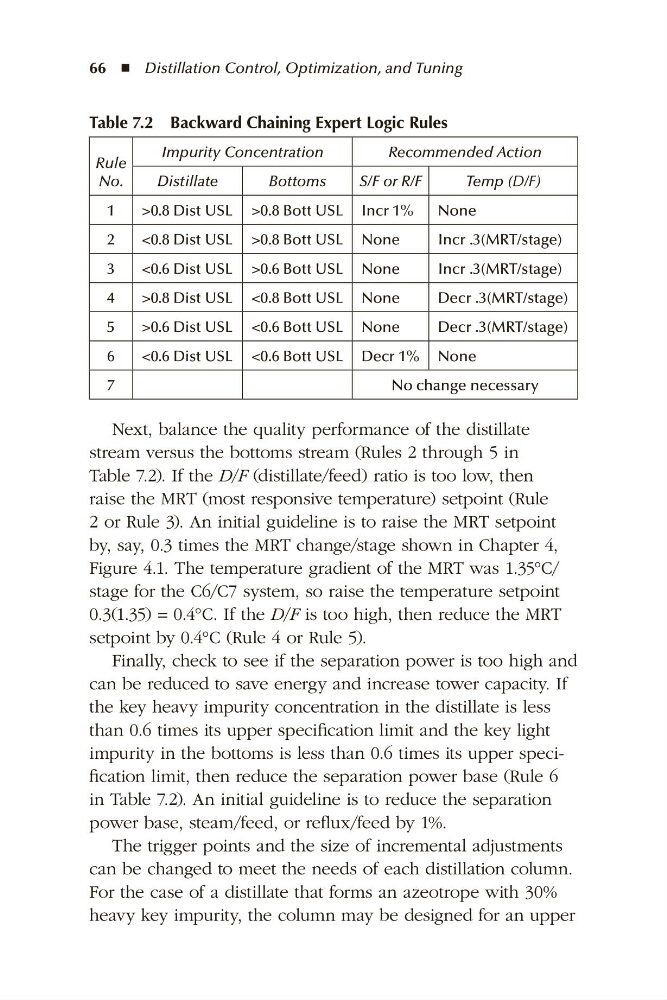
Table 7.2 Backward Chaining Expert Logic Rules
Rule
No.
Impurity Concentration
Recommended Action
Distillate
Bottoms
S/F or R/F
Temp (D/F)
1
>0.8 Dist USL >0.8 Bott USL Incr 1%
None
2
<0.8 Dist USL >0.8 Bott USL None
Incr .3(MRT/stage)
3
<0.6 Dist USL >0.6 Bott USL None
Incr .3(MRT/stage)
4
>0.8 Dist USL <0.8 Bott USL None
Decr .3(MRT/stage)
5
>0.6 Dist USL <0.6 Bott USL None
Decr .3(MRT/stage)
6
<0.6 Dist USL <0.6 Bott USL Decr 1% None
7
No change necessary
66 ◾ Distillation Control, Optimization, and Tuning
Next, balance the quality performance of the distillate
stream versus the bottoms stream (Rules 2 through 5 in
Table 7.2). If the D/F (distillate/feed) ratio is too low, then
raise the MRT (most responsive temperature) setpoint (Rule
2 or Rule 3). An initial guideline is to raise the MRT setpoint
by, say, 0.3 times the MRT change/stage shown in Chapter 4,
Figure 4.1. The temperature gradient of the MRT was 1.35°C/
stage for the C6/C7 system, so raise the temperature setpoint
0.3(1.35) = 0.4°C. If the D/F is too high, then reduce the MRT
setpoint by 0.4°C (Rule 4 or Rule 5).
Finally, check to see if the separation power is too high and
can be reduced to save energy and increase tower capacity. If
the key heavy impurity concentration in the distillate is less
than 0.6 times its upper specification limit and the key light
impurity in the bottoms is less than 0.6 times its upper specification limit, then reduce the separation power base (Rule 6
in Table 7.2). An initial guideline is to reduce the separation
power base, steam/feed, or reflux/feed by 1%.
The trigger points and the size of incremental adjustments
can be changed to meet the needs of each distillation column.
For the case of a distillate that forms an azeotrope with 30%
heavy key impurity, the column may be designed for an upper