

50 ◾ Distillation Control, Optimization, and Tuning
concentration by a factor of 1,000 with a pure stripping gas.
The number of theoretical stages and transfer units are nearly
the same for stripping factor values from 1.0 to 1.5. But the
mass transfer becomes severely rate limited at higher stripping
factors. If the stripping factor is 5 or higher in a distillation column because the relative volatility is high, then increasing the
boilup will not increase the separation power by any significant amount in the stripping section.
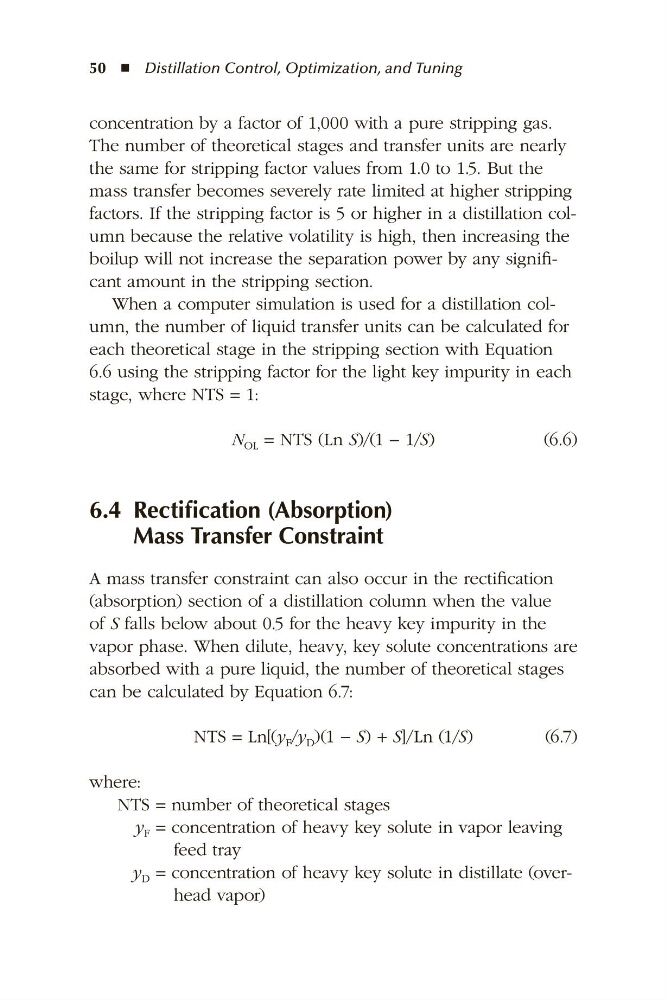
When a computer simulation is used for a distillation column, the number of liquid transfer units can be calculated for
each theoretical stage in the stripping section with Equation
6.6 using the stripping factor for the light key impurity in each
stage, where NTS = 1:
N OL = NTS (Ln S)/(1 − 1/S)
(6.6)
6.4 Rectification (Absorption)
Mass Transfer Constraint
A mass transfer constraint can also occur in the rectification
(absorption) section of a distillation column when the value
of S falls below about 0.5 for the heavy key impurity in the
vapor phase. When dilute, heavy, key solute concentrations are
absorbed with a pure liquid, the number of theoretical stages
can be calculated by Equation 6.7:
NTS = Ln[(y F /y D )(1 − S) + S]/Ln (1/S)
(6.7)
where:
NTS = number of theoretical stages
y F = concentration of heavy key solute in vapor leaving
feed tray
y D = concentration of heavy key solute in distillate (overhead vapor)