

Open-Loop Testing of Process Response ◾ 109
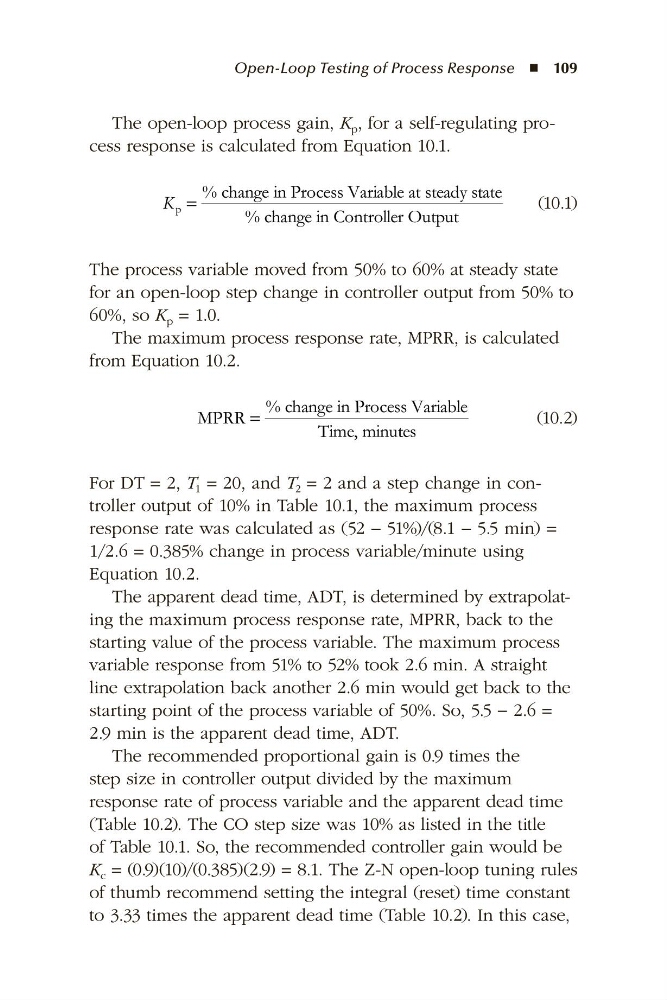
The open-loop process gain, K p , for a self-regulating process response is calculated from Equation 10.1.
% change in Process Variable at steady st tate
K p =
(10.1)
% change in Controller Output
The process variable moved from 50% to 60% at steady state
for an open-loop step change in controller output from 50% to
60%, so K p = 1.0.
The maximum process response rate, MPRR, is calculated
from Equation 10.2.
% change in Process Variable
MPRR =
(10.2)
Time, minut tes
For DT = 2, T 1 = 20, and T 2 = 2 and a step change in controller output of 10% in Table 10.1, the maximum process
response rate was calculated as (52 − 51%)/(8.1 − 5.5 min) =
1/2.6 = 0.385% change in process variable/minute using
Equation 10.2.
The apparent dead time, ADT, is determined by extrapolating the maximum process response rate, MPRR, back to the
starting value of the process variable. The maximum process
variable response from 51% to 52% took 2.6 min. A straight
line extrapolation back another 2.6 min would get back to the
starting point of the process variable of 50%. So, 5.5 − 2.6 =
2.9 min is the apparent dead time, ADT.
The recommended proportional gain is 0.9 times the
step size in controller output divided by the maximum
response rate of process variable and the apparent dead time
(Table 1 0.2). The CO step size was 10% as listed in the title
of Table 1 0.1. So, the recommended controller gain would be
K c = (0.9)(10)/(0.385)(2.9) = 8.1. The Z-N open-loop tuning rules
of thumb recommend setting the integral (reset) time constant
to 3.33 times the apparent dead time (Table 1 0.2). In this case,