

82
Topological defects
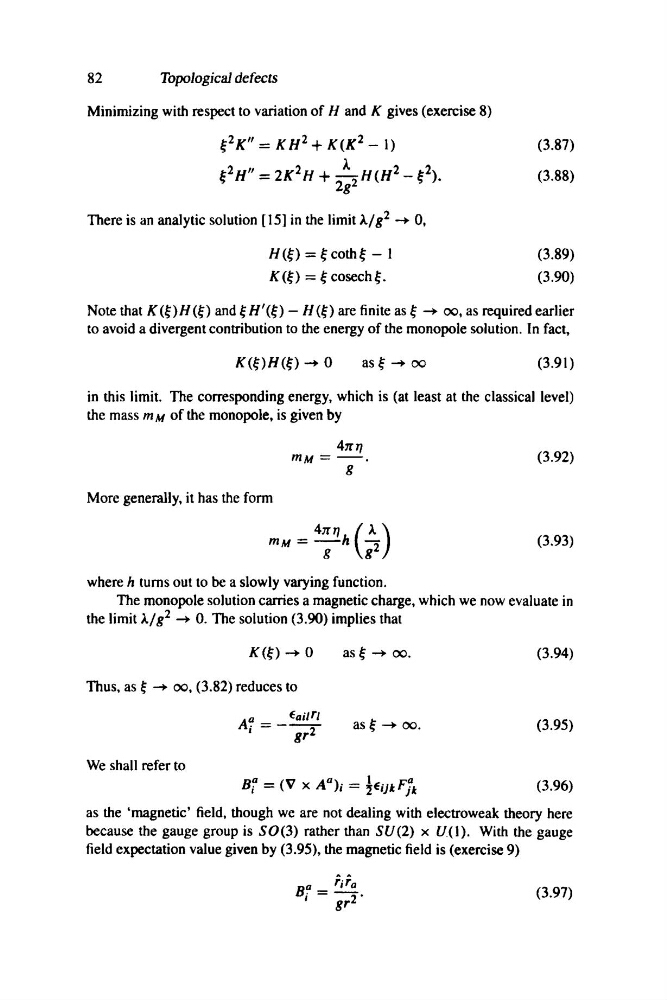
Minimizing with respect to variation of Hand K gives (exercise 8)
eK" = KH2 + K(K 2 -I)
(3.87)
~2H/I = 2K2H + -;'H(H 2 _ ~2).
(3.88)
2g
There is an analytic solution [15] in the limit AI g2 ~ 0,
H(~) = ~ coth~ - I
(3.89)
K(~) = ~cosech~.
(3.90)
Note that K(~)H(~) and ~ H'(~) - H(~) are finite as ~ ~ 00, as required earlier
to avoid a divergent contribution to the energy of the monopole solution. In fact,
K(~)H(~) ~ 0
as~~oo
(3.91)
in this limit. The corresponding energy, which is (at least at the classical level)
the mass mM of the monopole, is given by
4n'11
mM=--·
(3.92)
g
More generally, it has the form
4n'11 (A)
(3.93)
mM=---gh g2
where h turns out to be a slowly varying function.
The monopole solution carries a magnetic charge, which we now evaluate in
the limit )..lg2 ~ O. The solution (3.90) implies that
K(~) ~ 0
as~ ~ 00.
(3.94)
Thus, as ~ - 00, (3.82) reduces to
A~
1---_ EaU'1
as~ ~ 00.
(3.95)
gr2
We shall referto
Br = (V x AD); = ~E;JI: Fjl;
(3.96)
as the 'magnetic' field, though we are not dealing with electroweak theory here
because the gauge group is SO(3) rather than SU(2) x U.(I). With the gauge
field expectation value given by (3.95), the magnetic field is (exercise 9)
B~ _
1 -~~
,d'a
(3.97)
gr2 '
Topological defects
Minimizing with respect to variation of Hand K gives (exercise 8)
eK" = KH2 + K(K 2 -I)
(3.87)
~2H/I = 2K2H + -;'H(H 2 _ ~2).
(3.88)
2g
There is an analytic solution [15] in the limit AI g2 ~ 0,
H(~) = ~ coth~ - I
(3.89)
K(~) = ~cosech~.
(3.90)
Note that K(~)H(~) and ~ H'(~) - H(~) are finite as ~ ~ 00, as required earlier
to avoid a divergent contribution to the energy of the monopole solution. In fact,
K(~)H(~) ~ 0
as~~oo
(3.91)
in this limit. The corresponding energy, which is (at least at the classical level)
the mass mM of the monopole, is given by
4n'11
mM=--·
(3.92)
g
More generally, it has the form
4n'11 (A)
(3.93)
mM=---gh g2
where h turns out to be a slowly varying function.
The monopole solution carries a magnetic charge, which we now evaluate in
the limit )..lg2 ~ O. The solution (3.90) implies that
K(~) ~ 0
as~ ~ 00.
(3.94)
Thus, as ~ - 00, (3.82) reduces to
A~
1---_ EaU'1
as~ ~ 00.
(3.95)
gr2
We shall referto
Br = (V x AD); = ~E;JI: Fjl;
(3.96)
as the 'magnetic' field, though we are not dealing with electroweak theory here
because the gauge group is SO(3) rather than SU(2) x U.(I). With the gauge
field expectation value given by (3.95), the magnetic field is (exercise 9)
B~ _
1 -~~
,d'a
(3.97)
gr2 '