

Dynamics of local cosmic strings
79
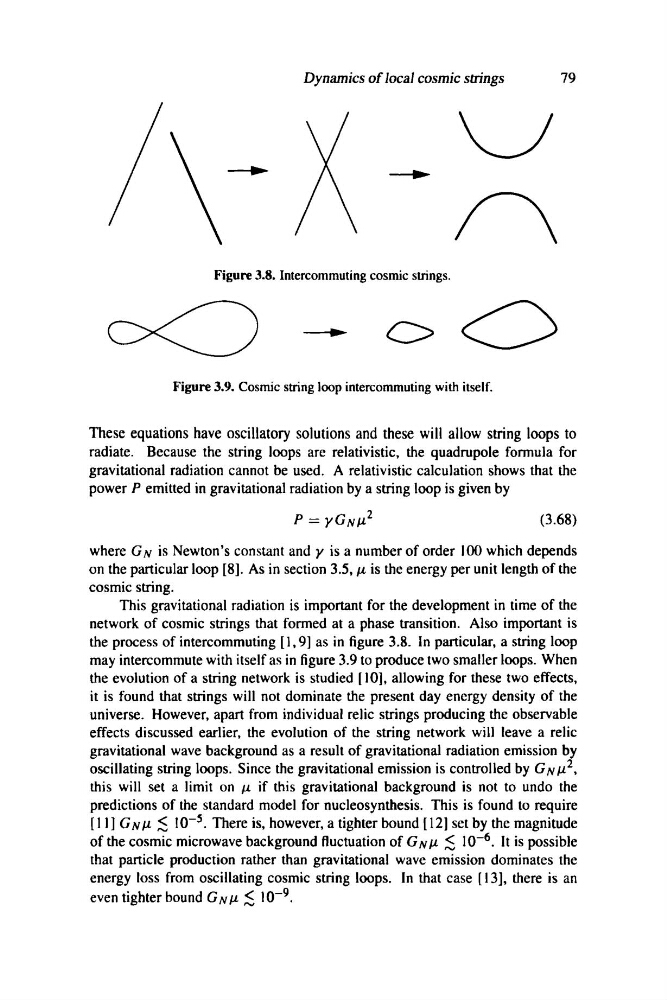
Figure 3.8. Intercommuting cosmic strings.
Figure 3.9. Cosmic string loop intercommuting with itself.
These equations have oscillatory solutions and these will allow string loops to
radiate. Because the string loops are relativistic, the quadrupole formula for
gravitational radiation cannot be used. A relativistic calculation shows that the
power P emitted in gravitational radiation by a string loop is given by
P = yGNIL
2
(3.68)
where G N is Newton's constant and y is a number of order 100 which depends
on the particular loop [8]. As in section 3.5, IL is the energy per unit length of the
cosmic string.
This gravitational radiation is important for the development in time of the
network of cosmic strings that formed at a phase transition. Also important is
the process of intercommuting [1,9] as in figure 3.8. In particular, a string loop
may intercommute with itself as in figure 3.9 to produce two smaller loops. When
the evolution of a string network is studied [10], allowing for these two effects.
it is found that strings will not dominate the present day energy density of the
universe. However. apart from individual relic strings producing the observable
effects discussed earlier. the evolution of the string network will leave a relic
gravitational wave background as a result of gravitational radiation emission by
oscillating string loops. Since the gravitational emission is controlled by G N IL 2 •
this will set a limit on IL if this gravitational background is not to undo the
predictions of the standard model for nucleosynthesis. This is found to require
[Il] G N IL ~ 10- 5 . There is. however. a tighter bound [12] set by the magnitude
of the cosmic microwave background fluctuation of G N IL ~ 10- 6 . It is possible
that particle production rather than gravitational wave emission dominates the
energy loss from oscillating cosmic string loops. In that case [13], there is an
even tighter bound G N IL ~ 10- 9 .
79
Figure 3.8. Intercommuting cosmic strings.
Figure 3.9. Cosmic string loop intercommuting with itself.
These equations have oscillatory solutions and these will allow string loops to
radiate. Because the string loops are relativistic, the quadrupole formula for
gravitational radiation cannot be used. A relativistic calculation shows that the
power P emitted in gravitational radiation by a string loop is given by
P = yGNIL
2
(3.68)
where G N is Newton's constant and y is a number of order 100 which depends
on the particular loop [8]. As in section 3.5, IL is the energy per unit length of the
cosmic string.
This gravitational radiation is important for the development in time of the
network of cosmic strings that formed at a phase transition. Also important is
the process of intercommuting [1,9] as in figure 3.8. In particular, a string loop
may intercommute with itself as in figure 3.9 to produce two smaller loops. When
the evolution of a string network is studied [10], allowing for these two effects.
it is found that strings will not dominate the present day energy density of the
universe. However. apart from individual relic strings producing the observable
effects discussed earlier. the evolution of the string network will leave a relic
gravitational wave background as a result of gravitational radiation emission by
oscillating string loops. Since the gravitational emission is controlled by G N IL 2 •
this will set a limit on IL if this gravitational background is not to undo the
predictions of the standard model for nucleosynthesis. This is found to require
[Il] G N IL ~ 10- 5 . There is. however. a tighter bound [12] set by the magnitude
of the cosmic microwave background fluctuation of G N IL ~ 10- 6 . It is possible
that particle production rather than gravitational wave emission dominates the
energy loss from oscillating cosmic string loops. In that case [13], there is an
even tighter bound G N IL ~ 10- 9 .