

76
Topological defects
0)
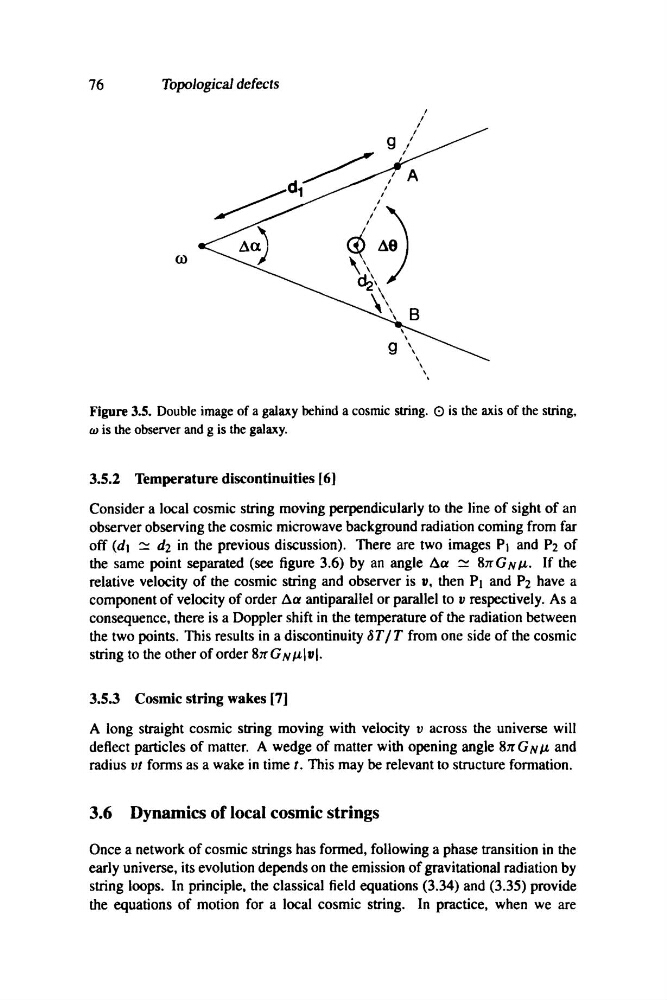
Figure 3.5. Double image of a galaxy behind a cosmic string. 0 is the axis of the string,
CJ) is the observer and g is the galaxy.
3.5.2 Temperature discontinuities [6J
Consider a local cosmic string moving perpendicularly to the line of sight of an
observer observing the cosmic microwave background radiation coming from far
off (dl ::: d2 in the previous discussion). There are two images PI and P2 of
the same point separated (see figure 3.6) by an angle 6.a ::: 8rrGNIl. If the
relative velocity of the cosmic string and observer is v, then PI and P2 have a
component of velocity of order 6.a antiparallel or parallel to v respectively. As a
consequence, there is a Doppler shift in the temperature of the radiation between
the two points. This results in a discontinuity f, T / T from one side of the cosmic
string to the other of order 8rr G N III 17 I.
3.5.3 Cosmic string wakes [7J
A long straight cosmic string moving with velocity v across the universe will
deflect particles of matter. A wedge of matter with opening angle 8rr G N Il and
radius vt forms as a wake in time t. This may be relevant to structure formation.
3.6 Dynamics of local cosmic strings
Once a network of cosmic strings has formed, following a phase transition in the
early universe, its evolution depends on the emission of gravitational radiation by
string loops. In principle, the classical field equations (3.34) and (3.35) provide
the equations of motion for a local cosmic string. In practice, when we are
Topological defects
0)
Figure 3.5. Double image of a galaxy behind a cosmic string. 0 is the axis of the string,
CJ) is the observer and g is the galaxy.
3.5.2 Temperature discontinuities [6J
Consider a local cosmic string moving perpendicularly to the line of sight of an
observer observing the cosmic microwave background radiation coming from far
off (dl ::: d2 in the previous discussion). There are two images PI and P2 of
the same point separated (see figure 3.6) by an angle 6.a ::: 8rrGNIl. If the
relative velocity of the cosmic string and observer is v, then PI and P2 have a
component of velocity of order 6.a antiparallel or parallel to v respectively. As a
consequence, there is a Doppler shift in the temperature of the radiation between
the two points. This results in a discontinuity f, T / T from one side of the cosmic
string to the other of order 8rr G N III 17 I.
3.5.3 Cosmic string wakes [7J
A long straight cosmic string moving with velocity v across the universe will
deflect particles of matter. A wedge of matter with opening angle 8rr G N Il and
radius vt forms as a wake in time t. This may be relevant to structure formation.
3.6 Dynamics of local cosmic strings
Once a network of cosmic strings has formed, following a phase transition in the
early universe, its evolution depends on the emission of gravitational radiation by
string loops. In principle, the classical field equations (3.34) and (3.35) provide
the equations of motion for a local cosmic string. In practice, when we are